카드 1 / 8
Korean Processed Food to Australia: FSANZ Standards, DAFF Biosecurity, and the 10-Allergen Declaration (2026)
TL;DR
Australia’s food import system splits across two agencies: DAFF (Department of Agriculture, Fisheries and Forestry) oversees biosecurity at the border, and FSANZ (Food Standards Australia New Zealand) sets the Food Standards Code that all imported food must meet (Trace One — AU/NZ Regulation Updates). For Korean exporters, mismatch with FSANZ labelling = non-compliant at point of sale. The 10 mandatory allergens, NIP format, and 2026 digital labelling innovations are the key compliance points.
1. FSANZ vs DAFF — Two Different Borders
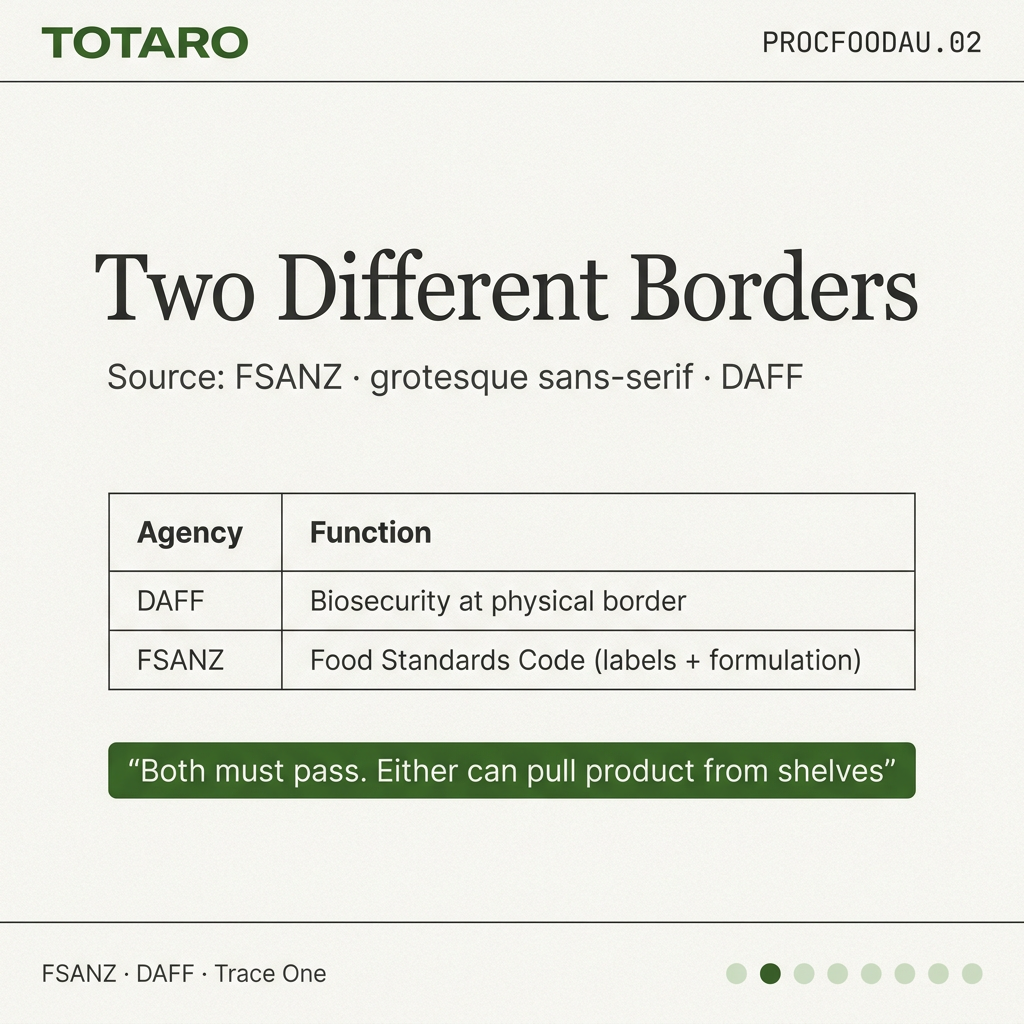
DAFF controls biosecurity at the physical border — quarantine, fumigation, plant/animal disease prevention (DAFF — Imported Food Notices). FSANZ controls what’s on the label and in the formulation (FSANZ — Imported Foods). A Korean shipment that clears DAFF can still be pulled from shelves for FSANZ non-compliance, and vice versa. Both must pass.
2. Australia’s 10 Mandatory Allergens
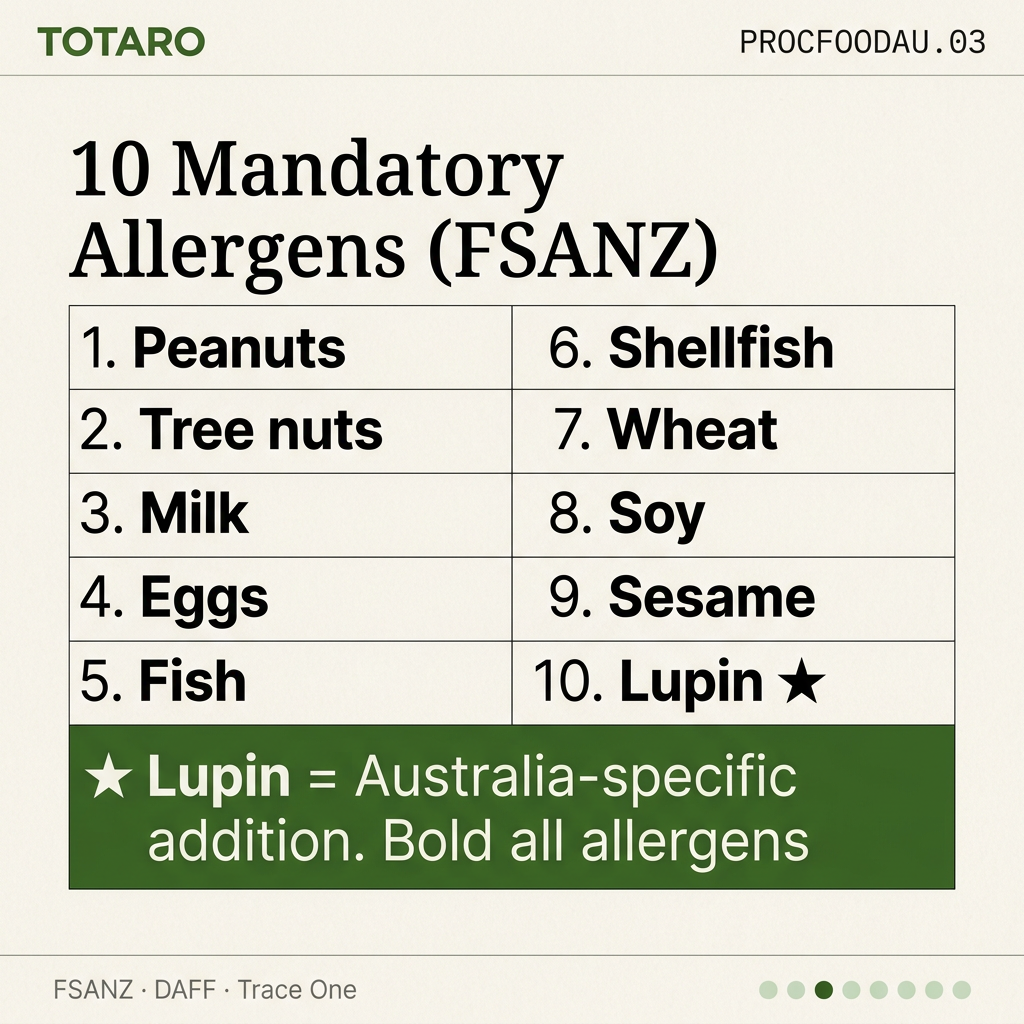
Australia’s list differs from US Big 9 — it has 10 allergens: peanuts, tree nuts, milk, eggs, fish, shellfish, wheat, soy, sesame, and lupin (the Australia-specific addition) (FSANZ — Labelling). All allergens must be declared in bold. Lupin is a legume common in Mediterranean cuisine but used in Korean baked goods occasionally — exporters must flag this.
3. Nutrition Information Panel (NIP)
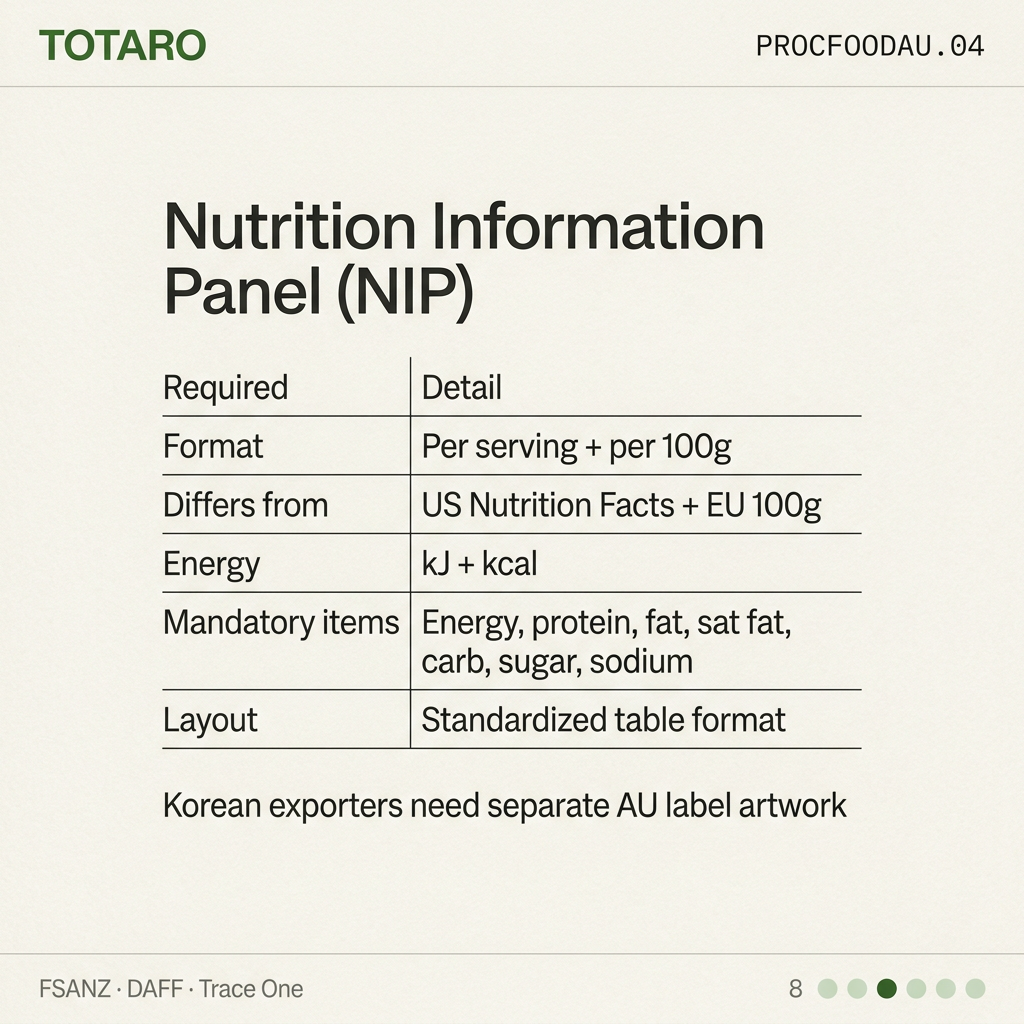
FSANZ mandates the NIP for most packaged foods. Format: energy, protein, fat, saturated fat, carbohydrate, sugars, sodium — both per serving and per 100g. Australian NIP differs from US Nutrition Facts Panel and EU 100g standard — Korean exporters need a separate AU label artwork, not a recycled US version.
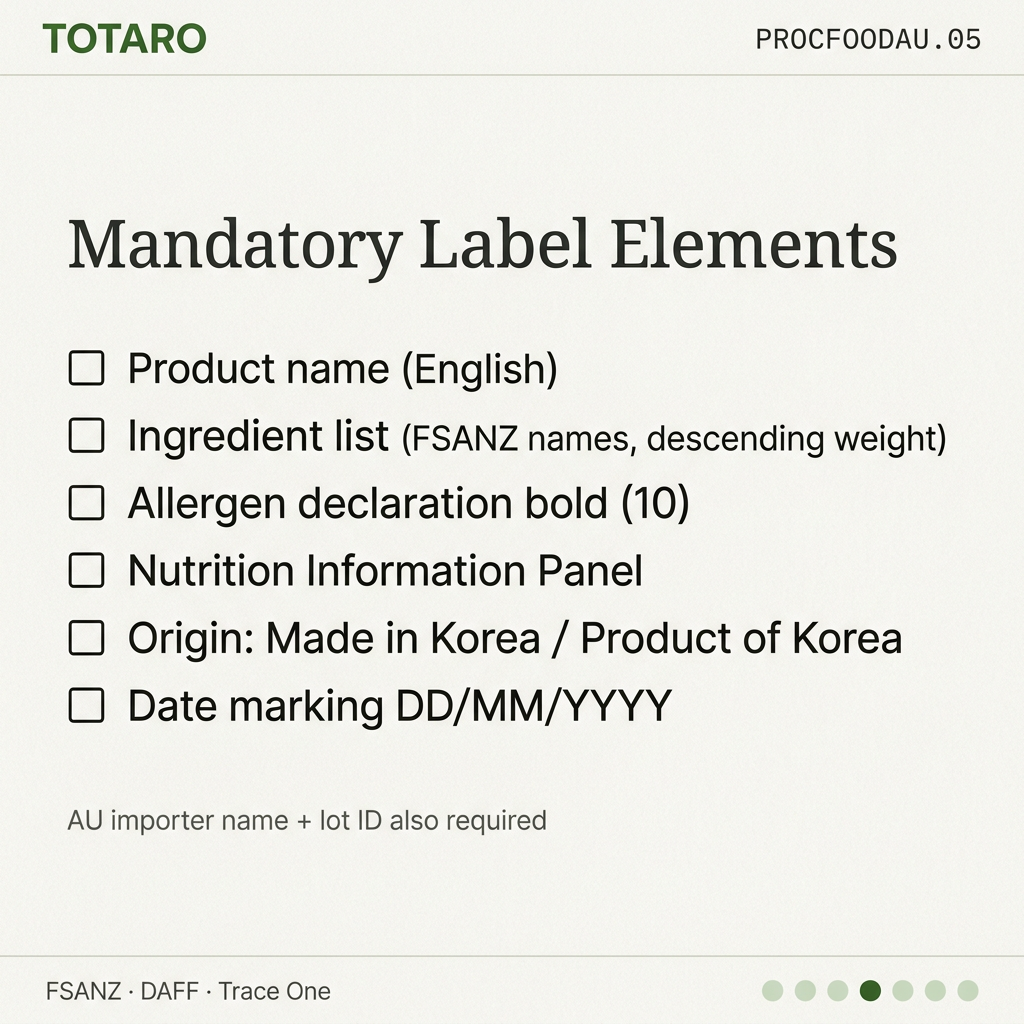
4. Mandatory Labelling Elements
- Product name (clear English description)
- Ingredient list in descending order by weight, using FSANZ-prescribed names
- Allergen declaration (10 allergens, bold)
- Nutrition Information Panel
- Country of origin (Made in Korea, or Product of Korea)
- Date marking (Use by / Best before, format DD/MM/YYYY)
- Storage instructions
- Business name and address of supplier (importer in Australia)
- Lot identification
- Directions for use (if needed)
5. 2026 Updates — Digital Innovation in Labelling
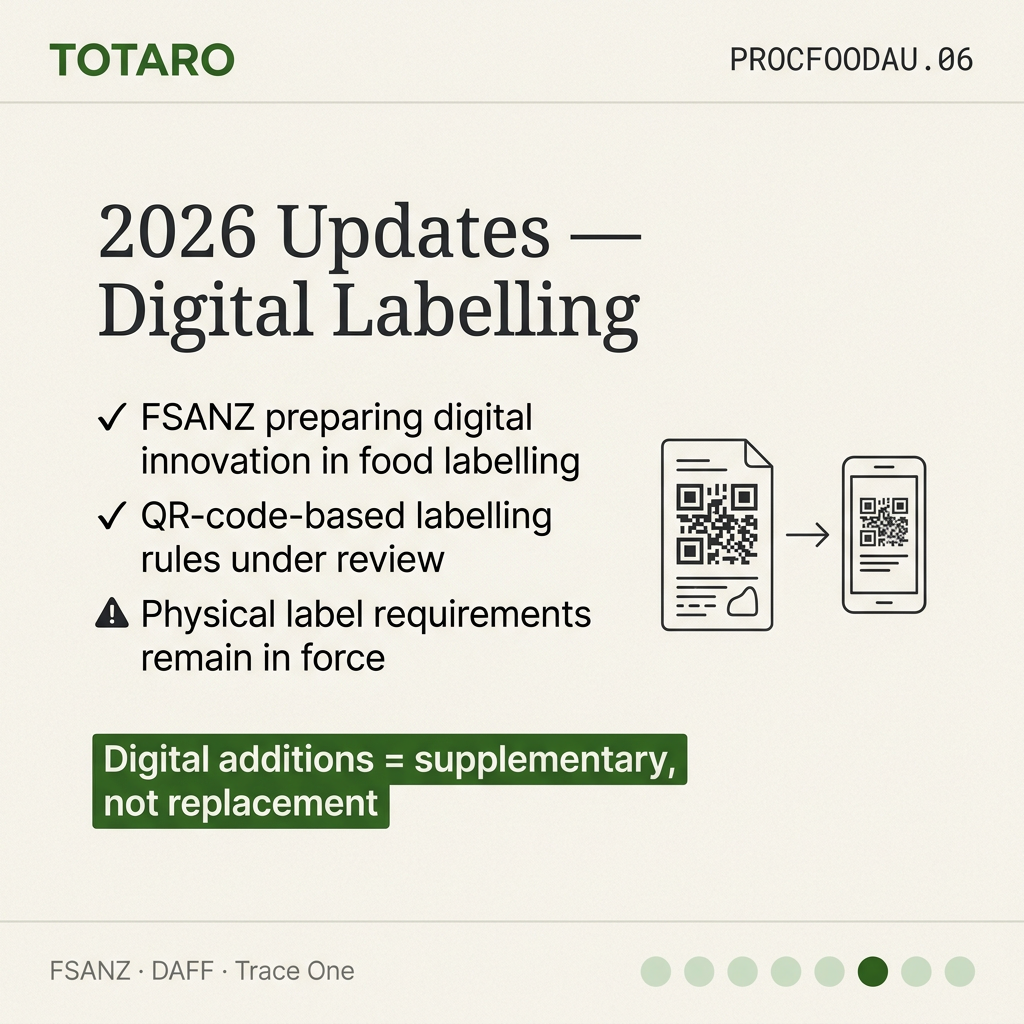
FSANZ announced 2026 preparation for digital labelling innovation (FSANZ — Welcome to 2026). Korean exporters should watch for QR-code-based labelling rules. Current physical label requirements remain in force; digital additions are supplementary, not replacement.
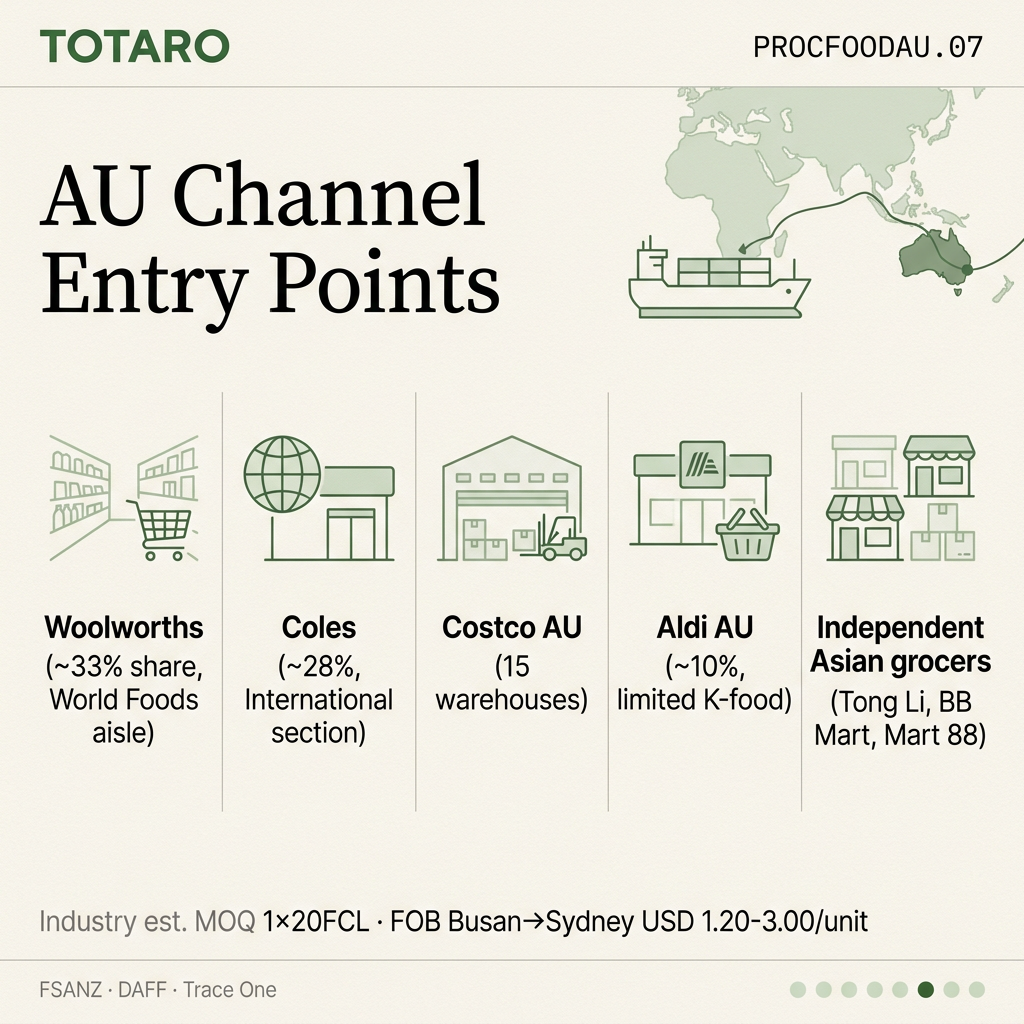
6. Channel Entry Points
- Woolworths (Australia’s largest grocer, ~33% market share) — World Foods aisle is the entry point
- Coles (second largest, ~28%) — similar International section
- Costco Australia (15 warehouses) — Korean shoppers driving K-food demand
- Aldi Australia (~10% share) — limited Korean SKUs but growing
- Independent Asian grocers — Tong Li Supermarket, BB Mart, Mart 88 networks
7. Pricing Reality (MOQ / FOB)
Industry estimate for retail SKU shelf-stable Korean food: MOQ 1×20FCL (~10,000-15,000 retail units), FOB Busan→Sydney/Melbourne USD 1.20-3.00/unit (early 2026). Direct RFQ required. AUD 4.50-9.50 retail for typical Korean food at Woolworths.
Action Checklist
(1) Confirm Korean facility has HACCP equivalent + supports FSANZ documentation, (2) Build AU-specific label artwork — 10 allergens bold, NIP per 100g + per serving, (3) Engage AU importer with imported food licence (DAFF registered), (4) Apply to Woolworths or Coles via their commercial buyer (or via UK&I distributor with AU office). Australia is the 4th largest English-speaking food market for K-food — opportunity is real.
Sources
Related Guides
Ask AI to find your Korean food supplier
Describe what you need in plain language — get matched with verified suppliers in seconds.
Try AI Supplier Search