카드 1 / 8
Korean Sauce OEM & Private Label Partners — US Manufacturer Guide
Korean sauce and condiment exports reached $372M in 2024 with the United States as the #1 destination at $78.9M (+6.4% YoY), according to the Observatory of Economic Complexity (OEC). The most recent rolling-year data (Apr 2025-Mar 2026) shows exports climbing to $437M total with US imports at $92.3M, making US the fastest-growing destination market for Korean sauces. This momentum has accelerated US food brand interest in commissioning Korean manufacturers for OEM/PB production of K-BBQ, K-bulldak, and K-fusion sauce lines.
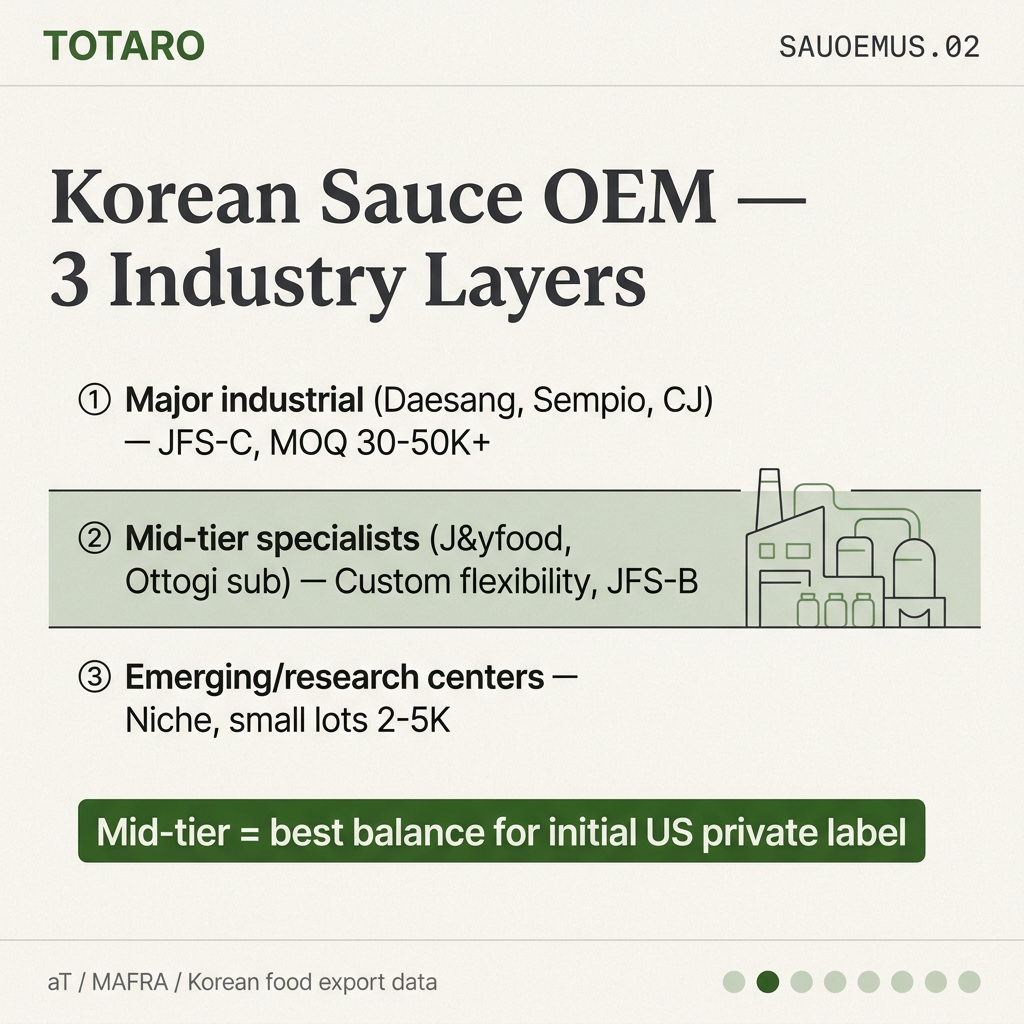
Three Layers of Korean Sauce OEM Industry
The Korean sauce OEM landscape has three distinct layers: ① Major industrial (Daesang, Sempio, CJ) — JFS-C certified, MOQ 30,000-50,000+ bottles, slower development cycles. ② Mid-tier specialists (J&yfood, Ottogi sub-brands) — flexible custom recipe development, JFS-B typical, MOQ 5,000-10,000. ③ Emerging/food research centers — niche category strength, small lots from 2,000-5,000 bottles.
For initial US private label, the mid-tier offers the best balance of capability and accessibility. (MOQ ranges noted are industry estimates pending direct supplier RFQ — verify with each manufacturer.)
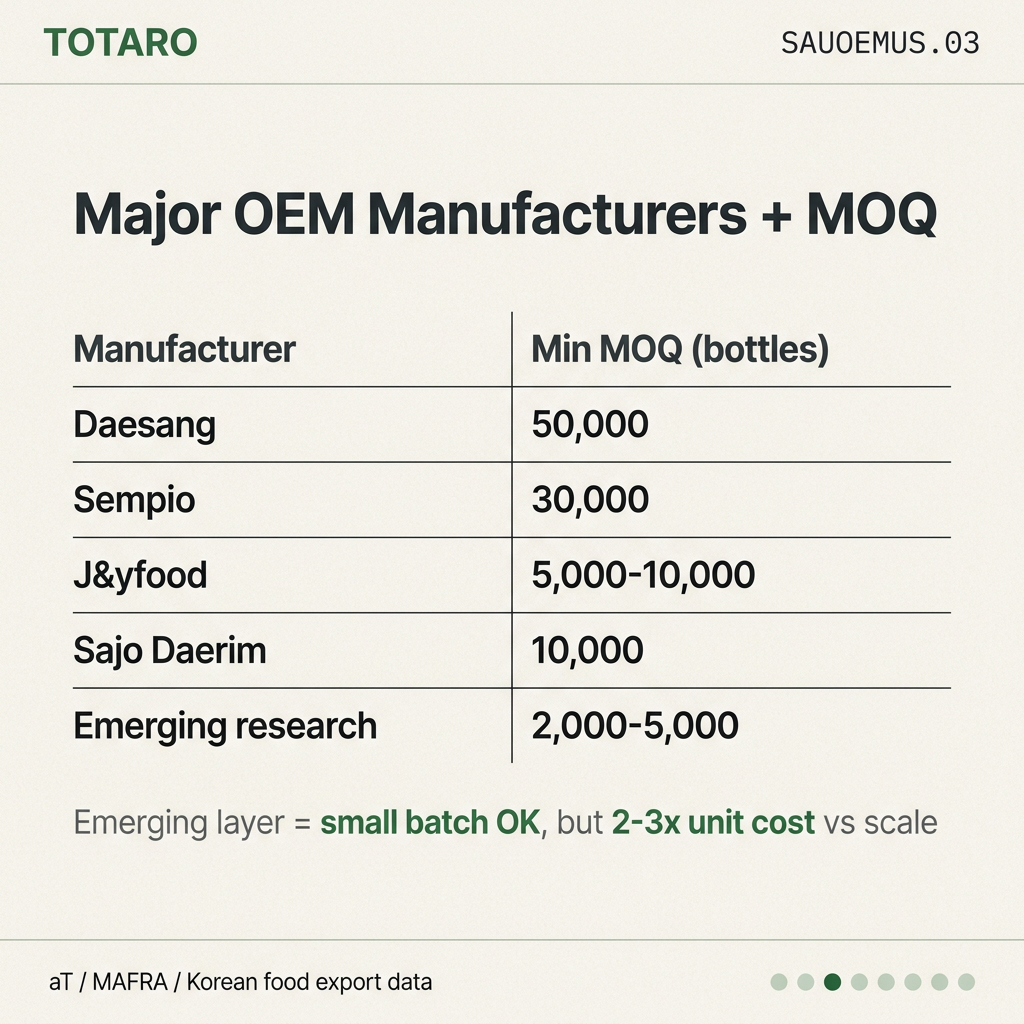
Major Korean OEM Manufacturers
| Manufacturer | Strength | Industry-Estimate MOQ (bottles) |
|---|---|---|
| Daesang (daesang.com) | Gochujang and soy products major | 50,000 |
| Sempio (sempio.com) | Soy sauce and traditional pastes | 30,000 |
| J&yfood | Multi-category sauces, custom-strong | 5,000-10,000 |
| Sajo Daerim (sajo.co.kr) | BBQ and marinade specialist | 10,000 |
| Emerging food research | Niche, small batch | 2,000-5,000 |
Direct supplier quotation required for confirmed MOQ, lead time, and pricing — public disclosures unavailable.
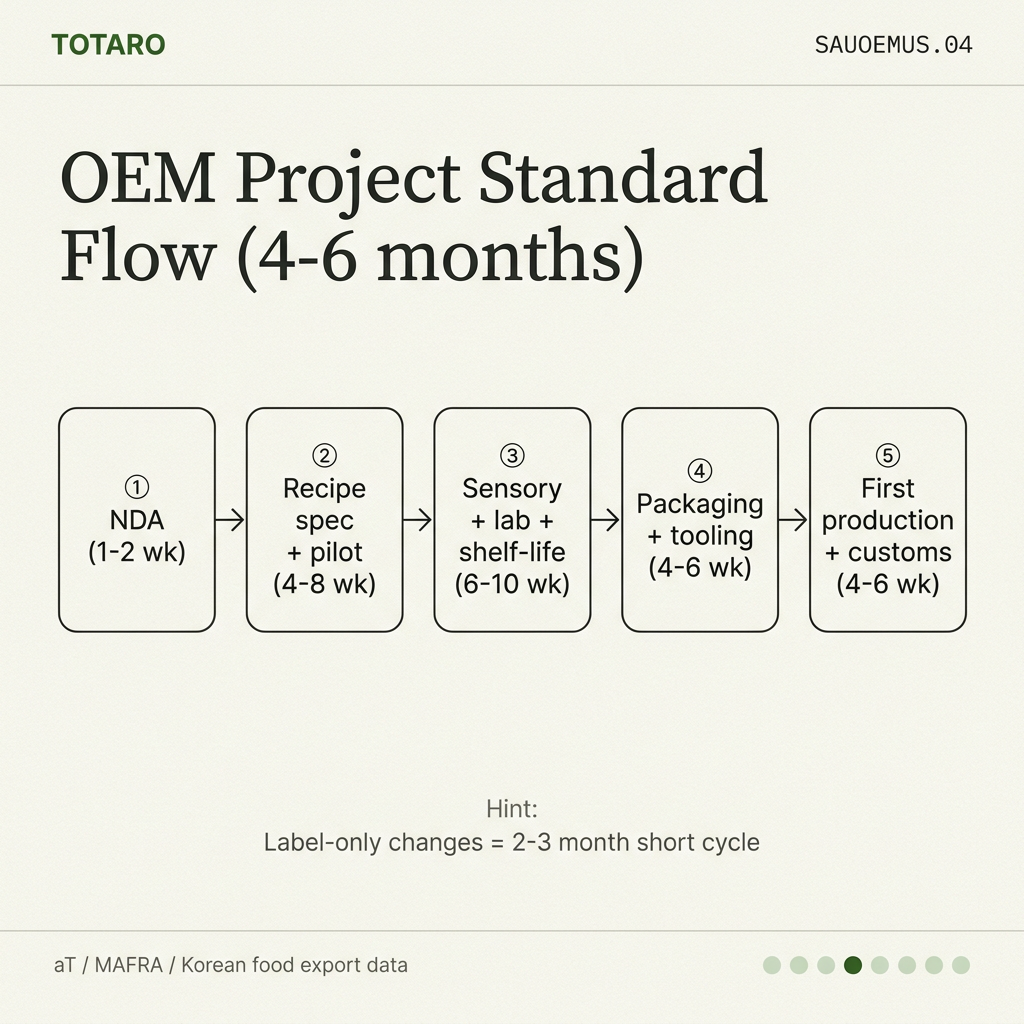
Standard OEM Project Flow (4-6 Months)
① NDA execution (1-2 weeks). ② Recipe specification and pilot production (4-8 weeks). ③ Sensory testing, lab analysis, shelf-life testing (6-10 weeks). ④ Packaging design and mold tooling (4-6 weeks). ⑤ First production run and customs clearance (4-6 weeks). Short-cycle variants (label change on existing recipe only) can complete in 2-3 months.
Cost Structure Reference (Industry Pattern)
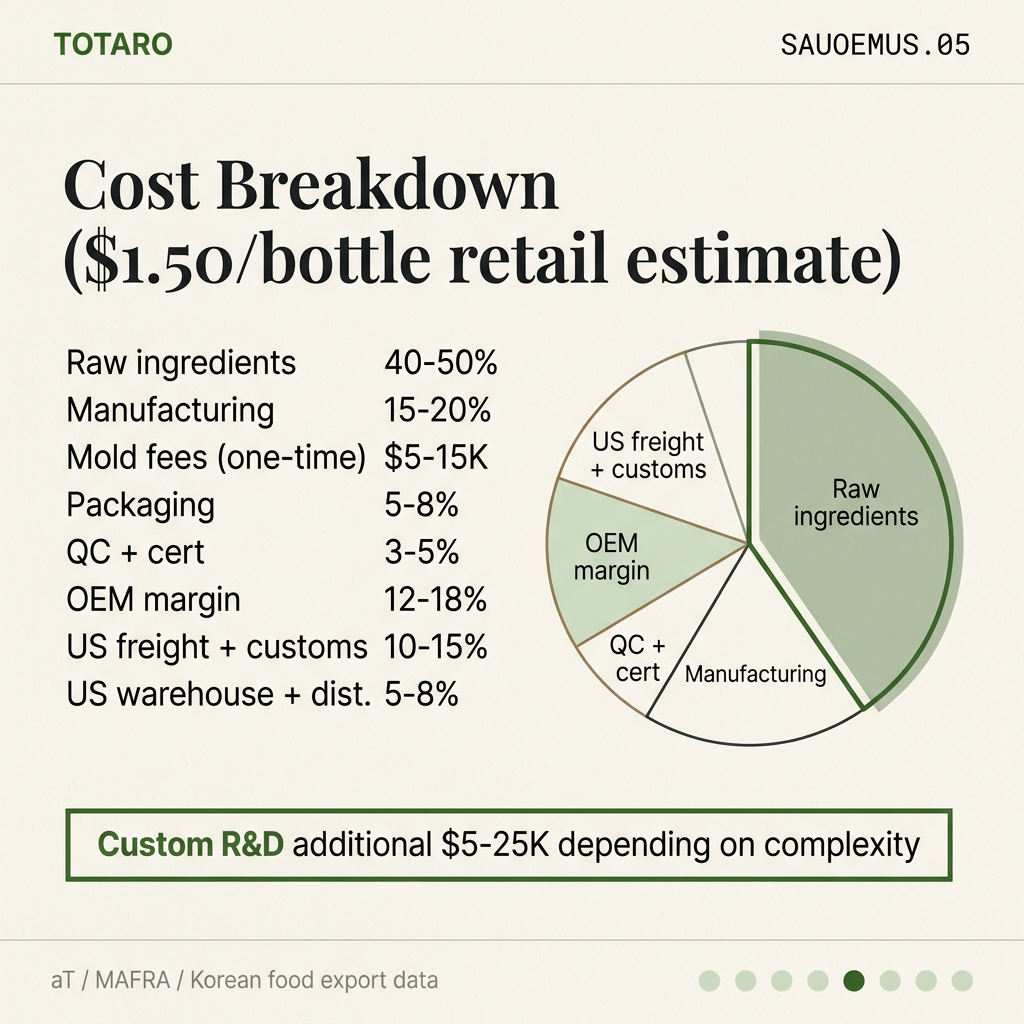
Typical cost breakdown for a $1.50/bottle wholesale product (industry pattern, not specific quotation):
| Component | Range |
|---|---|
| Raw ingredients | 40-50% |
| Manufacturing | 15-20% |
| Mold fees (one-time) | $5,000-15,000 |
| Packaging/printing | 5-8% |
| QC and certification | 3-5% |
| OEM margin | 12-18% |
| US freight and customs | 10-15% |
| US warehousing/distribution | 5-8% |
Custom R&D fees additional $5,000-25,000 depending on complexity.
US Compliance Requirements
For Korean sauce imports to US:
FDA Requirements (FDA Food Facility Registration):
- FDA food facility registration (Korean facility + US importer)
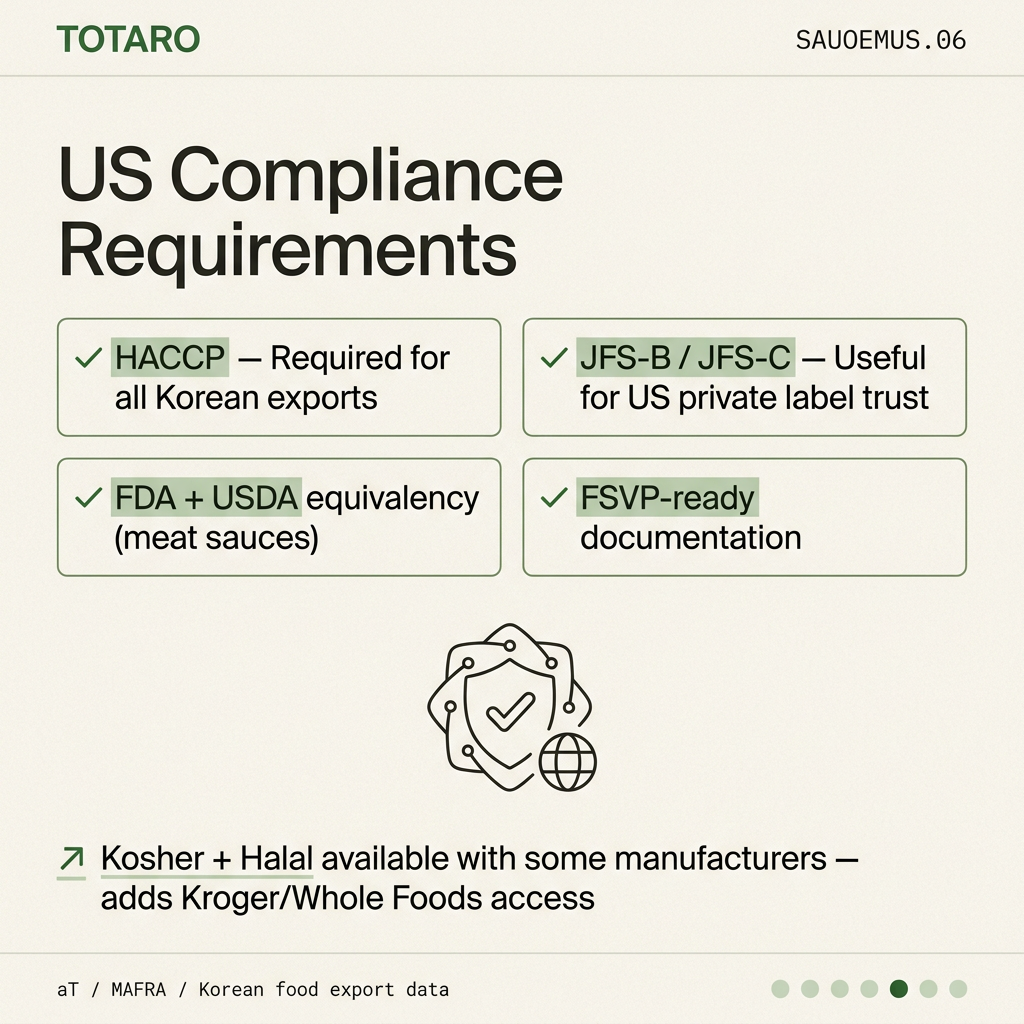
- FSVP (Foreign Supplier Verification Program) compliance — see FDA FSVP page
- Prior Notice per shipment
Acidified Foods Process Filing (relevant for many Korean sauces): Per 21 CFR 114, low-acid and acidified canned foods require process filing with FDA. Most Korean gochujang, BBQ, and ssamjang products fall under acidified food rules.
Key Certifications:
- HACCP (required for all Korean food exports)
- JFS-B or JFS-C (Japan equivalency, useful for US buyer trust)
- USDA equivalency for meat-containing sauces (galbi marinade with beef extract, etc.)
- Kosher and Halal certifications available with select manufacturers (adds Whole Foods, Kroger, halal-focused channels)
K-BBQ Sauce Success Factors for US Market
Based on industry pattern observation:
| Factor | US Adjustment |
|---|---|
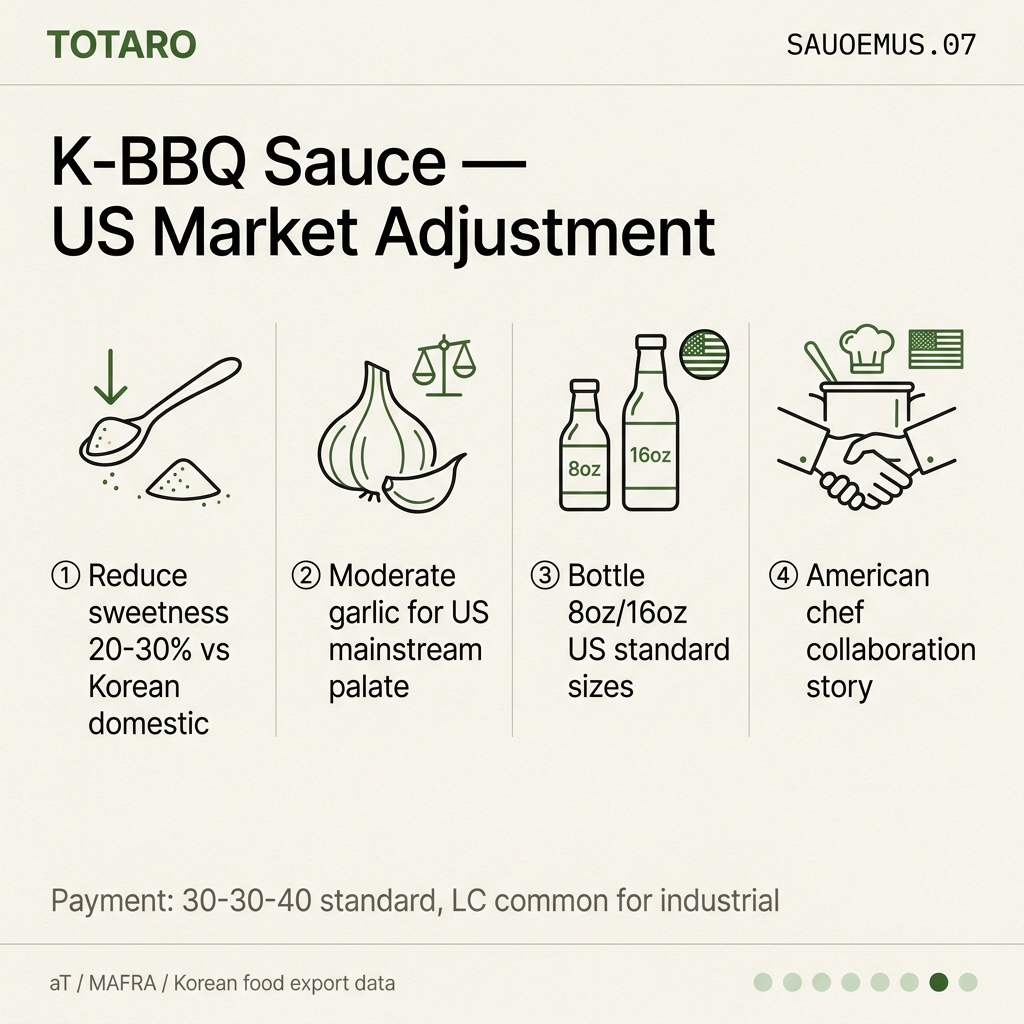
| Sweetness | Reduce 20-30% vs Korean domestic spec |
| Garlic intensity | Moderate to reach mainstream palate |
| Bottle size | 280-450ml home use; 8oz/16oz US standard |
| Brand story | American chef collaboration adds credibility |
(Adjustment ranges based on industry exporter feedback patterns — verify with consumer testing for your target market.)
FAQ
Q1. Can we provide our own recipe and have Korea only manufacture? A. Yes — 'full custom' arrangement. Korean side handles ingredient sourcing, formulation following your spec, and production. Recommended: NDA with 3-5 year non-disclosure plus non-compete clause on identical formulations. Per Korean Contract Law, IP protection enforceable through Korea Trade Commission registration.
Q2. Small batch (500-1,000 bottles) test runs? A. Major manufacturers (Daesang, Sempio): not feasible. Emerging food research centers and Korean food incubators (Seoul Food Cluster) accept 500-2,000 bottle test runs at 2-3x the per-unit cost of volume production. Direct quotation required.
Q3. What payment terms are standard? A. Industry pattern: Major OEMs — 30-30-40 (30% on contract, 30% pre-production, 40% on shipment), Letter of Credit common for large industrial. Mid-tier and emerging — 50% deposit, 50% on shipment. T/T (Telegraphic Transfer) standard for smaller accounts. Verify in NDA negotiation.
Q4. How do we evaluate which OEM is right for our category? A. Request: facility audit results, JFS-B/HACCP certificates, recent US shipment history (with FDA registration numbers), and 2-3 product samples produced for other US clients within the same category. KOTRA's Korea Trade-Investment Promotion Agency can provide manufacturer verification support.
This article verified with OEC, MAFRA, FDA, KOTRA primary sources. MOQ, cost breakdown, and adjustment ranges marked as industry estimates pending direct supplier RFQ.
Sources
Related Guides
Ask AI to find your Korean food brand
Describe what you need in plain language — get matched with verified brands in seconds.
Try AI Brand Search