카드 1 / 8
Korean Food Sourcing Partner: US Buyer's Vetting Guide
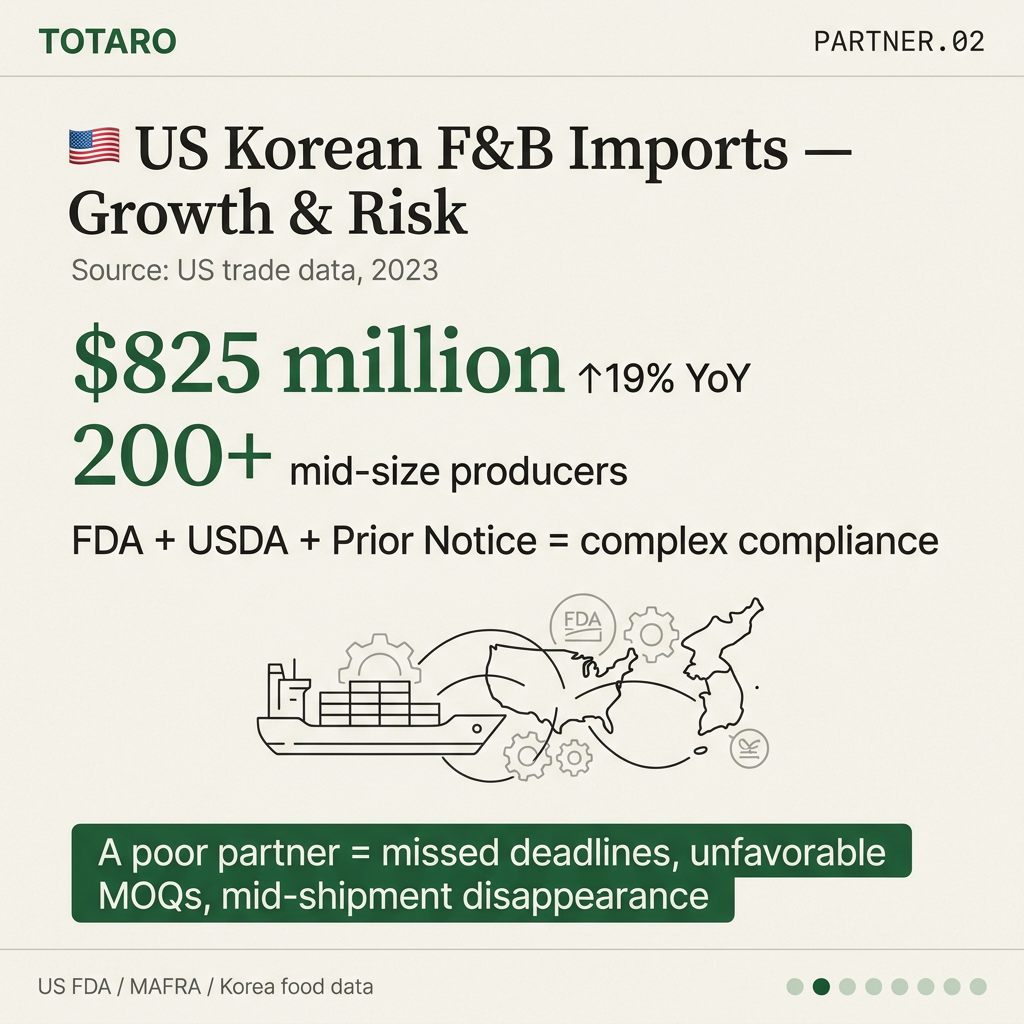
The US imported $825 million of Korean food and beverage products in 2023, up 19% year-over-year. That growth brings opportunity—and risk. A poor sourcing partner can lock you into unfavorable MOQs, miss FDA deadlines, or disappear mid-shipment. A good one becomes a strategic asset that handles compliance, negotiates container rates, and scales with your sales.
This guide walks through the hard criteria US importers use to vet Korean food sourcing partners—from factory audits to Incoterms—so you can move from sampling to container orders with confidence.
Why Korean Food Sourcing Needs a Specialist Partner
Korean food is not a commodity play. You're dealing with:
- Short shelf-life goods (kimchi, tteokbokki, fresh noodles) that require reefer containers and tight cold-chain coordination
- Complex compliance (FDA food facility registration, FSVP, USDA for meat/poultry, Prior Notice for every shipment)
- Language and time-zone gaps between US buyers and Korean manufacturers
- Fragmented supply (the Big 3—Nongshim, Samyang, Ottogi—control instant noodles, but kimchi, sauces, and snacks come from 200+ mid-size producers)
A sourcing partner de-risks this. They consolidate orders, manage FDA paperwork, and give you leverage with factories you'd never reach as a one-off buyer.
Core Vetting Criteria for a Korean Food Sourcing Partner
1. FDA and USDA Compliance Infrastructure
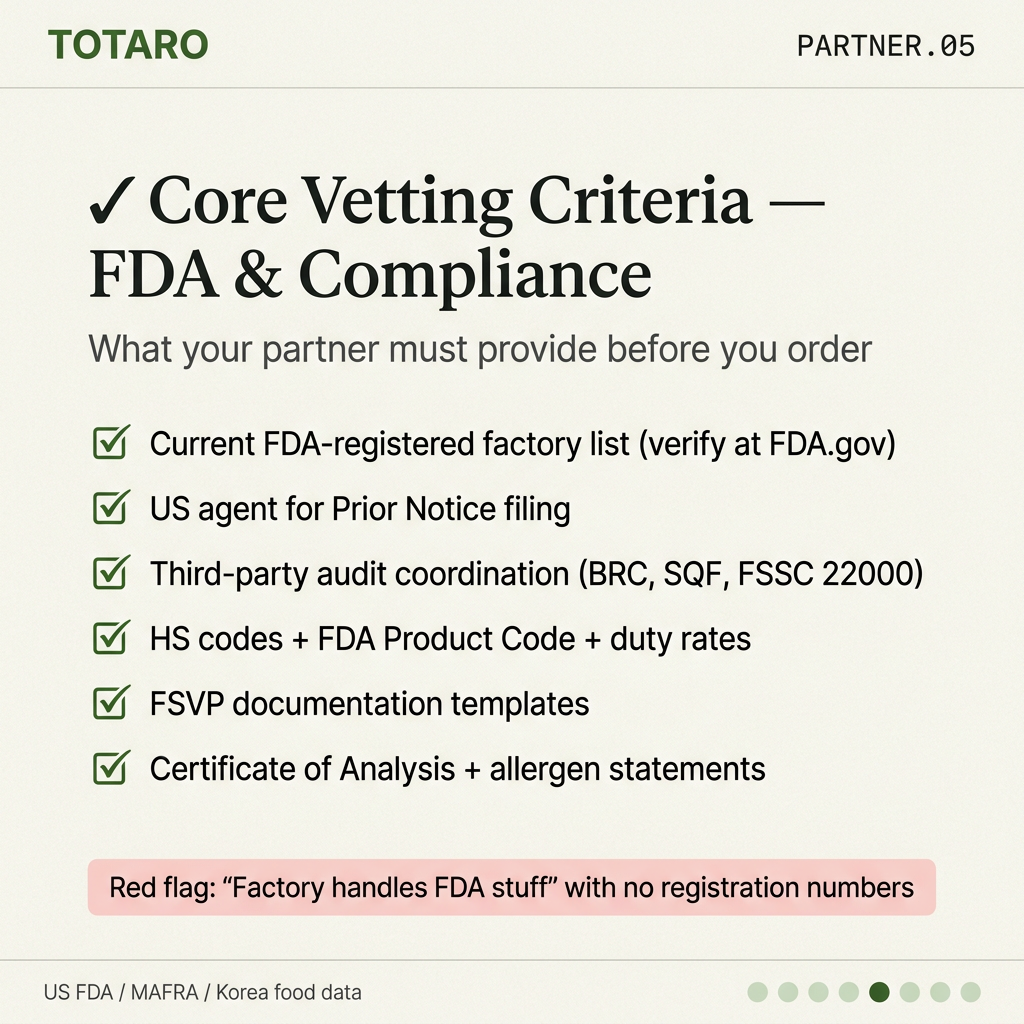
Every Korean food facility exporting to the US must register with FDA (Food Facility Registration) and have a US agent for Prior Notice. Your sourcing partner should either:
- Maintain a current list of FDA-registered partner factories (verify registration numbers at FDA.gov)
- Act as the US agent themselves, filing Prior Notice and managing FSVP documentation
- Coordinate third-party audits (BRC, SQF, FSSC 22000) for your retail or foodservice customers
Red flag: A partner who says "the factory handles FDA stuff" without providing registration numbers or FSVP templates. You are the importer of record—you're liable if documentation fails at the port.
Green flag: They send you a compliance checklist before you place an order, including HS codes (e.g. 2103.90 for gochujang, 1902.30 for instant noodles), FDA Product Code, and estimated duty rates (most Korean food enters duty-free under HTS rules, but check chapter-specific exceptions).
2. Minimum Order Quantities and Container Economics
Korean factories typically quote in full container loads (FCL):
- 20-foot container: ~10-12 pallets, 20,000–24,000 lbs
- 40-foot container: ~20-22 pallets, 42,000–44,000 lbs
- 40-foot reefer (refrigerated): Same volume, $2,500–$4,000 premium over dry container
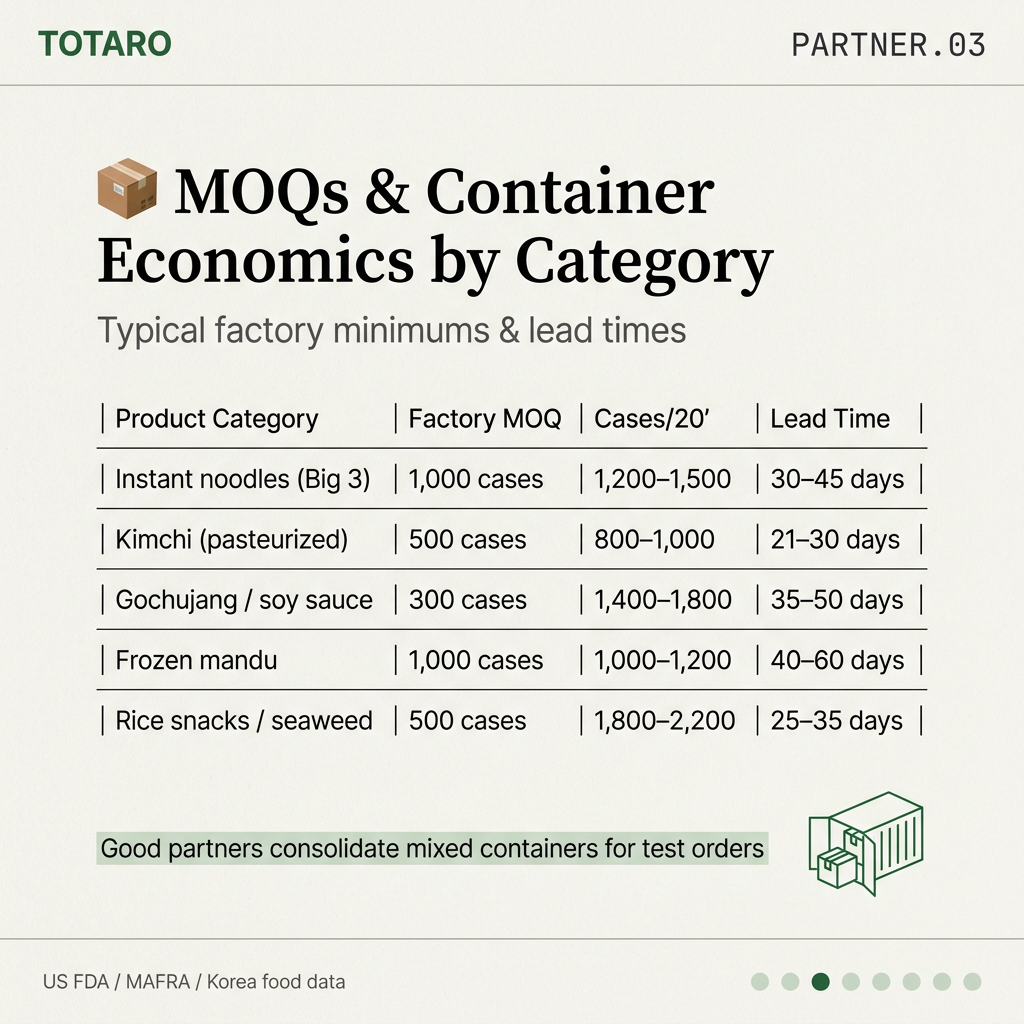
MOQs vary by category:
| Product Category | Typical Factory MOQ | Cases per 20' Container | Lead Time (Order → Port) |
|---|---|---|---|
| Instant noodles (Big 3) | 1,000 cases (mixed SKU) | 1,200–1,500 cases | 30–45 days |
| Kimchi (pasteurized) | 500 cases | 800–1,000 cases | 21–30 days |
| Gochujang / soy sauce | 300 cases | 1,400–1,800 cases | 35–50 days |
| Frozen mandu (dumplings) | 1,000 cases | 1,000–1,200 cases | 40–60 days |
| Rice snacks / seaweed | 500 cases | 1,800–2,200 cases | 25–35 days |
A capable sourcing partner consolidates your order with others to hit MOQs, especially for emerging brands. If you want 200 cases of a new kimchi SKU, they should be able to mix it with other buyers' orders in the same container.
Ask: "What's your minimum per SKU, and do you consolidate mixed containers?" If they demand 1,000+ cases for a test order, walk away unless you're a national chain.
3. Payment Terms and Trade Finance
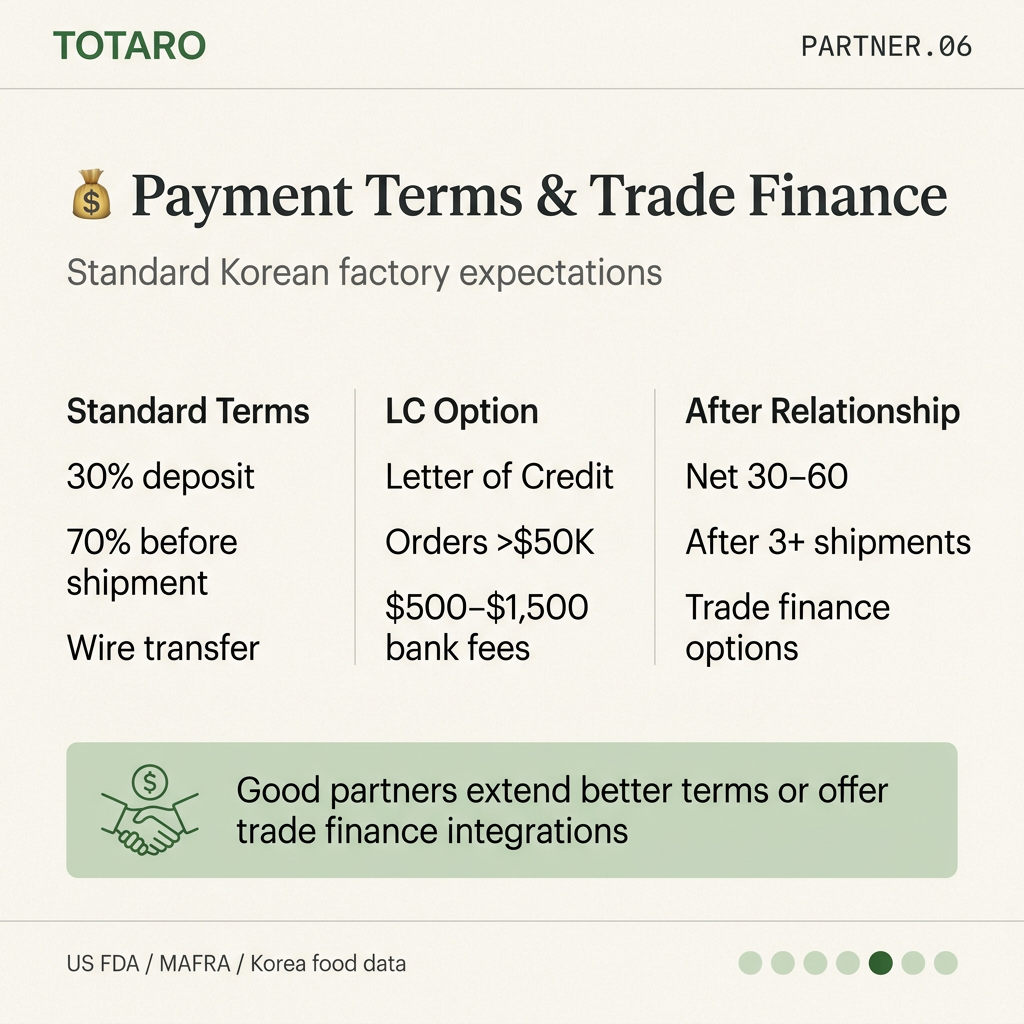
Korean factories—especially mid-size producers—are conservative on credit. Expect:
- 30% deposit, 70% before shipment (wire transfer)
- Letter of Credit (LC) for orders above $50,000 (adds $500–$1,500 in bank fees but protects both parties)
- Net 30–60 payment terms only after 3+ successful shipments or personal relationship
A good sourcing partner either:
- Extends you better terms (e.g. net 30) because they've already built credit with factories
- Offers trade finance or financing partnerships (some platforms integrate with Flexport Capital, Fundbox, or Korean trade banks)
Red flag: Demand for 100% payment upfront via wire to a personal account or non-business PayPal. Standard practice is a deposit to the factory's corporate account, balance against a commercial invoice and packing list.
4. Logistics Network: Busan/Incheon to US Ports
Korea has two major export hubs:
- Busan (South): Closest to Nongshim, Samyang, and most food manufacturers
- Incheon (Seoul area): Proximity to smaller artisan producers and kimchi specialists
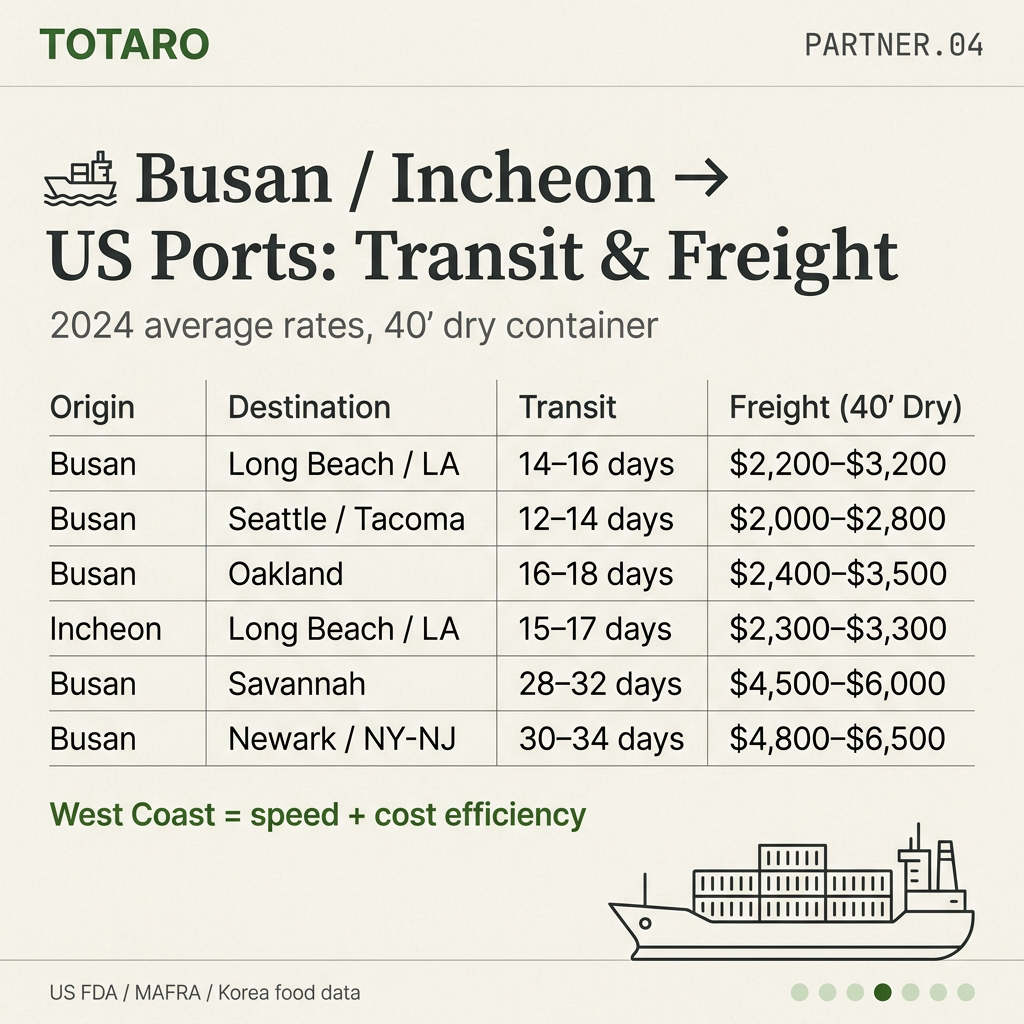
Transit times to US ports:
| Origin | Destination Port | Transit (Days) | Typical Freight (40' Dry, 2024 Avg) |
|---|---|---|---|
| Busan | Long Beach / LA | 14–16 | $2,200–$3,200 |
| Busan | Oakland | 16–18 | $2,400–$3,500 |
| Busan | Seattle / Tacoma | 12–14 | $2,000–$2,800 |
| Incheon | Long Beach / LA | 15–17 | $2,300–$3,300 |
| Busan | Savannah | 28–32 | $4,500–$6,000 |
| Busan | Newark / NY-NJ | 30–34 | $4,800–$6,500 |
West Coast = speed and cost efficiency. If you're distributing to CA, NV, AZ, or OR, route through Long Beach or Oakland.
East Coast = longer lead time, higher cost, but worth it for direct access to NY, NJ, and Southeast markets.
Your sourcing partner should:
- Offer both FOB (you arrange shipping) and CIF (they deliver to your port) pricing
- Have relationships with 2-3 freight forwarders to get competitive quotes
- Handle reefer container booking for cold-chain products (kimchi, frozen mandu, fresh noodles)
Ask: "What's your CIF Long Beach rate for a 40' reefer, and how many days from factory to my warehouse?" If they can't answer with a number and timeline, they're a middleman, not a logistics operator.
5. Quality Control and Product Sampling
Before you commit to 1,000 cases, you need samples. A professional sourcing partner will:
- Send retail-packaged samples (not bulk or unlabeled test batches) so you can evaluate label compliance, taste, and shelf appeal
- Provide Certificate of Analysis (COA) and allergen statements for every SKU
- Arrange pre-shipment inspection (PSI) by a third party (SGS, Bureau Veritas, Intertek) for large orders
Cost benchmark: Air-shipped samples (2–3 cases) run $80–$150 in freight. Pre-shipment inspections cost $300–$600 per factory visit.
Red flag: Samples that arrive with no English labels, no ingredient breakdown, or no production date. If the sample doesn't match what you'll receive in the container, you've wasted time and money.
6. Transparency: Factory Names, Certifications, and References
Anonymous sourcing is dead in 2024. You need to know:
- Factory name and location (city, province)
- Certifications (HACCP, ISO 22000, BRC, SQF, Halal, Kosher if applicable)
- Production capacity (cases/month, lead time during peak season)
- Customer references (other US importers they've supplied, without breaching NDAs)
Ask: "Can I get a factory profile sheet and a reference from another US buyer?" A mature partner will have templated one-pagers for each factory, including photos, certifications, and export history.
What a Korean Food Sourcing Platform Should Offer
If you're evaluating a digital platform (like TOTARO) versus a traditional trading company, look for:
- Searchable factory directory with filters (product category, certification, MOQ, FDA-registered)
- Instant RFQ (Request for Quote) submission with response SLA (48–72 hours is standard)
- Integrated compliance tools (HS code lookup, FSVP templates, Prior Notice checklists)
- Payment escrow or milestone-based release (protects both buyer and supplier)
- Order tracking dashboard (production status, container booking, ETA updates)
Traditional trading companies offer white-glove service but charge 8-15% markup. Platforms lower that to 3-8% in exchange for self-service tools.
Choose based on your internal capacity: if you have a compliance team and freight forwarder, a platform saves money. If you're a first-time importer, a full-service partner is worth the premium.
Red Flags: When to Walk Away
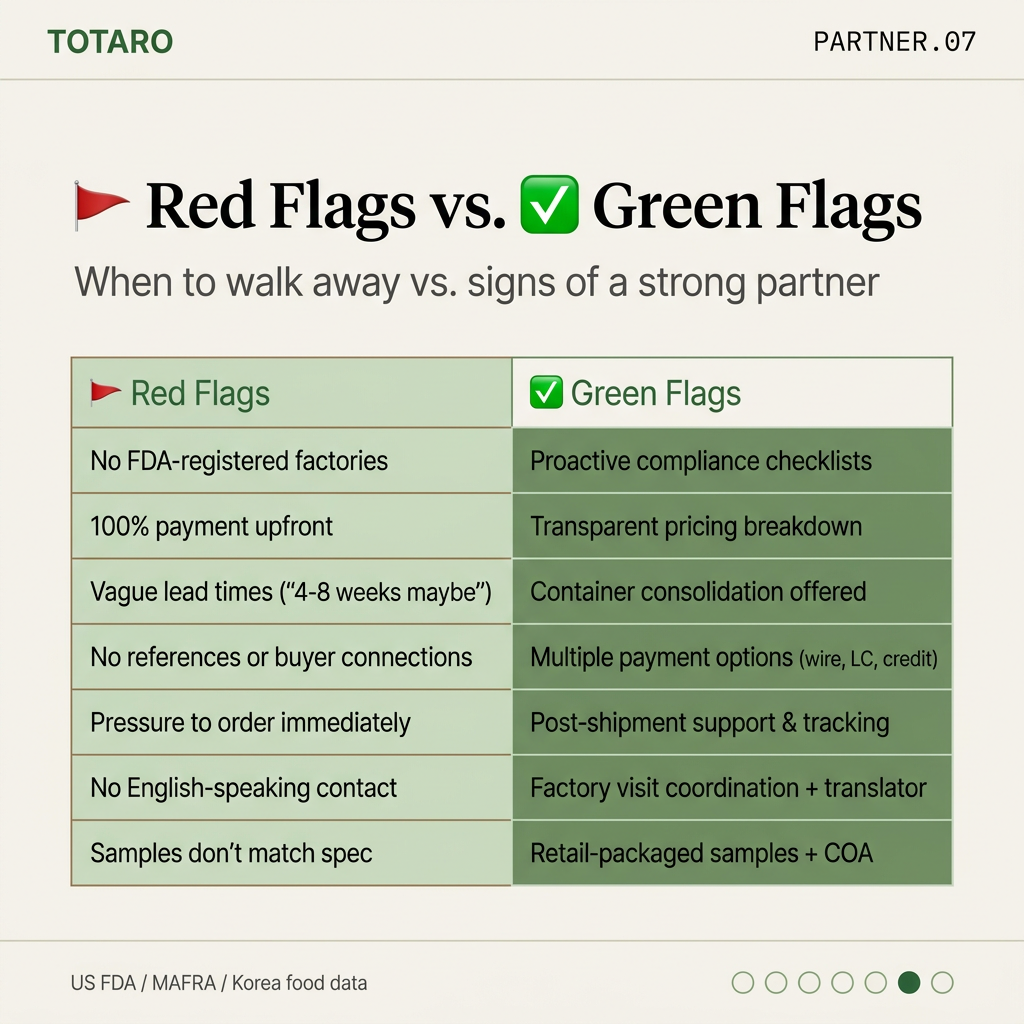
- No FDA-registered factories or refusal to share registration numbers
- 100% payment upfront with no LC or escrow option
- Vague lead times ("4–8 weeks maybe") with no production schedule
- No references or refusal to connect you with other US buyers
- Pressure to order immediately ("This price expires tomorrow")
- Unwillingness to send samples or samples that don't match your spec
- No English-speaking point of contact (you'll need real-time communication during FDA inspections or port issues)
Green Flags: Signs of a Strong Partner
- Proactive compliance support (they send you FDA checklists before you ask)
- Transparent pricing breakdown (factory cost + freight + markup itemized)
- Multiple payment options (wire, LC, trade credit after initial orders)
- Container consolidation for mixed SKU or multi-factory orders
- Post-shipment support (they help if the container is delayed or if FDA issues a hold)
- Factory visit coordination (they arrange your visit to Busan or Incheon with translator support)
How to Start: A 90-Day Vetting Process
Days 1-30: Discovery and Sampling
- Submit RFQ with target specs (product, MOQ, FOB/CIF port, target price)
- Review factory profiles and certifications
- Request samples (2-3 SKUs max to control cost)
- Evaluate taste, packaging, label compliance (work with a US food attorney if needed)
Days 31-60: Negotiation and Compliance
- Negotiate pricing, MOQ, payment terms
- Request FDA registration numbers and FSVP template
- Confirm lead time and container booking process
- Get references from other US buyers (LinkedIn is useful here)
Days 61-90: Pilot Order
- Place a half-container or one-container test order
- Arrange pre-shipment inspection
- Coordinate Prior Notice filing (72 hours before arrival at US port)
- Track container in real-time (use partner dashboard or freight forwarder portal)
- Clear customs, deliver to warehouse, inspect upon arrival
If that container arrives on time, correctly labeled, and FDA-compliant, you've found a partner. If not, the low cost of a pilot order just saved you from a $50,000 mistake.
FAQ
What's the typical markup a Korean food sourcing partner charges?
Traditional trading companies charge 8-15% on top of factory FOB price. Digital platforms like TOTARO charge 3-8%, depending on service level (self-service vs. managed). Volume buyers (5+ containers/year) can often negotiate flat monthly fees or tiered pricing.
Do I need a Korean business entity to import Korean food to the US?
No. You need a US business entity (LLC, corporation) to act as the importer of record. The Korean factory or your sourcing partner handles export documentation from Korea; you handle import clearance with US Customs and FDA. You do not need a Korean company, but you do need a US-based customs broker.
How do I verify a Korean factory is FDA-registered?
Go to the FDA Food Facility Registry at FDA.gov > Food > Compliance & Enforcement > Registration. Search by facility name or registration number. Every foreign food facility exporting to the US must register and renew biennially (every two years, odd-numbered years). If the factory isn't listed, they cannot legally export to the US.
What's the difference between FOB and CIF pricing?
FOB (Free On Board): Factory delivers to Busan or Incheon port and loads the container. You arrange and pay for ocean freight, insurance, and US port fees. You control the logistics but assume more responsibility.
CIF (Cost, Insurance, Freight): Factory delivers to your US port (e.g. Long Beach) and pays ocean freight and marine insurance. You only pay US port fees (drayage, customs clearance). Simpler for first-time importers but slightly higher cost and less control over carrier choice.
Related Guides
Korean Jerusalem Artichoke + Psyllium Husk Halal Enzyme Supplement for the US: The SlimFox-Style Constipation + Weight Management Combo (2026)
Related Guides →Korean Jerusalem Artichoke for Constipation: 14-19% Inulin Content and Clinical Evidence on Gut Health (2026)
Related Guides →How to Import Korean Food into the USA: Complete 2026 Guide
Related Guides →Ask AI to find your Korean food supplier
Describe what you need in plain language — get matched with verified suppliers in seconds.
Try AI Supplier Search