카드 1 / 8
Korean Food Import: Incoterms & Payment Terms for US Buyers
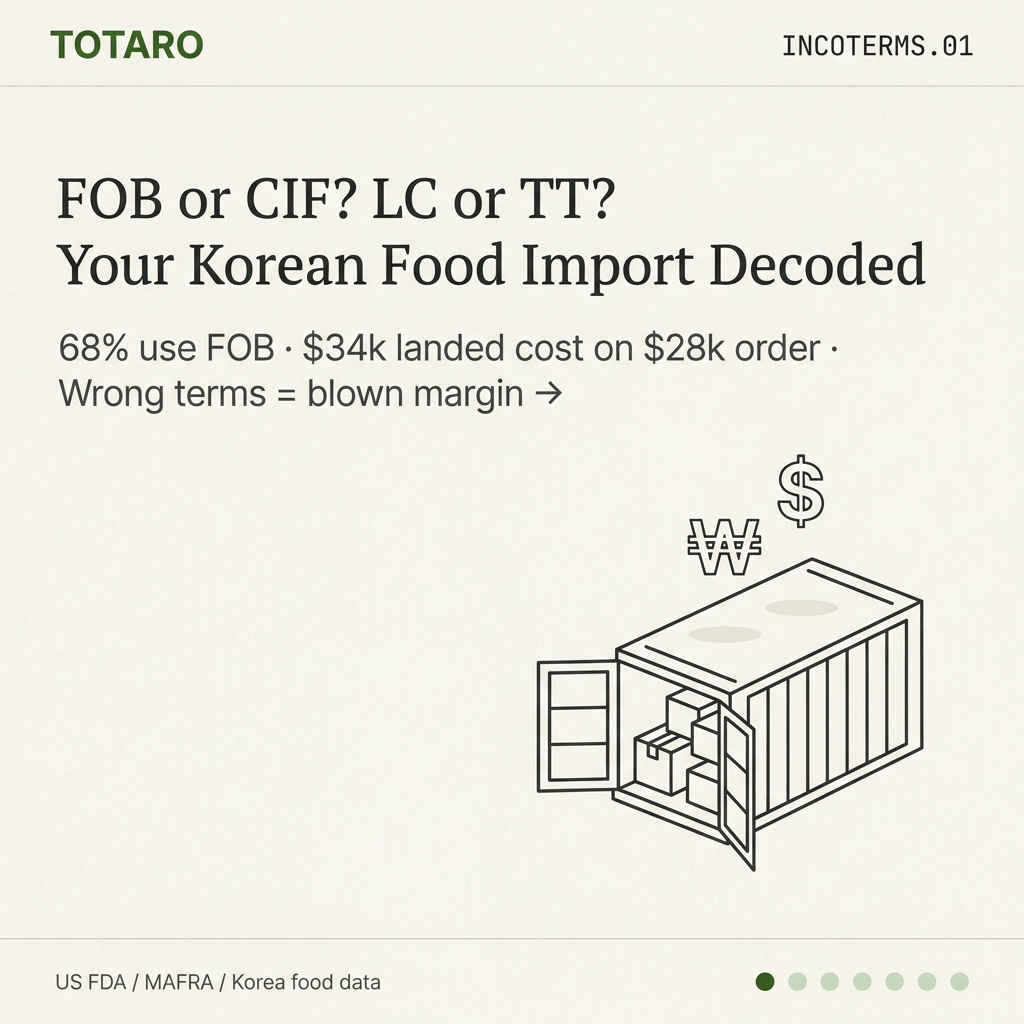
You've found a Korean manufacturer who can supply 5,000 cases of ramyeon at $2.80 per case. But when the invoice arrives, it says "FOB Busan" and requests a letter of credit. What does that mean for your landed cost, cash flow, and risk?
Incoterms and payment terms are the backbone of every Korean food import deal. Get them wrong, and you'll blow your margin, tie up capital for 90 days, or worse—pay for goods that never arrive. This guide walks US buyers through the Incoterms and payment structures used in 90% of Korean food transactions, with real numbers and decision frameworks.
Why Incoterms Matter in Korean Food Imports
Incoterms (International Commercial Terms) define who pays for what, who bears the risk, and where responsibility transfers from seller to buyer. They're published by the International Chamber of Commerce and updated every decade—Incoterms 2020 is the current version.
For Korean food imports into the US, two Incoterms dominate: FOB (Free on Board) and CIF (Cost, Insurance, and Freight). A 2022 survey of 340 US food importers found that 68% use FOB for Asian container shipments, 24% use CIF, and the remainder use EXW or DAP.
Incoterms impact:
- Landed cost calculation. FOB Busan means you add ocean freight ($3,000–$7,000 per 40' container), marine insurance (0.3–0.5% of cargo value), destination charges ($800–$1,200), customs brokerage ($150–$300), and inland trucking.
- Risk transfer. Under FOB, risk passes when goods cross the ship's rail at Busan Port. Under CIF, the seller arranges freight and insurance but risk still transfers at origin.
- Cash flow. CIF simplifies budgeting for first-time importers because freight and insurance are bundled in the supplier's quote.
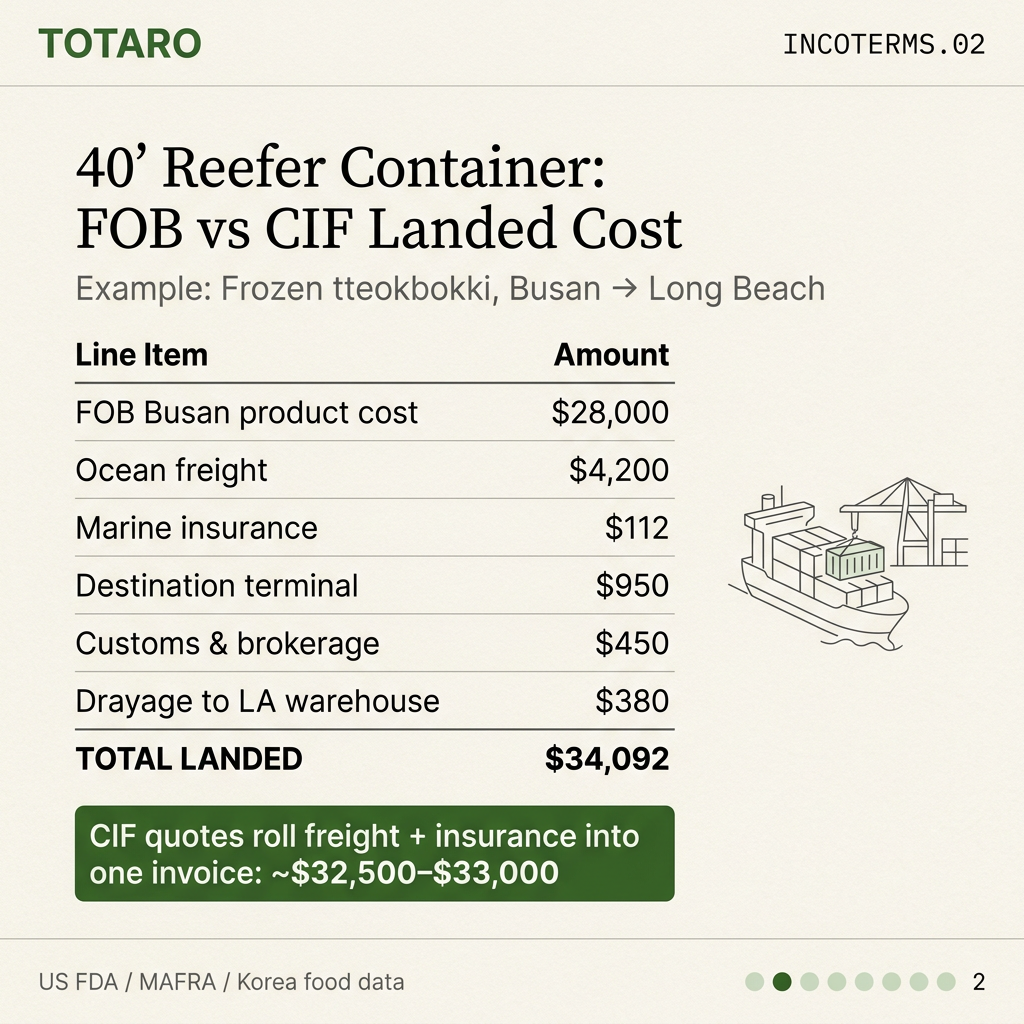
Example: A 40' reefer container of frozen tteokbokki, FOB Busan $28,000. Add ocean freight to Long Beach ($4,200), marine insurance ($112), destination terminal handling ($950), customs bond and brokerage ($450), drayage to Los Angeles warehouse ($380). Total landed cost: $34,092. CIF Long Beach would quote around $32,500–$33,000, rolling freight and insurance into the supplier's invoice.
FOB vs CIF: Which Incoterm to Choose
| Incoterm | Seller's Responsibility | Buyer's Responsibility | Best For |
|---|---|---|---|
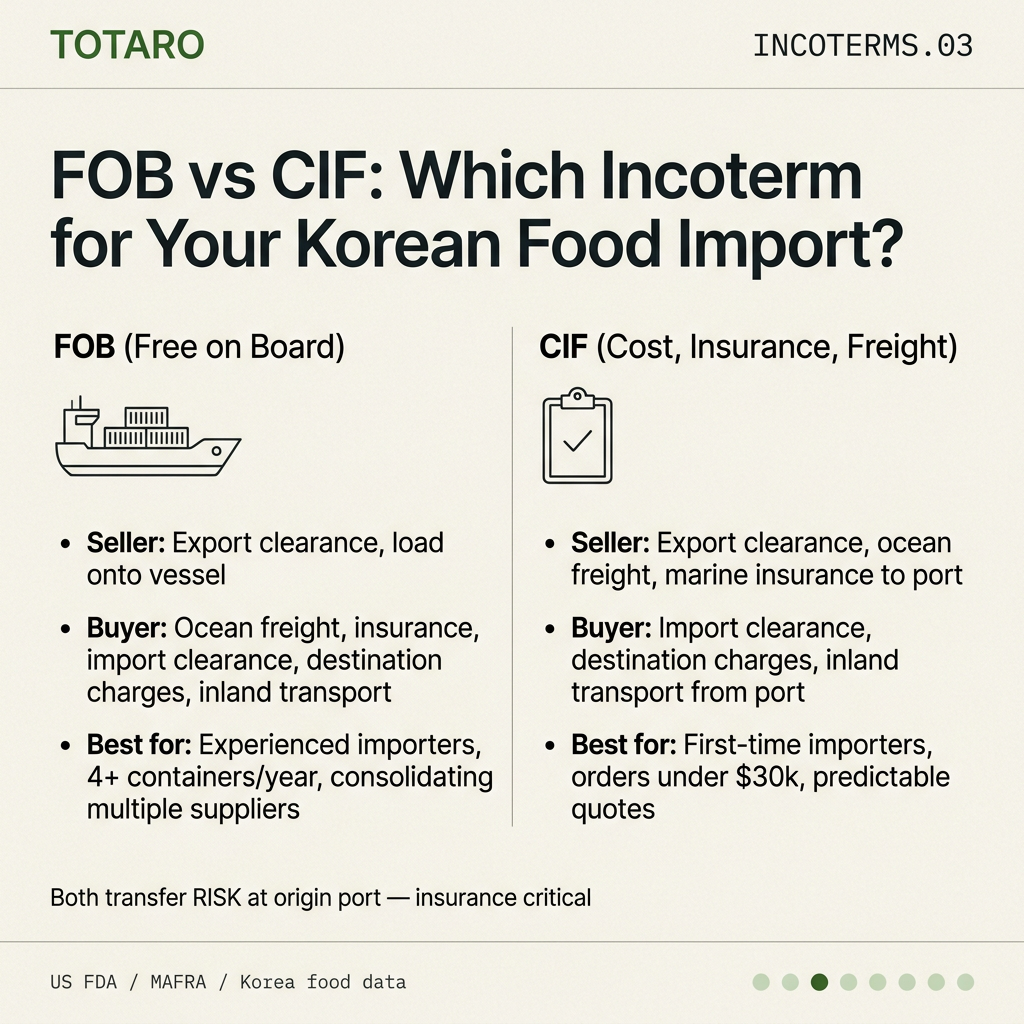
| FOB (Free on Board) | Export clearance, load goods onto vessel at origin port | Ocean freight, marine insurance, import clearance, destination charges, inland transport | Experienced importers with freight forwarder relationships; buyers consolidating multiple suppliers into one container |
| CIF (Cost, Insurance, Freight) | Export clearance, ocean freight, marine insurance to destination port | Import clearance, destination charges, inland transport from port | First-time importers; buyers wanting predictable quotes; small orders where freight-shopping isn't worth the effort |
FOB gives you control. You choose the freight forwarder, the shipping line, and the insurance provider. You can consolidate cargo from Nongshim, Pulmuone, and a smaller kimchi maker into a single 40' container and book one shipment. FOB is standard for buyers importing 4+ containers per year.
CIF is simpler. The Korean supplier books the ocean freight and buys insurance. You receive one invoice covering product + freight + insurance, often making accounting and budgeting easier. CIF is common for orders under $30,000 or when the supplier has better freight rates than you do (Korean exporters shipping 10+ containers a week often get 15–20% lower rates than a US buyer shipping sporadically).
Risk caveat: Under both FOB and CIF, risk transfers at origin. If the container is lost at sea, the buyer bears the loss (though insurance should cover it). CIF obligates the seller to buy insurance, but the minimum coverage under Incoterms 2020 CIF is only Institute Cargo Clauses C (110% of CIF value, limited perils). For frozen or refrigerated Korean food, request Institute Cargo Clauses A or specify "all risk" coverage.
Understanding Korean Food Payment Terms
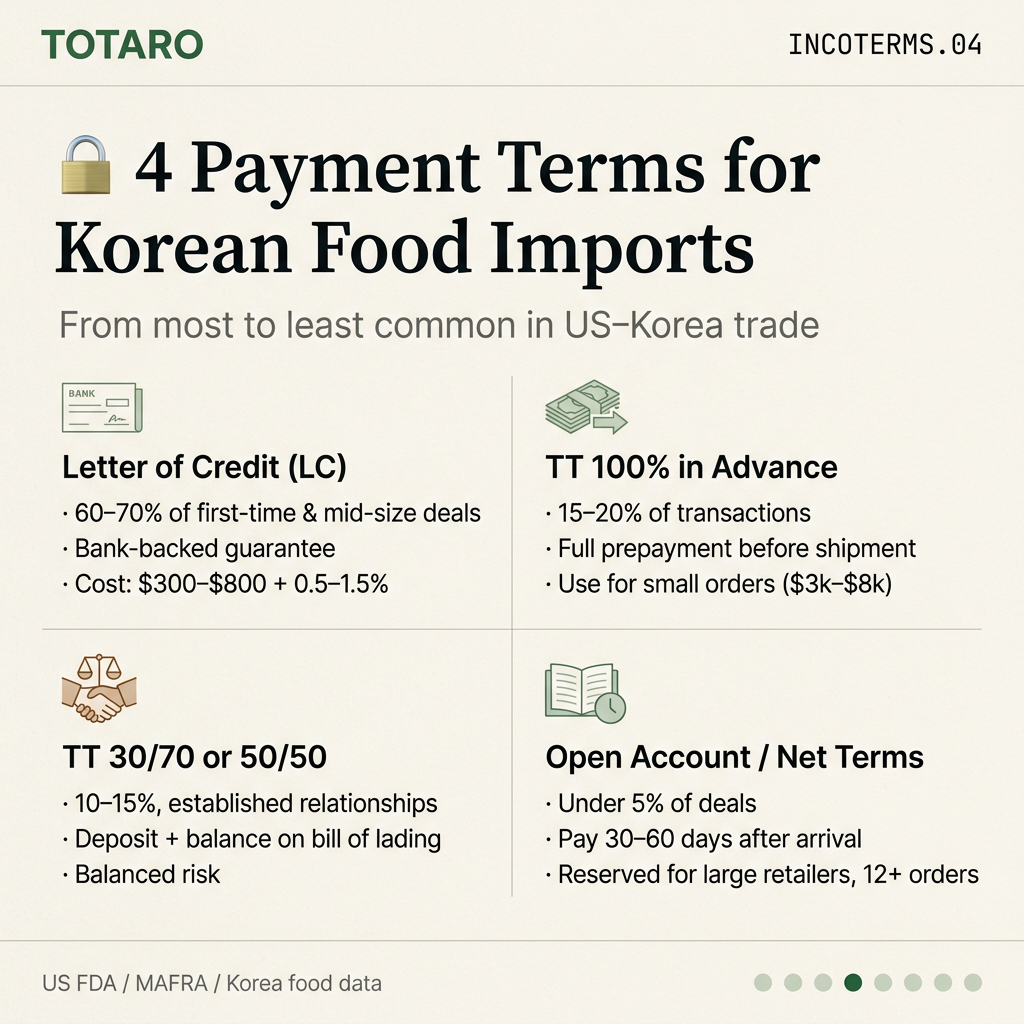
Payment terms define when and how you pay the supplier. The four most common structures in Korean food imports:
- Letter of Credit (LC) – Bank-backed guarantee, 60–70% of first-time and mid-size deals.
- Telegraphic Transfer in Advance (TT 100%) – Full prepayment, 15–20% of transactions, mostly small orders or brand-new suppliers.
- TT 30/70 or 50/50 – Deposit + balance on copy of bill of lading, 10–15%, established relationships.
- Open Account / Net Terms (OA) – Pay after goods arrive, under 5%, reserved for long-term partners or large retailers.
Letter of Credit (LC)
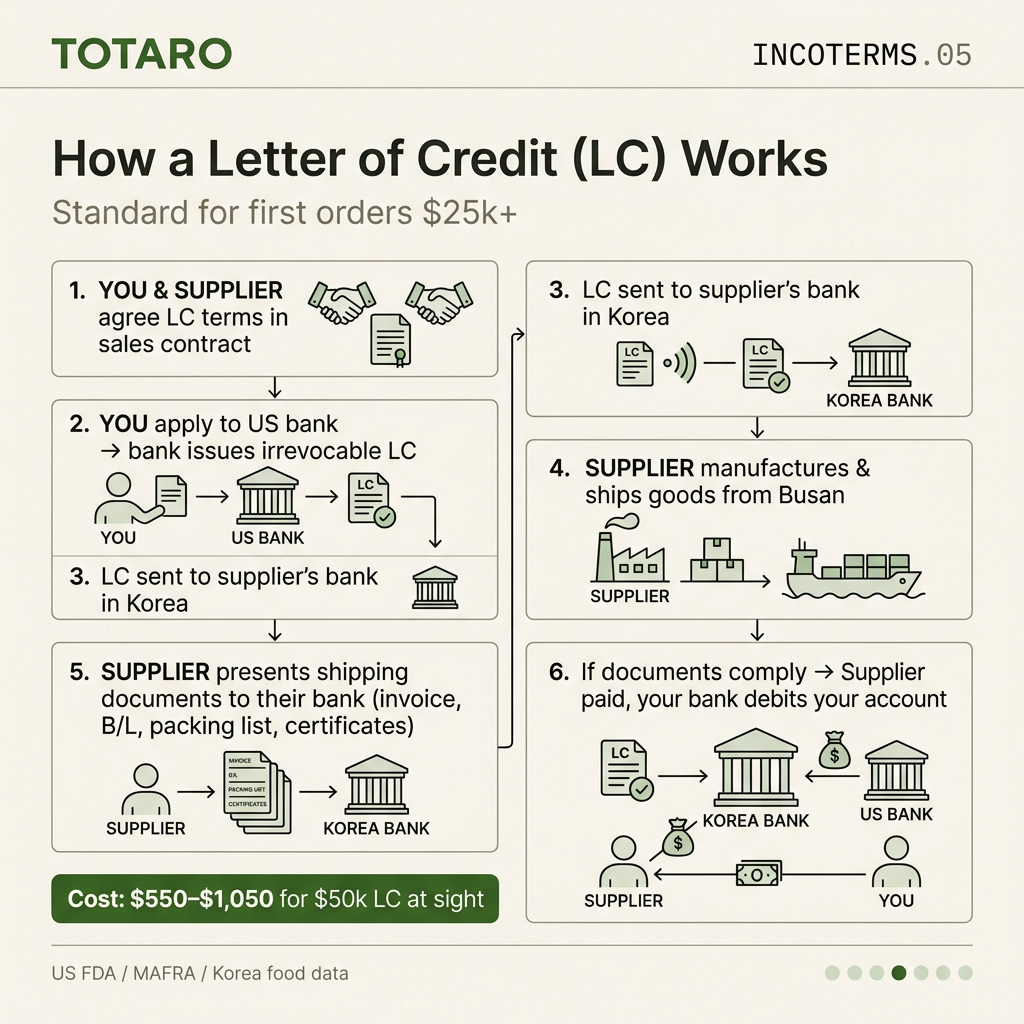
A letter of credit is a payment instrument issued by your bank that guarantees payment to the Korean supplier once they present compliant shipping documents (commercial invoice, packing list, bill of lading, certificate of origin, phytosanitary certificate if required).
How it works:
- You and the supplier agree on LC terms in the sales contract.
- You apply to your bank (the issuing bank) to open an irrevocable LC in favor of the supplier.
- The issuing bank sends the LC to the supplier's bank in Korea (the advising or confirming bank).
- The supplier manufactures and ships the goods.
- The supplier presents shipping documents to their bank.
- If documents match LC terms exactly, the supplier's bank pays them; your bank debits your account or extends short-term credit.
Cost: $300–$800 flat fee + 0.5–1.5% of the LC amount, depending on your bank and the tenor (at sight vs 30/60/90 days). A $50,000 LC at sight typically costs $550–$1,050.
Pros:
- The supplier is guaranteed payment if they ship correctly.
- You're guaranteed the goods shipped before payment is released (assuming documents are in order).
- Common for orders $25,000+, especially with new suppliers.
Cons:
- Any discrepancy in documents (misspelled company name, wrong HS code, late shipment) can delay payment or trigger amendment fees ($150–$300).
- Banks are strict: they check documents, not goods. If the container arrives empty but the bill of lading says "1,000 cartons kimchi," the bank pays.
When to use LC: First 2–3 orders with a new Korean supplier, orders over $40,000, or when your CFO requires bank-backed assurance.
Telegraphic Transfer (TT)
TT is a wire transfer. TT 100% means you pay the full invoice amount before the supplier ships. TT 30/70 means 30% deposit when you sign the purchase order, 70% balance against a copy of the bill of lading (before the container arrives).
Cost: $25–$50 per wire, plus your bank's FX margin (typically 1–2% above the mid-market USD/KRW rate).
TT 100% in advance:
- Fastest for the supplier, highest risk for you.
- Use only with suppliers you trust or for small test orders ($3,000–$8,000) where LC fees are disproportionate.
- Nongshim, Samyang, and other top-tier manufacturers rarely require TT 100% for US buyers with references.
TT 30/70 or 50/50:
- Balanced risk. The deposit covers the supplier's raw material costs; the balance is due before the goods leave Korea or shortly after, but you have proof they shipped.
- Common after 2–3 successful LC transactions.
- Some suppliers release the bill of lading only after receiving the balance TT, which means you can't take delivery until you pay.
When to use TT: Established relationships, reorders, or when the supplier offers a 2–3% discount for skipping the LC.
Open Account / Net 30/60
The supplier ships, you pay 30 or 60 days after the invoice date or after the goods arrive. Zero upfront cost, maximum cash flow benefit.
Reality check: Fewer than 5% of Korean food suppliers offer open account terms to US buyers unless (a) you're a national chain like Whole Foods or H Mart, (b) you've completed 12+ orders over 18 months with perfect payment history, or (c) you accept a 3–5% price increase to offset the supplier's working capital cost.
Korean suppliers run on thin margins (5–12% net for mid-tier manufacturers). Extending 60-day credit ties up their cash, so they reserve it for proven, high-volume buyers.
Combining Incoterms and Payment Terms
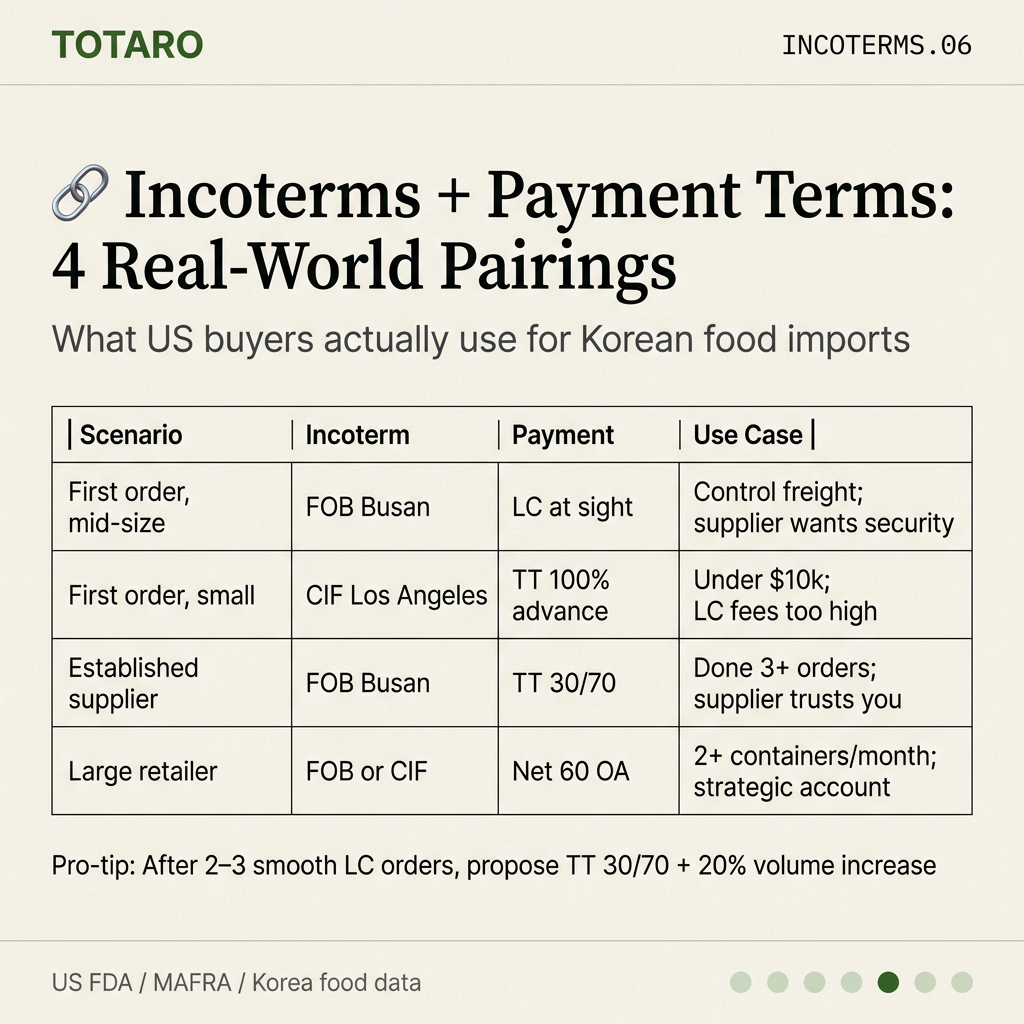
In practice, you negotiate Incoterms and payment terms together. Here are four common pairings for Korean food imports:
| Scenario | Incoterm | Payment Term | Use Case |
|---|---|---|---|
| First order, mid-size | FOB Busan | Irrevocable LC at sight | You want control over freight; supplier wants payment security |
| First order, small | CIF Los Angeles | TT 100% in advance | Order under $10,000; LC fees aren't worth it |
| Established supplier | FOB Busan | TT 30% deposit, 70% against B/L copy | You've done 3+ orders; supplier trusts you'll pay the balance |
| Large retailer, steady volume | FOB Busan or CIF | Net 60 days OA | You import 2+ containers per month; supplier sees you as a strategic account |
Tip: On your first order, propose FOB Busan + LC at sight. This is the industry standard for new US–Korea food trade relationships. After 2–3 smooth transactions, ask to move to TT 30/70 and offer to increase order volume by 20% in exchange.
Red Flags and Negotiation Pitfalls
Red flag 1: Supplier insists on TT 100% but won't provide references or a factory audit. Legitimate mid-size and large Korean food manufacturers (Daesang, Dongwon, CJ Cheiljedang, Pulmuone, Ottogi, Samyang, Nongshim) accept LC or at minimum TT 30/70. If a supplier demands full prepayment with no verifiable track record, walk away or use a third-party inspection service (SGS, Intertek) and escrow.
Red flag 2: CIF quote but no marine insurance certificate provided. Under CIF Incoterms 2020, the seller must provide proof of insurance. If they don't, you're not actually getting CIF—you're getting CFR (Cost and Freight) and paying for phantom insurance.
Red flag 3: LC terms that are impossible to meet. Some buyers write LCs requiring a phytosanitary certificate for shelf-stable gochujang (not always mandatory) or a certificate of free sale from MFDS (takes 3–4 weeks). Unrealistic document requirements cause discrepancies, delays, and amendment fees. Work with your freight forwarder and the supplier to draft clean, achievable LC terms.
Negotiation tip: Offer a higher deposit or shorter LC tenor in exchange for a better FOB price. Example: "We'll do TT 50% deposit + 50% against docs instead of LC at sight. In return, can you reduce the unit price by $0.08?" Suppliers save $600–$1,200 in LC advising and confirmation fees and often share part of that saving.
Step-by-Step: First Korean Food Import with FOB + LC
- Sign the sales contract. Specify product, quantity, unit price, Incoterm (FOB Busan), payment term (irrevocable LC at sight), shipment deadline, HS code (e.g., 2103.90 for gochujang, 1902.30 for ramyeon), and required certificates.
- Apply for the LC. Submit the sales contract, proforma invoice, and supplier's bank details to your US bank. Allow 3–5 business days for issuance.
- Supplier manufactures and books export. Production takes 2–6 weeks depending on the product. Frozen and refrigerated goods require a reefer container; dry goods use a standard 20' or 40' container.
- Goods ship from Busan (or Incheon). Transit time to Los Angeles/Long Beach: 12–16 days. To Savannah or New York: 24–28 days.
- Supplier presents documents to their bank. Bill of lading, commercial invoice, packing list, certificate of origin (Form A for GSP duty savings if applicable).
- Your bank reviews and pays. If documents comply, your bank releases payment to the supplier's bank and forwards the documents to you.
- File Prior Notice (FDA) and ISF (Importer Security Filing). Due 24 hours before the container is loaded onto the vessel (ISF) and before arrival (Prior Notice). Your customs broker handles this.
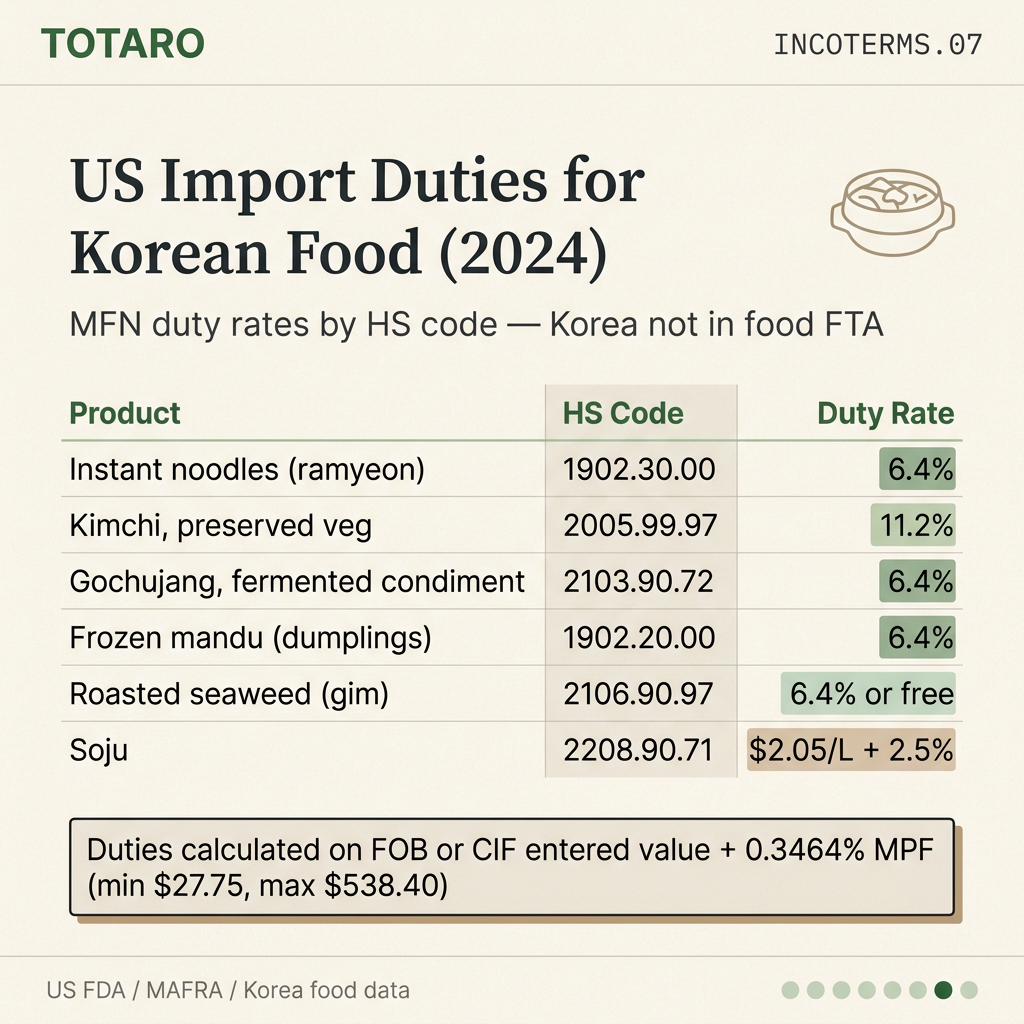
- Clear customs, pay duties, pick up container. For ramyeon (1902.30.00), duty is 6.4%. For kimchi (2005.99.97), duty is 11.2%. Add Merchandise Processing Fee (0.3464% of entered value, min $27.75, max $538.40).
- Transport to your warehouse. If you're using a 3PL, the drayage company delivers the container directly; if not, you devan at the port or a nearby warehouse.
Total timeline from LC issuance to goods in your warehouse: 6–10 weeks.
Tariffs, Duties, and HS Codes for Korean Food
Incoterms define cost and risk, but they don't include US import duties. Duties are based on the HS (Harmonized System) classification and the entered value (usually the FOB or CIF amount on the commercial invoice).
Common Korean food HS codes and 2024 duty rates:
| Product | HS Code | Duty Rate (MFN) |
|---|---|---|
| Instant noodles (ramyeon) | 1902.30.00 | 6.4% |
| Kimchi, prepared/preserved vegetables | 2005.99.97 | 11.2% |
| Gochujang, fermented condiments | 2103.90.72 | 6.4% |
| Frozen mandu (dumplings) | 1902.20.00 | 6.4% |
| Roasted seaweed (gim) | 2106.90.97 or 1212.21.00 | 6.4% or free |
| Soju | 2208.90.71 | $2.05/liter + 2.5% |
South Korea is not part of a US free-trade agreement that eliminates food duties (the KORUS FTA covers autos, electronics, and machinery but excludes most processed foods). However, some Korean products qualify for GSP (Generalized System of Preferences) or reduced rates under trade preference programs—confirm with your customs broker.
Entered value: If you buy FOB Busan $30,000 and pay $4,500 for ocean freight, your customs-entered value is still $30,000. Duties and MPF are calculated on the FOB amount. If you buy CIF Los Angeles $34,500, the entered value is $34,500 and duties are slightly higher.
FAQ
What's safer for a first Korean food import: FOB or CIF?
CIF is simpler for budgeting, but FOB gives you control over the freight forwarder, insurance level, and consolidation. For a first order over $20,000, use FOB Busan + irrevocable LC at sight. Hire a US-based freight forwarder with Korea expertise (e.g., Flexport, Shapiro, Mohawk Global) to book the ocean freight and handle customs clearance. You'll pay $200–$400 more in forwarder fees than CIF, but you'll have a single point of contact in the US and better visibility.
How much does a letter of credit cost for a $40,000 Korean food order?
Expect $500–$800 in bank fees (LC issuance, advising, document examination) plus 0.5–1.0% of the invoice amount if your bank charges a percentage. Total: $700–$1,200. If the supplier requests a confirmed LC (their bank guarantees payment even if your bank defaults), add another 0.5–1.5%, or $200–$600. Confirmed LCs are rare unless you're a startup with limited credit history.
Can I negotiate better payment terms after a few successful orders?
Yes. After 2–3 LC transactions with on-time payment, ask to switch to TT 30/70 (30% deposit, 70% against copy of bill of lading). Most Korean suppliers agree, saving both sides $600–$1,000 per order in LC fees. After 6–12 orders, some suppliers offer TT 50/50 or even Net 30 for high-volume buyers. Always link improved terms to increased order volume or frequency.
What happens if the container is delayed or damaged in transit under FOB?
Under FOB, risk transfers to you when goods are loaded on the vessel at Busan. If the container is delayed, damaged, or lost at sea, you bear the loss—but that's why you buy marine insurance (0.3–0.5% of cargo value). File a claim with your insurer (or the supplier's insurer if CIF). Reefer breakdowns are the most common claim for frozen Korean food; always specify "all risk" coverage and verify the container's temperature log via the shipping line's tracking system.
Bottom line: Incoterms and payment terms aren't legal boilerplate—they're the operating system of your Korean food import. Master FOB vs CIF, understand when to use an LC vs TT, and negotiate terms that balance risk, cost, and cash flow. Do it right, and you'll land a 40' container of ramyeon in Los Angeles for $34,000 with zero surprises. Do it wrong, and you'll spend $1,500 fixing document discrepancies, blow your margin, or wait 90 days for payment disputes to resolve.
Start with FOB Busan + LC at sight for your first order, build trust over 2–3 shipments, then migrate to TT 30/70 and reinvest the saved LC fees into your next container.
Related Guides
Korean Jerusalem Artichoke + Psyllium Husk Halal Enzyme Supplement for the US: The SlimFox-Style Constipation + Weight Management Combo (2026)
Related Guides →Korean Jerusalem Artichoke for Constipation: 14-19% Inulin Content and Clinical Evidence on Gut Health (2026)
Related Guides →How to Import Korean Food into the USA: Complete 2026 Guide
Related Guides →Ask AI to find your Korean food supplier
Describe what you need in plain language — get matched with verified suppliers in seconds.
Try AI Supplier Search