카드 1 / 8
How to Import Korean Food into the US: FDA & Compliance
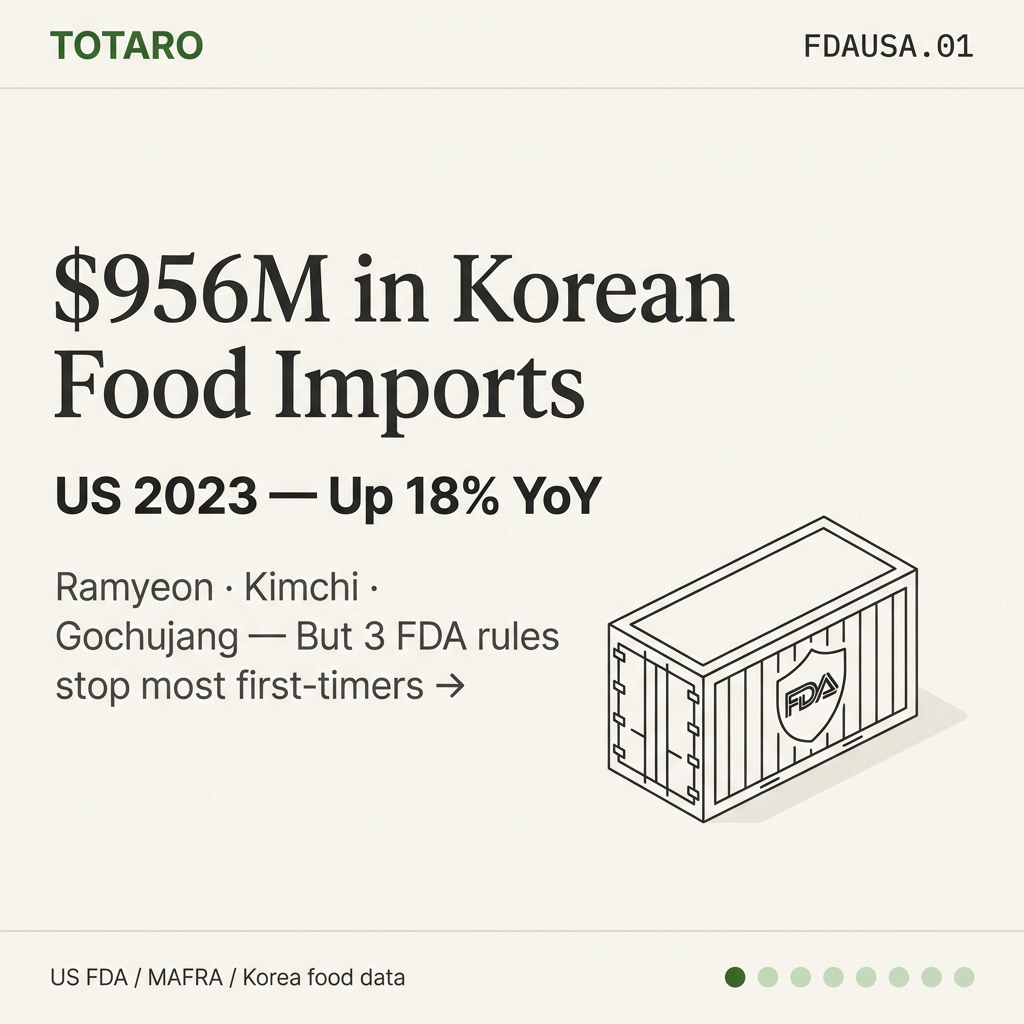
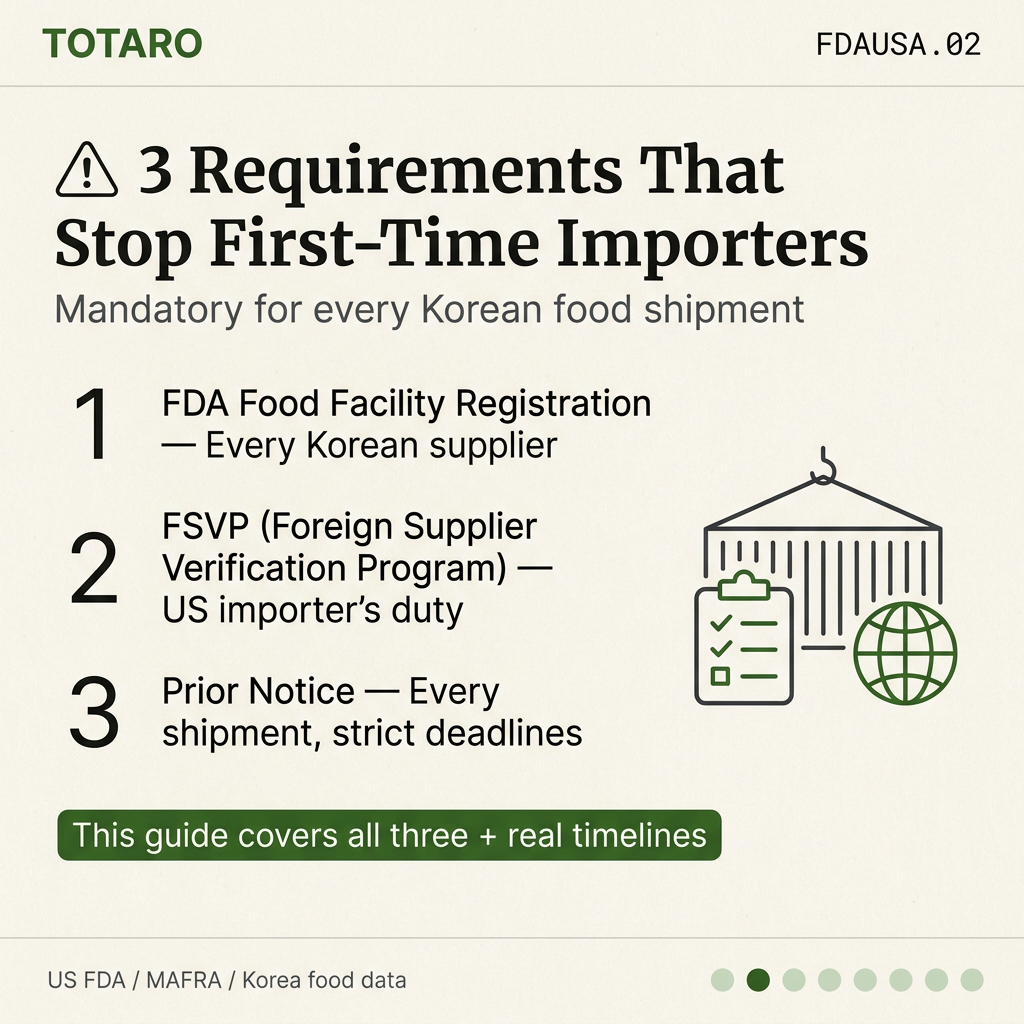
The US imported $956 million in Korean food in 2023, up 18% year-over-year. Ramyeon, kimchi, gochujang, and frozen kimbap are moving through Long Beach and Savannah at record volume. But three regulatory requirements stop most first-time importers cold: FDA food facility registration, Foreign Supplier Verification Programs (FSVP), and prior notice submissions.
This guide walks you through each requirement with timelines, forms, and real-world examples from importers who've cleared thousands of containers since 2018.
FDA Food Facility Registration: Every Korean Exporter Needs One
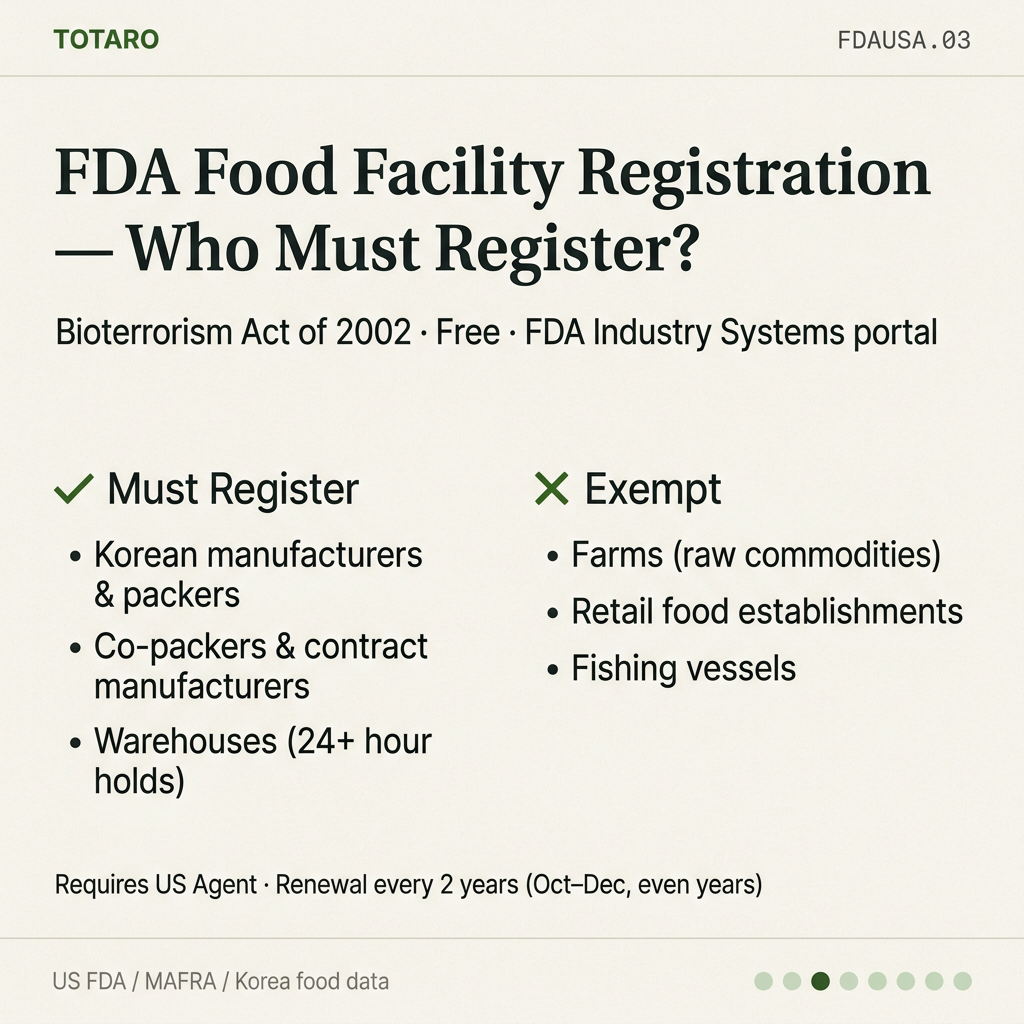
FDA requires every foreign food facility that manufactures, processes, packs, or holds food for US consumption to register under the Bioterrorism Act of 2002. That includes your Korean suppliers—noodle factories in Ansan, kimchi producers in Gwangju, sauce manufacturers in Gimpo.
Who must register:
- Korean food manufacturers and packers
- Co-packers and contract manufacturers
- Warehouses that store product before export (if they hold for 24+ hours)
Who does NOT need to register:
- Farms growing raw agricultural commodities
- Retail food establishments (e.g. a restaurant that occasionally exports product)
- Fishing vessels
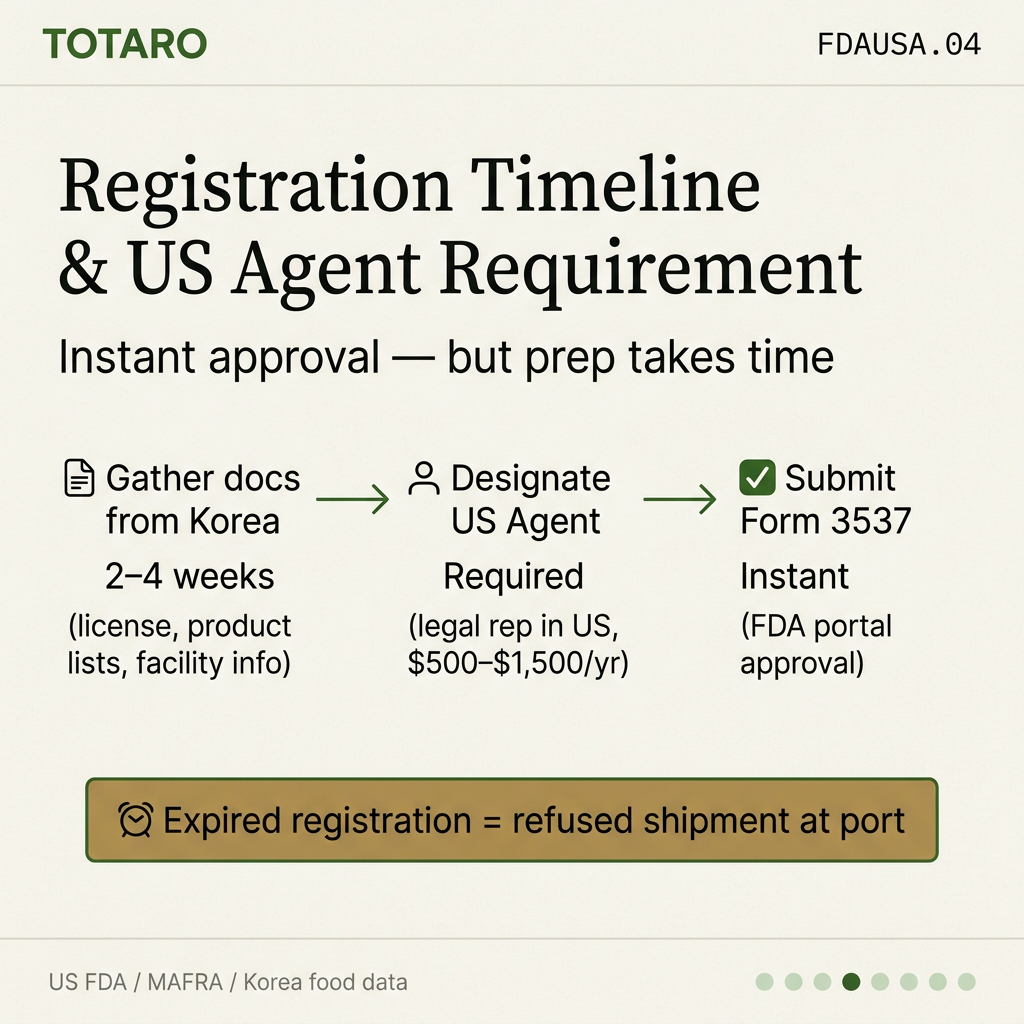
Registration is free and done online through FDA's Industry Systems portal. Korean suppliers submit a Form 3537 (Food Facility Registration) with facility name, physical address, parent company details, product categories (e.g. "soups, sauces, and dressings" or "bakery products"), and a US agent.
The US agent requirement: Every registered facility must designate a US agent who resides or maintains a business in the US. This agent acts as the FDA's communication point—not a customs broker or freight forwarder, but a legal representative who can receive and respond to FDA inquiries within hours. Many importers serve as the US agent for their Korean suppliers. Others hire third-party compliance firms ($500–$1,500/year per facility).
Registration renewal happens every other year between October 1 and December 31 of even-numbered years. FDA does not send reminders. Expired registrations mean refused shipments at the port.
Timeline: Registration approval is instant once submitted. But gathering documentation from a Korean supplier—business license, product lists, facility blueprints—can take 2–4 weeks if they've never exported to the US.
FSVP: Your Responsibility as the US Importer
The Foreign Supplier Verification Program regulation (21 CFR 1.500+) became mandatory in 2017. FSVP places the burden of supplier food-safety verification on the US importer, not the foreign manufacturer.
If you're the importer of record on the customs entry, you're the FSVP importer. You must:
- Identify known or reasonably foreseeable hazards for each food product (e.g. Salmonella in sesame seeds, histamine in frozen mackerel, allergen cross-contact in shared facilities).
- Evaluate the foreign supplier's performance and the risk of the food. High-risk foods—ready-to-eat kimchi, fresh tteok (rice cakes), raw seafood—require more rigorous verification than shelf-stable gochujang or dried noodles.
- Conduct supplier verification activities. Options include:
- Annual onsite audits by accredited third parties (most common for high-risk foods)
- Sampling and testing of shipments
- Review of supplier food safety records and HACCP plans
- Obtaining written assurances and certificates of analysis (COA)
- Document everything. FSVP compliance relies on written hazard analysis, supplier evaluations, corrective action records, and verification activity logs.
FSVP exemptions:
- Juice and seafood covered by FDA's Juice HACCP or Seafood HACCP (overlap rules apply)
- Food imported for research or evaluation (not for sale)
- Imports under $10,000 per year per importer (very small importer exemption, but you must still verify safety)
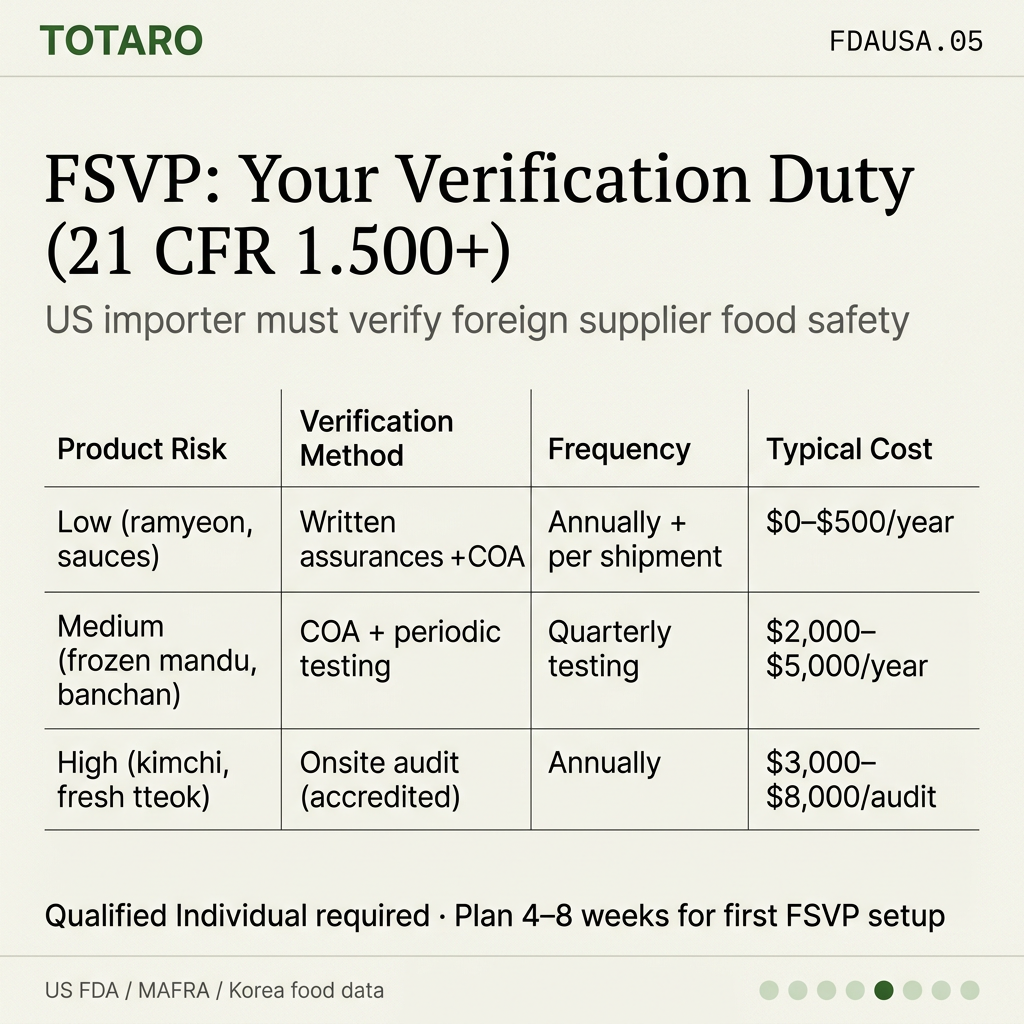
Most common FSVP model for Korean food importers:
| Product Risk | Verification Method | Frequency | Typical Cost |
|---|---|---|---|
| Low (shelf-stable ramyeon, sauces) | Written assurances + COA review | Annually + per shipment | $0–$500/year |
| Medium (frozen mandu, refrigerated banchan) | COA + periodic testing | Quarterly testing | $2,000–$5,000/year |
| High (ready-to-eat kimchi, fresh tteok) | Onsite audit by accredited firm | Annually | $3,000–$8,000/audit |
Who is your Qualified Individual? FSVP regulations require a "qualified individual" to perform or oversee your FSVP. This person must have education, training, or experience to perform these activities. Many importers hire food safety consultants ($150–$300/hour) to build their first FSVP plan, then maintain it in-house.
Timeline: Building a compliant FSVP from scratch takes 4–8 weeks. Onsite audits in Korea require 6–10 weeks advance notice to schedule, conduct, and receive reports. Plan FSVP setup before your first container ships.
Prior Notice: Every Shipment, Every Time
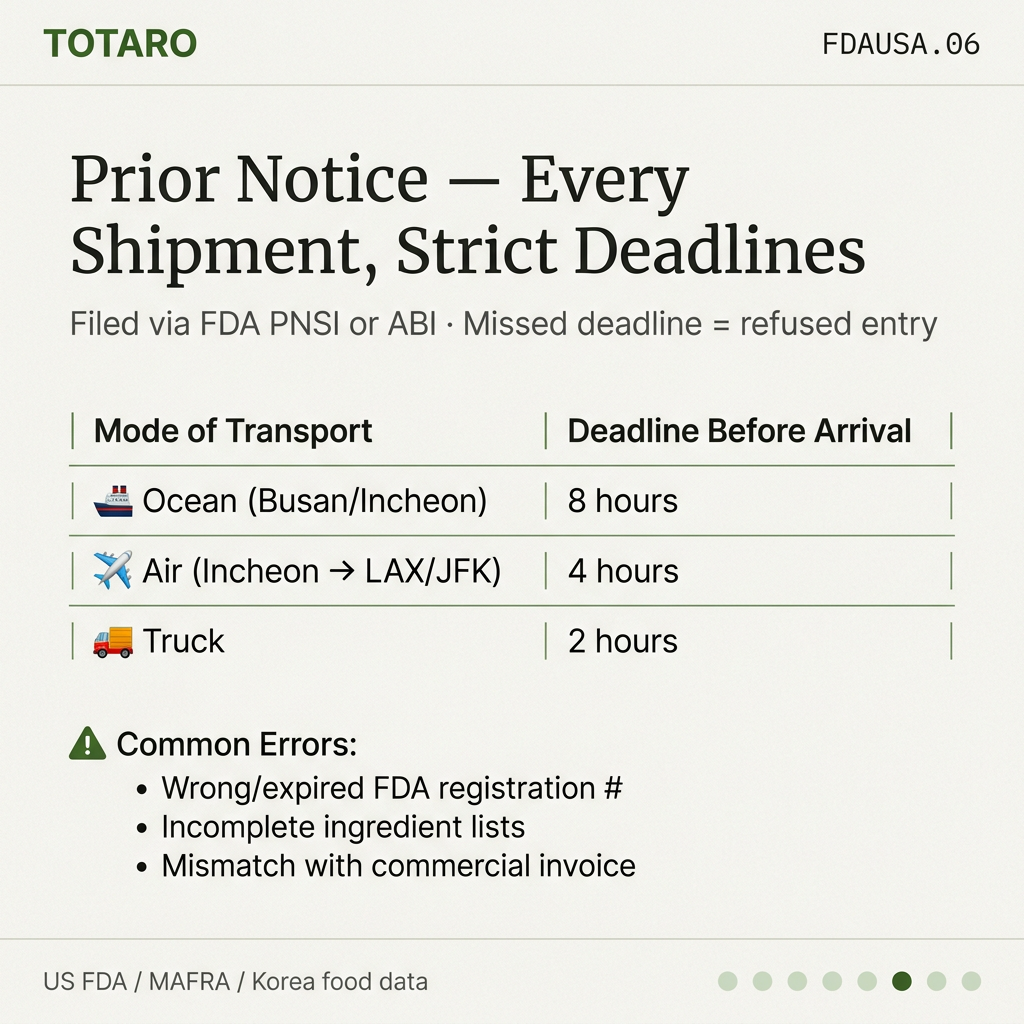
FDA requires advance electronic notice for every food shipment arriving in the US. Prior notice must be submitted through the FDA Prior Notice System Interface (PNSI) or via Customs and Border Protection's Automated Broker Interface (ABI)—most customs brokers file it for you.
What prior notice includes:
- FDA product code (search the FDA Product Code Database)
- Manufacturer name and registration number
- Country of origin and shipper
- Anticipated arrival date, time, and port
- Importer and consignee details
- Complete ingredient list (if a multi-ingredient food)
Filing deadlines:
| Mode of Transport | Deadline Before Arrival |
|---|---|
| Ocean (containers from Busan, Incheon) | 8 hours |
| Air (Incheon → LAX, JFK) | 4 hours |
| Truck (rare for Korean food) | 2 hours |
Miss the deadline and CBP refuses entry. The container sits at the port, accruing demurrage ($150–$300/day) until you file a corrected notice and FDA clears it.
Common prior notice errors:
- Wrong FDA registration number (typo or expired registration)
- Missing or incomplete ingredient lists (FDA requires all ingredients, even sub-ingredients in compound items like ramyeon soup base)
- Mismatch between prior notice and commercial invoice (quantity, product description)
- Filing for a consolidation without breaking out each manufacturer and product type
Timeline: Prior notice submission takes 15–30 minutes per line item. Experienced customs brokers batch-file for multiple products in one container. FDA reviews within minutes to a few hours; if flagged, shipments are held for inspection (see next section).
FDA Inspections, Holds, and Refusals
About 2–3% of food shipments receive physical examination by FDA. Another 5–8% are flagged for document review. Selection is risk-based: first-time importers, new products, suppliers with prior violations, or categories under import alert (e.g. certain seafood for histamine, sesame products for Salmonella) face higher scrutiny.
If your shipment is held:
- OASIS assignment. FDA's Operational and Administrative System for Import Support (OASIS) flags the entry. Your broker notifies you within hours.
- "May Proceed" or "Hold." Most flagged shipments receive a "may proceed" after document review. A small share are physically sampled—FDA collects samples at the port or CES (container examination station), and the container is held until lab results clear (3–10 days for microbiology, longer for chemical residues).
- Refusal. If FDA finds adulteration (e.g. Salmonella, undeclared allergens) or misbranding (e.g. incorrect nutrition label, unapproved food additive), the shipment is refused under Section 801(a) of the FD&C Act. You receive a Notice of Refusal. Options:
- Reconditioning: destroy the contaminated portion, relabel, retest, and apply for re-delivery ($5,000–$15,000 in fees and storage).
- Export or destroy: ship back to Korea or destroy under FDA supervision.
Case example: A California importer brought in 18,000 units of Korean frozen mandu in March 2023. Prior notice listed "pork, cabbage, garlic, onion, soy sauce" but omitted wheat flour in the wrapper. FDA refused entry for misbranding (undeclared allergen). The importer relabeled all 18,000 units dockside ($12,000 labor + $3,200 warehouse fees) and was cleared after 9 days.
HS Codes, Duties, and Import Costs
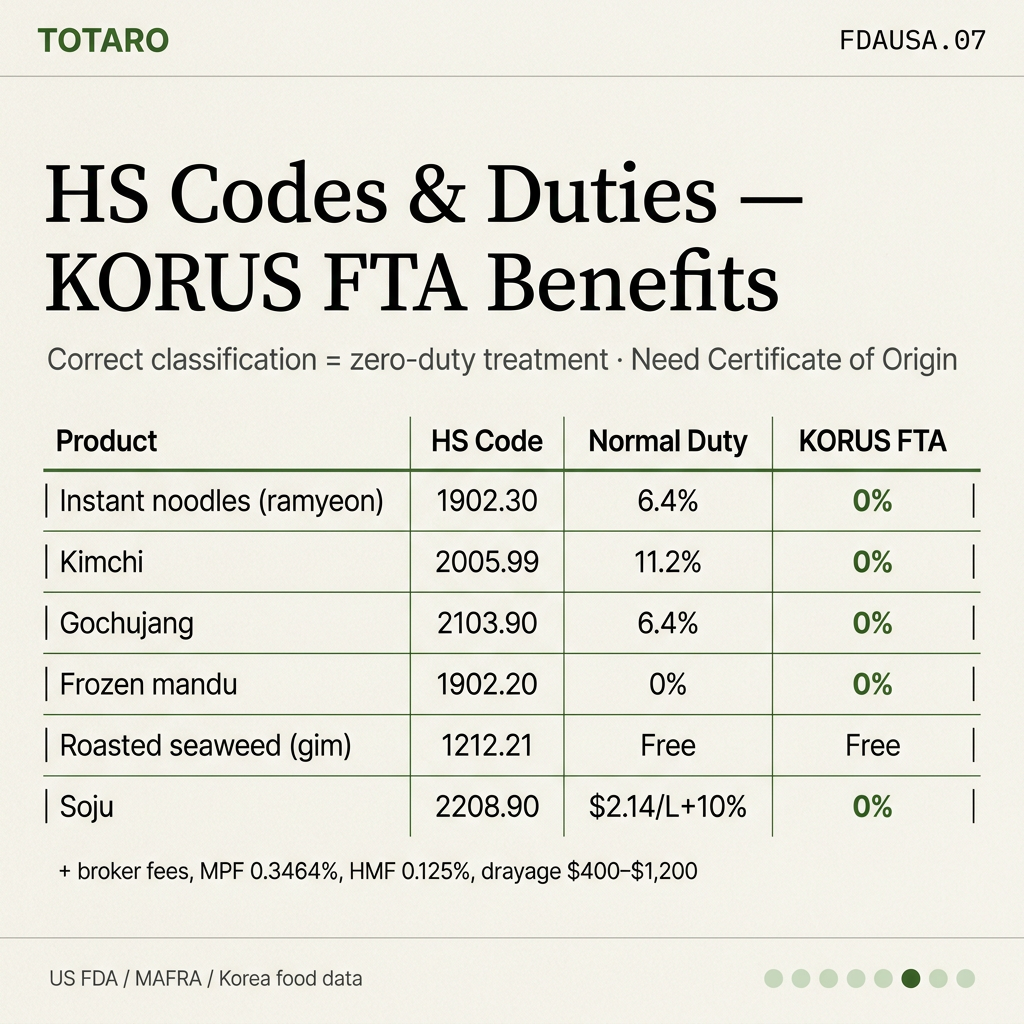
Korean food falls under dozens of Harmonized Tariff Schedule codes. Correct classification affects duty rates and whether your product qualifies for the US-Korea Free Trade Agreement (KORUS FTA) zero-duty treatment.
Common HS codes for Korean food:
| Product | HS Code | Normal Duty | KORUS FTA Duty |
|---|---|---|---|
| Instant noodles (ramyeon) | 1902.30 | 6.4% | 0% |
| Kimchi (prepared vegetables) | 2005.99 | 11.2% | 0% |
| Gochujang (fermented sauces) | 2103.90 | 6.4% | 0% |
| Frozen mandu (dumplings) | 1902.20 | 0% | 0% |
| Roasted seaweed (gim) | 1212.21 | Free | Free |
| Soju (distilled spirits) | 2208.90 | $2.14/liter + 10% | 0% (after phase-in) |
To claim KORUS FTA benefits, you need a KORUS Certificate of Origin from your Korean supplier, confirming the product originates in Korea and meets rules of origin (usually "wholly obtained" or "produced entirely" from Korean materials, or meets a tariff-shift rule for processed foods). Your customs broker files the claim at entry.
Other costs to budget:
- Customs broker fees: $125–$250 per entry
- Harbor Maintenance Fee: 0.125% of cargo value
- Merchandise Processing Fee: 0.3464% of value (min $27.75, max $538.40)
- USDA inspection (meat/poultry products): $50–$200 per line
- Container drayage (port to warehouse): $400–$900 West Coast, $600–$1,200 East Coast
- Demurrage/detention if container isn't returned within free time (typically 5 days): $150–$300/day escalating
Building a Compliant Korean Food Supply Chain
Compliance isn't a one-time checklist. It's an ongoing system that links your Korean suppliers, your internal QA, your broker, and your documentation.
Best practices from high-volume importers:
-
Audit suppliers before contracting. Request FDA registration confirmation, HACCP plans, allergen control procedures, and recent third-party audit reports. The Big 3 ramyeon brands (Nongshim, Samyang, Ottogi) and major kimchi exporters (Chongga, Jongga) maintain robust export compliance programs. Smaller producers in Gyeonggi or rural regions may need hand-holding.
-
Centralize FSVP documentation. Use a shared drive or compliance software (e.g. FoodLogiQ, SafetyChain) to store hazard analyses, supplier evaluations, COAs, audit reports, and corrective actions. FDA inspections of importers (domestic surveillance) can happen with 24 hours' notice. You must produce FSVP records on demand.
-
Work with a broker experienced in Korean food. Brokers who regularly clear ramyeon, kimchi, and sauces know the quirks—multi-ingredient prior notice formatting, KORUS origin documentation, USDA coordination for meat-containing products (e.g. bulgogi mandu). Expect to pay 10–20% more than a generalist broker, but you'll avoid costly holds.
-
Plan lead times around compliance, not just ocean transit. Busan to Long Beach is 16 days ocean, but add 2–3 weeks for FSVP audit scheduling, 1–2 weeks for prior notice prep and document gathering, and 3–5 days buffer for potential FDA holds. First-time imports typically require 8–10 weeks from PO to warehouse delivery.
-
Label review before production. FDA requires English-language labels with Nutrition Facts (FDA format), ingredient list in descending order of weight, allergen declarations (in or adjacent to ingredient list), manufacturer or distributor name and US address, net quantity, and country of origin. Korean suppliers often print bilingual labels—work with a US food label consultant ($500–$1,200 per SKU) to ensure compliance before the first print run.
FAQ
Do I need a food importer license to bring Korean food into the US?
No. The US does not issue a general "food importer license." However, you must obtain a DUNS number, register for a CBP importer of record number (IOR), and comply with FDA's FSVP as the importer. Some product categories—meat, poultry, alcohol—require additional USDA or TTB permits.
Can I import Korean kimchi and ramyeon in the same container?
Yes. Mixed containers are common. Each product line requires its own prior notice entry and FDA product code. Your customs broker will file multiple prior notice submissions under one bill of lading. Ensure every manufacturer in the container has a valid FDA registration.
How long does FDA food facility registration take for a Korean supplier?
Submission and approval are instant once you click "submit" in the FDA portal. The bottleneck is gathering the required information—facility address, parent company details, product categories, US agent designation. First-time registration for a small Korean producer typically takes 2–4 weeks from request to completion.
What happens if my Korean supplier's FDA registration expires mid-shipment?
If the registration lapses before your container arrives, FDA refuses entry. Your supplier must renew immediately (registration renewals are also instant), and you must file an amended prior notice with the updated registration number. The shipment may be held 1–3 days while FDA verifies. Always check registration status 30 days before each shipment and again at prior notice filing.
Related Guides
Korean Jerusalem Artichoke + Psyllium Husk Halal Enzyme Supplement for the US: The SlimFox-Style Constipation + Weight Management Combo (2026)
Related Guides →Korean Jerusalem Artichoke for Constipation: 14-19% Inulin Content and Clinical Evidence on Gut Health (2026)
Related Guides →How to Import Korean Food into the USA: Complete 2026 Guide
Related Guides →Ask AI to find your Korean food supplier
Describe what you need in plain language — get matched with verified suppliers in seconds.
Try AI Supplier Search