카드 1 / 8
Korean Sauce Wholesale: Gochujang, BBQ & Ssamjang Import
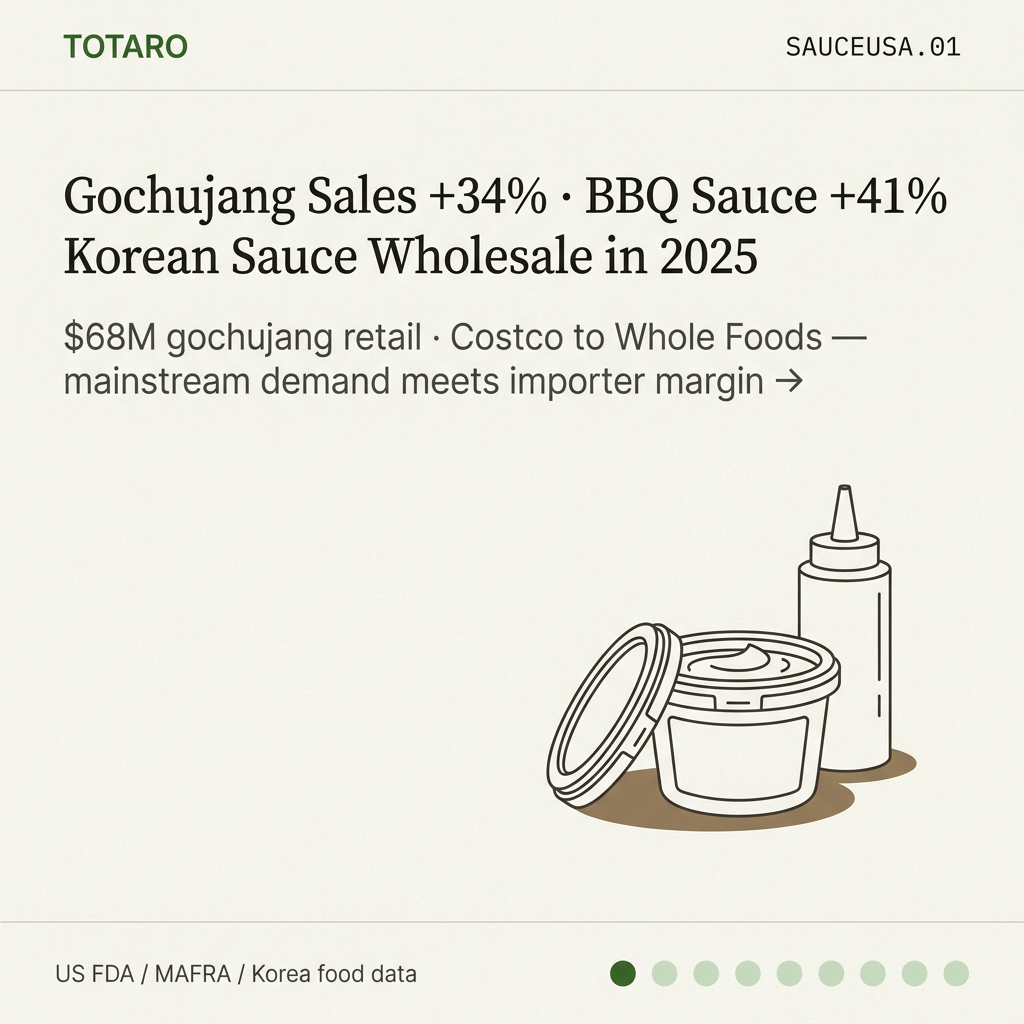
Korean sauces and condiments have moved from specialty shelves to mainstream retail across the United States. Gochujang retail sales hit $68 million in 2023, up 34% year-over-year, while Korean BBQ sauce grew 41% in the same period. For importers and distributors, this category offers strong margins, long shelf life, and proven consumer pull—but sourcing requires navigating manufacturer capabilities, regulatory hurdles, and private-label economics.
This guide walks through wholesale procurement of the three core Korean condiments—gochujang, Korean BBQ sauce, and ssamjang—with concrete MOQs, FDA compliance steps, OEM timelines, and real-world landed costs for container shipments to the US West and East Coast.
Why Korean Sauces Are High-Priority for US Importers
Korean condiments deliver margin and velocity. Gochujang wholesale typically lands at $1.80–$3.20 per 500 g tub FOB Busan, retails at $6.99–$9.99, and turns over faster than many Asian condiment SKUs. Korean BBQ sauce—both traditional ganjang-based and fusion styles—posts similar economics and crosses over into mainstream grilling and meal-kit channels.
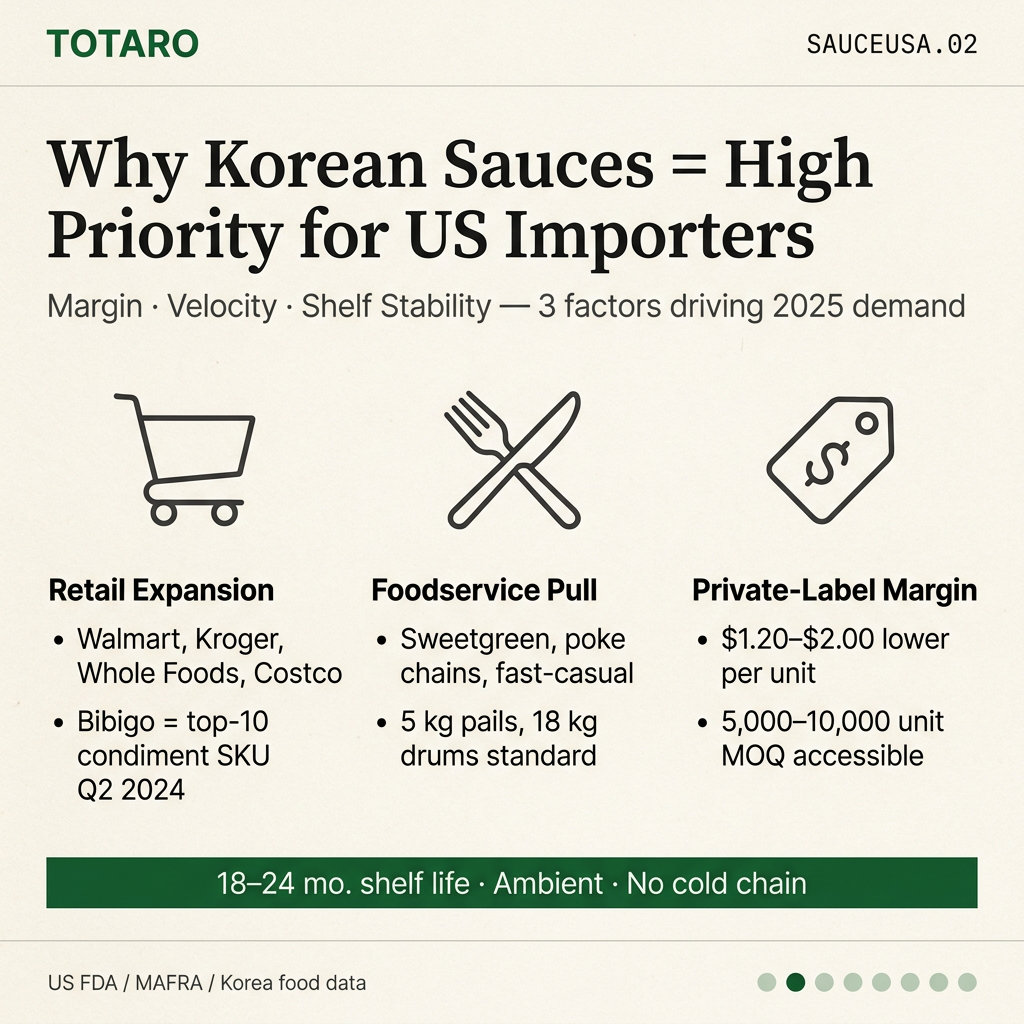
Three factors drive importer interest in 2025:
Retail expansion. Walmart, Kroger, Whole Foods, and Costco all expanded Korean sauce facings in 2023–2024. Costco's Bibigo gochujang (2-pack, 1 kg each) became a top-10 condiment SKU in Q2 2024. Regional chains like H-E-B and Wegmans added dedicated Korean sauce end-caps.
Foodservice pull. Fast-casual chains (Sweetgreen, Chipotle competitors, poke concepts) now spec gochujang mayo, Korean BBQ glaze, and ssamjang-based dressings. Foodservice pack sizes (5 kg pails, 18 kg drums) are standard from all major Korean manufacturers.
Private-label margin. OEM gochujang and ssamjang run $1.20–$2.00 per unit lower than branded equivalents at comparable volume, and Korean co-packers accept 5,000–10,000-unit minimums for private label—accessible for regional distributors and emerging retail brands.
Shelf life runs 18–24 months for gochujang and ssamjang, 12–18 months for Korean BBQ sauce, all ambient. No cold chain simplifies distribution and reduces landed costs versus kimchi or fresh banchan.
Major Korean Sauce Manufacturers and MOQs
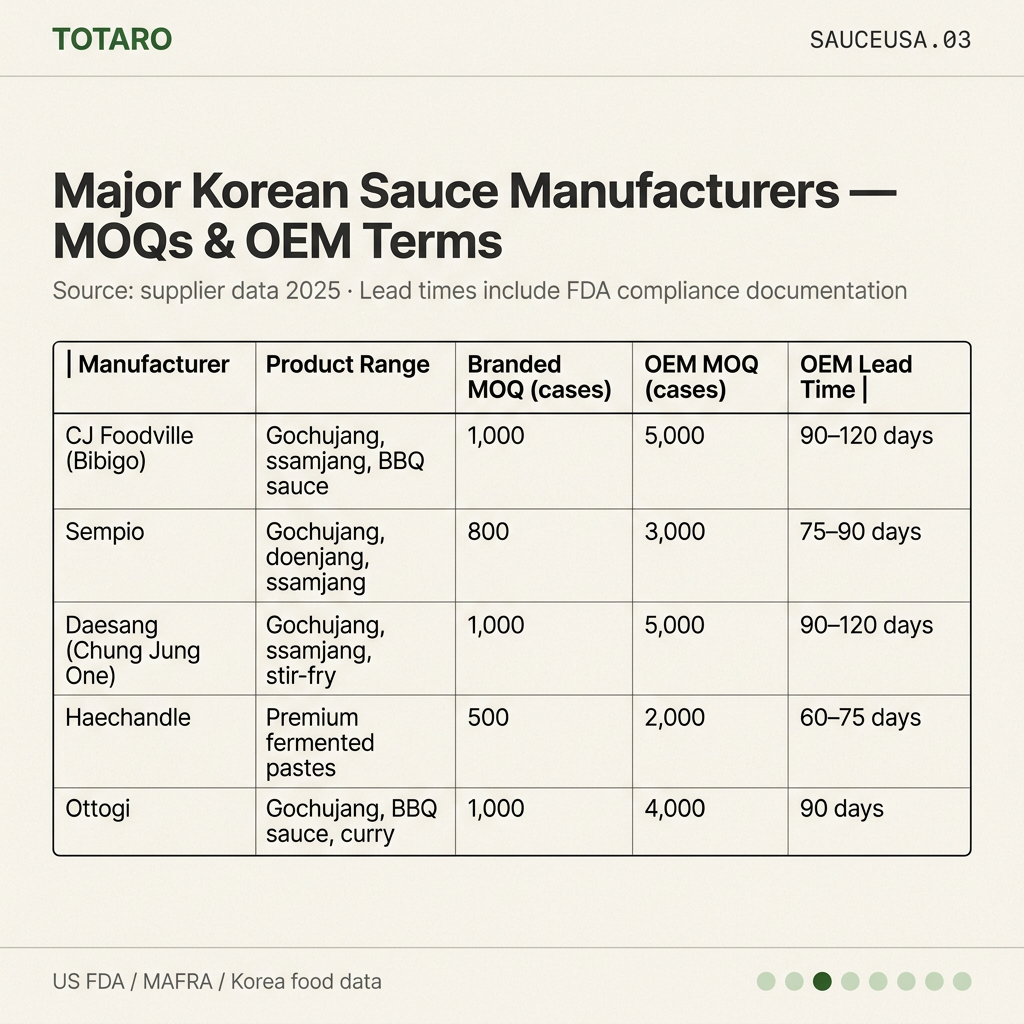
Korean condiment manufacturing is concentrated among a handful of verticals. Here are the primary suppliers US importers work with, along with typical first-order MOQs and OEM capabilities.
| Manufacturer | Product Range | Branded MOQ (cases) | OEM MOQ (cases) | OEM Lead Time |
|---|---|---|---|---|
| CJ Foodville (Bibigo) | Gochujang, ssamjang, BBQ sauce, gochugaru | 1,000 | 5,000 | 90–120 days |
| Sempio | Gochujang, doenjang, ssamjang, soy-based sauces | 800 | 3,000 | 75–90 days |
| Daesang (Chung Jung One) | Gochujang, ssamjang, red pepper paste, stir-fry sauce | 1,000 | 5,000 | 90–120 days |
| Haechandle | Premium gochujang, doenjang, traditional fermented pastes | 500 | 2,000 | 60–75 days |
| Ottogi | Gochujang, curry, ketchup, BBQ sauce | 1,000 | 4,000 | 90 days |
CJ Foodville (Bibigo brand) dominates US retail. Bibigo gochujang (500 g tub) is the #1 SKU by dollar sales in the Korean condiment category. CJ runs dedicated US-spec production lines and offers co-packing for private label, but OEM minimums are high (5,000 cases = one 20-ft container) and lead times stretch to 120 days including label approval and FDA compliance documentation.
Sempio is the second-largest player and offers more flexible OEM terms. First-order minimums for private-label gochujang start at 3,000 cases (roughly 36,000 units in 500 g format). Sempio's naturally brewed gochujang (fermented 6+ months) appeals to premium and natural-channel buyers. The company maintains FDA-registered facilities and provides Certificate of Analysis (COA) and allergen statements in English.
Haechandle specializes in traditional, small-batch gochujang and doenjang. OEM minimums are lower (2,000 cases), and the factory accommodates custom fermentation periods and organic certifications (USDA Organic, non-GMO). Haechandle is popular among US natural-foods distributors and farm-to-table restaurant groups sourcing high-end Korean condiments.
Daesang (Chung Jung One) offers mid-tier branded product and robust OEM capability. Chung Jung One gochujang is widely distributed through H Mart and other Korean grocers. Daesang's OEM division handles custom formulations (reduced sodium, vegan-certified, gluten-free) and accepts orders as low as 5,000 cases for private label with full artwork and nutritional-panel support.
Ottogi rounds out the Big Five. Known for instant curry and ketchup in Korea, Ottogi also produces gochujang and Korean BBQ sauce for export. Branded MOQs start at 1,000 cases; OEM requires 4,000 cases. Lead times are consistent at 90 days, and Ottogi's US importer network is well-established on both coasts.
Gochujang, Ssamjang, and Korean BBQ Sauce: Product Specs and Wholesale Pricing
Gochujang
Gochujang is fermented red chili paste made from gochugaru (Korean chili flakes), glutinous rice, fermented soybeans, and salt. It delivers umami, heat, and subtle sweetness. Standard retail pack is 500 g plastic tub; foodservice is 3 kg or 5 kg pails.
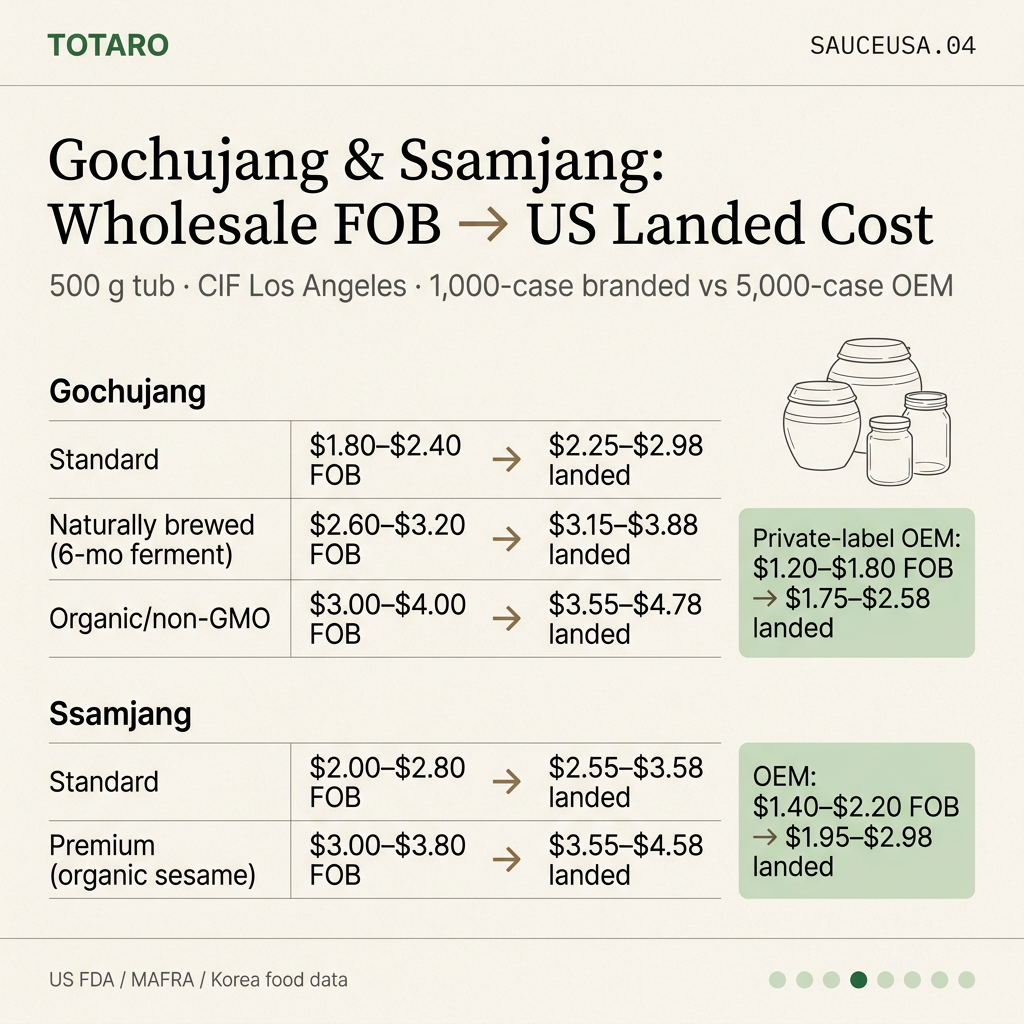
Wholesale FOB Busan pricing (500 g tub, branded, 1,000-case order):
- Standard gochujang: $1.80–$2.40
- Naturally brewed (6-month fermentation): $2.60–$3.20
- Organic/non-GMO: $3.00–$4.00
US landed cost (CIF Los Angeles, 1,000 cases, 20-ft container): Add $0.30–$0.50 per unit for ocean freight, $0.10 for customs brokerage and drayage, $0.05–$0.08 for tariff (HS code 2103.90.90, MFN duty 6.4%). Total landed cost: $2.25–$4.78 per 500 g unit.
Private-label discount: OEM gochujang from Sempio or Haechandle runs $1.20–$1.80 FOB for 5,000-case orders, landing at $1.75–$2.58 in LA.
Ssamjang
Ssamjang is a thick dipping sauce blending doenjang (fermented soybean paste), gochujang, garlic, sesame oil, and sweeteners. Used for Korean BBQ lettuce wraps (ssam) and as a vegetable dip. Shelf-stable, 18-month shelf life.
Wholesale FOB Busan pricing (500 g tub, branded, 800-case order):
- Standard ssamjang: $2.00–$2.80
- Premium (higher doenjang ratio, organic sesame): $3.00–$3.80
US landed cost (CIF LA): $2.55–$4.58 per unit.
Private-label: $1.40–$2.20 FOB for 3,000-case OEM orders (Sempio, Daesang), landing at $1.95–$2.98.
Korean BBQ Sauce
Korean BBQ sauce comes in two main styles: traditional ganjang-based (soy sauce, sesame, garlic, pear) and fusion (gochujang, tomato, brown sugar). Retail bottles are 300–500 ml glass or PET; foodservice is 1.8 L or 5 L jugs.
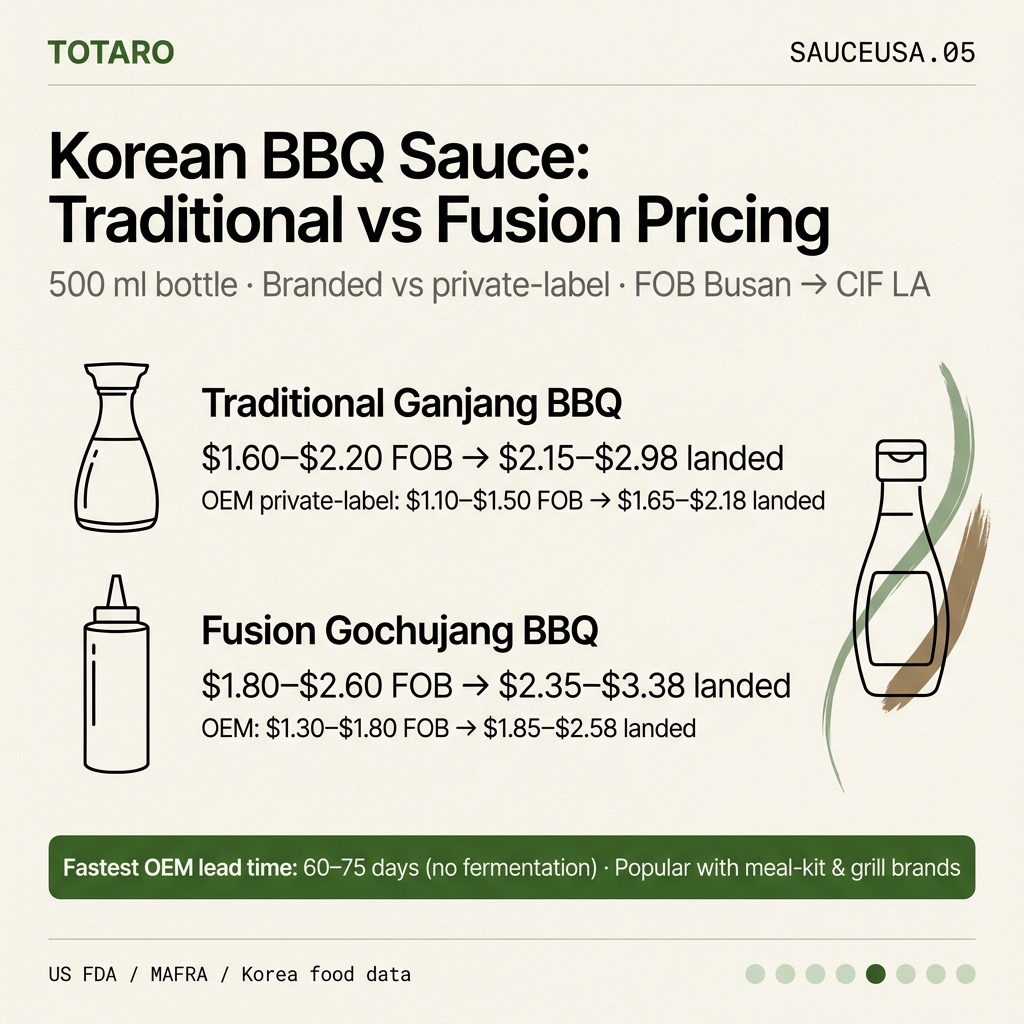
Wholesale FOB Busan pricing (500 ml bottle, branded, 1,000-case order):
- Traditional ganjang BBQ sauce: $1.60–$2.20
- Fusion/gochujang BBQ: $1.80–$2.60
US landed cost (CIF LA): $2.15–$3.38 per bottle.
Private-label: $1.10–$1.80 FOB for 5,000-bottle orders, landing at $1.65–$2.58.
Korean BBQ sauce private label is especially popular with US grill-sauce brands and meal-kit companies. Lead times are shorter (60–75 days) because fermentation is not required, and formulation tweaks (spice level, sweetness) are straightforward.
FDA Compliance, Labeling, and Import Documentation
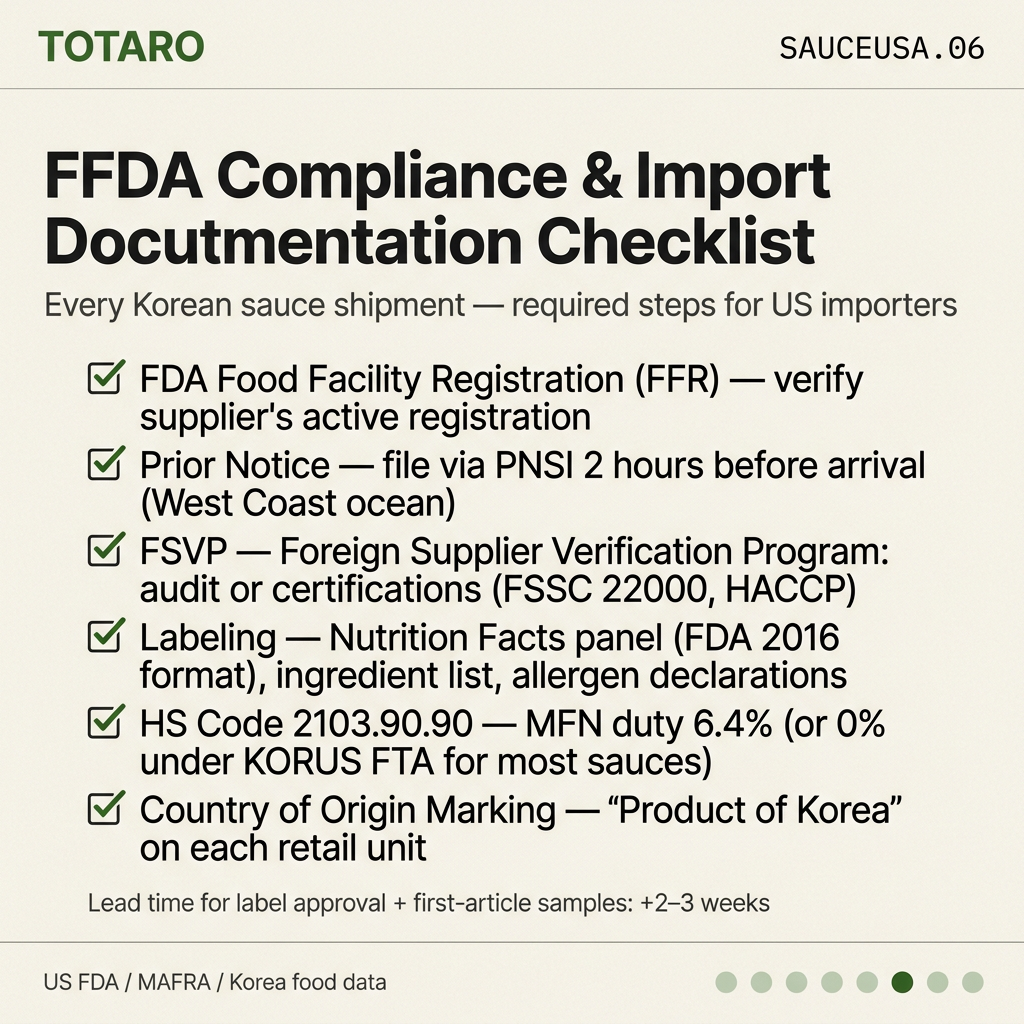
Every Korean sauce shipment to the US requires the same FDA food-import compliance as any other processed food.
FDA Food Facility Registration. The Korean manufacturing facility must be registered with FDA (every even-numbered year renewal). CJ, Sempio, Daesang, Haechandle, and Ottogi all maintain active registrations. Verify your supplier's FFR number before placing an order.
Prior Notice. File electronically via FDA's Prior Notice System Interface (PNSI) or through your customs broker, no later than 2 hours before arrival (ocean cargo to West Coast). Include product description, manufacturer, shipper, and intended US consignee.
Foreign Supplier Verification Program (FSVP). US importers must identify and approve foreign suppliers, evaluate hazards, and conduct supplier verification activities (audits, sampling, or review of supplier food-safety certifications). Larger Korean manufacturers provide FSSC 22000, ISO 22000, or HACCP certificates that satisfy FSVP documentation.
Labeling. All retail-packaged sauces require a compliant Nutrition Facts panel (FDA format, 2016 rules), ingredient list in descending order by weight, allergen declarations (soy, wheat if present), net quantity, and manufacturer/importer name and address. Korean co-packers typically provide label artwork services for OEM clients. Artwork approval and first-article label samples add 2–3 weeks to lead time.
HS code and tariff. Korean sauces generally fall under HS 2103.90.90 ("Sauces and preparations therefor, mixed condiments and mixed seasonings, other"). MFN duty rate is 6.4% ad valorem. Korean goods benefit from the US-Korea Free Trade Agreement (KORUS FTA), which zeroed tariffs on most food products in 2012—but sauces containing over 20% sugar by weight may face higher rates under HS 2103.90.72 (watch fusion BBQ sauces). Verify with your broker.
Country of origin marking. Each retail unit must be marked "Product of Korea" or "Made in Korea" in a conspicuous location. For OEM/private label, the brand owner's US address satisfies the "distributed by" requirement.
Private-Label and OEM Process: Timeline and Costs
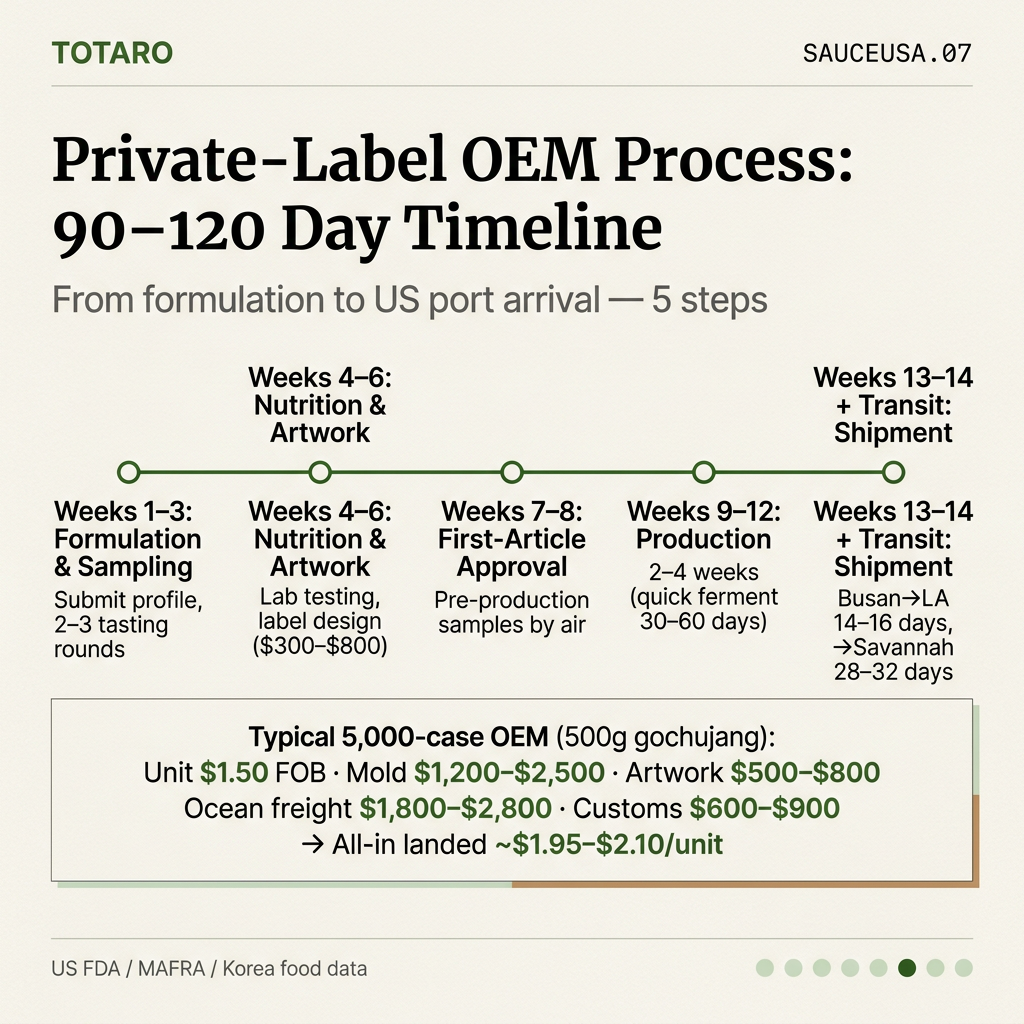
Private-label Korean sauce production follows a standard OEM workflow. Here's what US importers should expect when launching a gochujang, ssamjang, or BBQ sauce under their own brand.
Step 1: Formulation and sampling (Weeks 1–3). Submit your target profile (heat level, sodium, sugar, organic/non-GMO requirements). The manufacturer sends 3–5 samples. Tasting and internal approval typically take 2–3 rounds. If you want to match an existing product, send a reference sample to Korea.
Step 2: Nutritional analysis and artwork (Weeks 4–6). Once the formulation is locked, the factory conducts official nutritional testing (required for the US Nutrition Facts panel). Provide label artwork or request design services. Korean co-packers charge $300–$800 for artwork and nutritional-panel layout. The factory reviews for compliance and sends a digital proof.
Step 3: First-article approval (Weeks 7–8). The manufacturer produces a pre-production run and ships 10–20 labeled samples by air for your final sign-off. This is your last chance to catch label errors or tweak flavor.
Step 4: Production (Weeks 9–12). Full production runs 2–4 weeks depending on order size and fermentation time (gochujang requires longer lead). Sempio's naturally brewed gochujang adds 6 months of fermentation before packaging, but most OEM clients opt for "quick" fermentation (30–60 days) to shorten time-to-market.
Step 5: FDA documentation and shipment (Weeks 13–14). The factory provides commercial invoice, packing list, Bill of Lading, Certificate of Origin (if claiming KORUS FTA preference), COA, and allergen statement. Container is loaded and departs Busan or Incheon.
Ocean transit: Busan to LA/Long Beach is 14–16 days; Busan to Savannah or New York is 28–32 days.
Total timeline: 90–120 days from formulation kickoff to arrival at US port.
Typical OEM costs (5,000-case order, 500 g gochujang):
- Unit cost (FOB): $1.50
- Mold/tooling fee (one-time, if custom tub shape): $1,200–$2,500
- Artwork and nutritional testing: $500–$800
- Ocean freight (20-ft container, Busan–LA): $1,800–$2,800 (2025 rates)
- Customs brokerage and drayage: $600–$900
- Tariff (6.4% if not claiming FTA exemption): ~$480 on a $7,500 shipment
All-in landed cost per unit: ~$1.95–$2.10 for a mid-tier gochujang OEM, compared to $2.40–$3.20 FOB for branded Bibigo or Sempio.
Logistics: Container Load, Ports, and Warehousing
Korean sauce shipments almost always move in 20-ft dry containers (ambient, no refrigeration). A 20-ft container holds roughly 1,200–1,400 cases of 500 g tubs, depending on pallet configuration and case pack.
West Coast (LA/Long Beach, Oakland, Seattle/Tacoma): Preferred for distributors serving California, Southwest, and Pacific Northwest. Transit 14–16 days from Busan. Drayage and warehousing rates are higher than East Coast but transit time is shorter and total landed cost is typically $0.10–$0.20 per unit lower.
East Coast (Savannah, New York/Newark, Norfolk): Better for distributors covering the Southeast, Mid-Atlantic, and Northeast. Transit 28–32 days. Longer lead time but competitive drayage rates and proximity to major population centers.
Midwest (via West Coast + rail or East Coast + truck): Importers serving Chicago, Dallas, or Denver often land at LA/Long Beach and rail to inland intermodal hubs, or land at Savannah and truck north. Total transit can stretch to 21–25 days (West Coast + rail) or 32–35 days (East Coast + truck).
Warehousing. Ambient sauce storage runs $8–$14 per pallet per month in major markets (LA, Atlanta, Dallas, New Jersey). FIFO (first in, first out) is standard. Most 3PLs require advance notice for container unloading ("floor-loaded" containers need hand unloading, which adds $150–$300 to drayage).
Market Trends and SKU Strategy for 2025
Korean sauce importers should watch three trends shaping assortment and positioning in 2025:
Fusion and crossover formats. Gochujang mayo, gochujang ketchup, and Korean BBQ wing sauce are the fastest-growing subcategories. US co-packers are now blending imported gochujang base with domestic mayo and ketchup to shorten supply chains, but importers who bring finished fusion SKUs from Korea capture higher margins and better flavor authenticity.
Clean label and organic. Retailers increasingly demand non-GMO, organic, or "no artificial preservatives" callouts. Haechandle, Sempio, and Daesang all offer USDA Organic–certified gochujang and ssamjang. Organic OEM adds $0.60–$1.00 per unit to FOB cost but commands $2–$3 retail premiums.
Foodservice pack sizes. Fast-casual and QSR chains want 5 kg pails and 18 kg drums with pump dispensers. CJ and Sempio stock these formats and can co-pack private-label foodservice sizes at the same 5,000-unit minimums as retail tubs.
Recommended starter assortment for a regional distributor (6 SKUs):
- Gochujang, 500 g tub (mild and spicy)
- Ssamjang, 500 g tub
- Korean BBQ sauce, 500 ml bottle (traditional and fusion)
- Gochujang, 3 kg pail (foodservice)
This mix covers retail, foodservice, and both traditional and crossover use cases, and fits comfortably in a single 20-ft container order with mixed SKUs.
FAQ
What is the typical MOQ for branded Korean gochujang and ssamjang?
Branded orders from major manufacturers (CJ, Sempio, Daesang, Ottogi) start at 500–1,000 cases per SKU. A mixed-SKU container (gochujang, ssamjang, BBQ sauce) is common for first orders. Private-label/OEM minimums are higher: 2,000–5,000 cases per SKU, depending on the supplier.
Do Korean sauce manufacturers handle FDA labeling and compliance?
Yes. CJ, Sempio, Daesang, Haechandle, and Ottogi all maintain FDA-registered facilities and provide English-language COAs, allergen statements, and nutritional data. For OEM, most offer label-design services ($300–$800) and will produce artwork that meets FDA Nutrition Facts and allergen-labeling rules. Final label approval and compliance remain the US importer's responsibility under FSVP.
How long is the shelf life, and is refrigeration required?
Gochujang and ssamjang have 18–24 months shelf life, ambient storage. Korean BBQ sauce is 12–18 months, also ambient. No cold chain is needed for import or distribution, which simplifies logistics and reduces cost versus kimchi or fresh products.
What is the landed cost difference between branded and private-label gochujang?
Branded gochujang (500 g) from Bibigo or Sempio lands in LA at roughly $2.25–$3.20 per unit (1,000-case order, CIF + duty). Private-label gochujang from the same factories lands at $1.75–$2.10 per unit (5,000-case OEM order). The $0.50–$1.10 difference per unit drives strong interest in private label among regional distributors and emerging retail brands, especially when retail price points can remain competitive with national brands.
Related Guides
Ask AI to find your Korean food supplier
Describe what you need in plain language — get matched with verified suppliers in seconds.
Try AI Supplier Search