카드 1 / 8
Korean Food & Beverage Sourcing Partner — B2B Buyer Guide
Korean B2B Food Sourcing — A Buyer's Playbook
Korean food exports hit $13.05B in 2024 (MAFRA), led by ramen, snacks, sauces, and seaweed. The category grows 8–12% annually, but most international buyers still struggle to source efficiently. This guide walks through the practical B2B mechanics — platforms, verification, MOQ negotiation, and what changed in 2026.
Who searches "korean b2b"
Three buyer profiles dominate:
- First-time importers — small distributors in SEA, Middle East, Latin America entering K-Food with one container per quarter
- Existing US/EU buyers — adding a Korean SKU after seeing Asian-fusion demand spike
- Retail private-label teams — Costco / Whole Foods / Trader Joe's sourcing teams looking for OEM partners
Different intents, but they all ask the same first question: which platform do I use, and how do I verify the supplier?
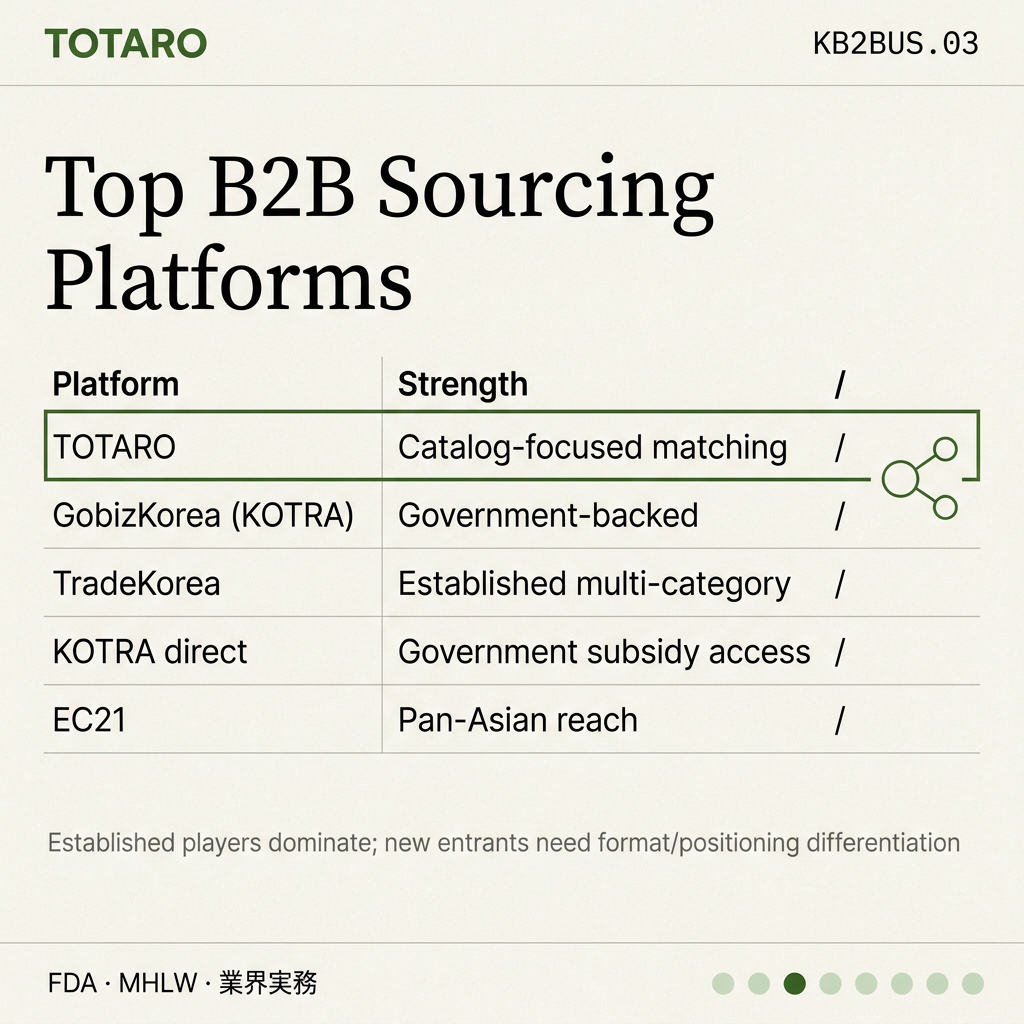
B2B sourcing platforms — quick comparison
| Platform | Supplier count | Languages | AI matching | Best for |
|---|---|---|---|---|
| TradeKorea (KITA) | ~80k | EN, KO | No | Established trade shows, government-backed |
| GobizKorea (KOTRA) | ~70k | EN, KO, JP, CN | No | SME exporters with KOTRA support |
| TOTARO | 44k+ verified food-only | EN, KO, JP | Yes (AI) | Food-specific, faster matching |
| Alibaba (Korean Pavilion) | ~30k | EN, multi | Limited | Generic, mixed quality |
| Direct factory contact | — | KO (mostly) | — | Once you know who to trust |
Reality check: Generic platforms list everyone, including paper companies. Food-specific platforms (like TOTARO) filter for HACCP and export track record up-front — saving 2–3 weeks of due diligence.
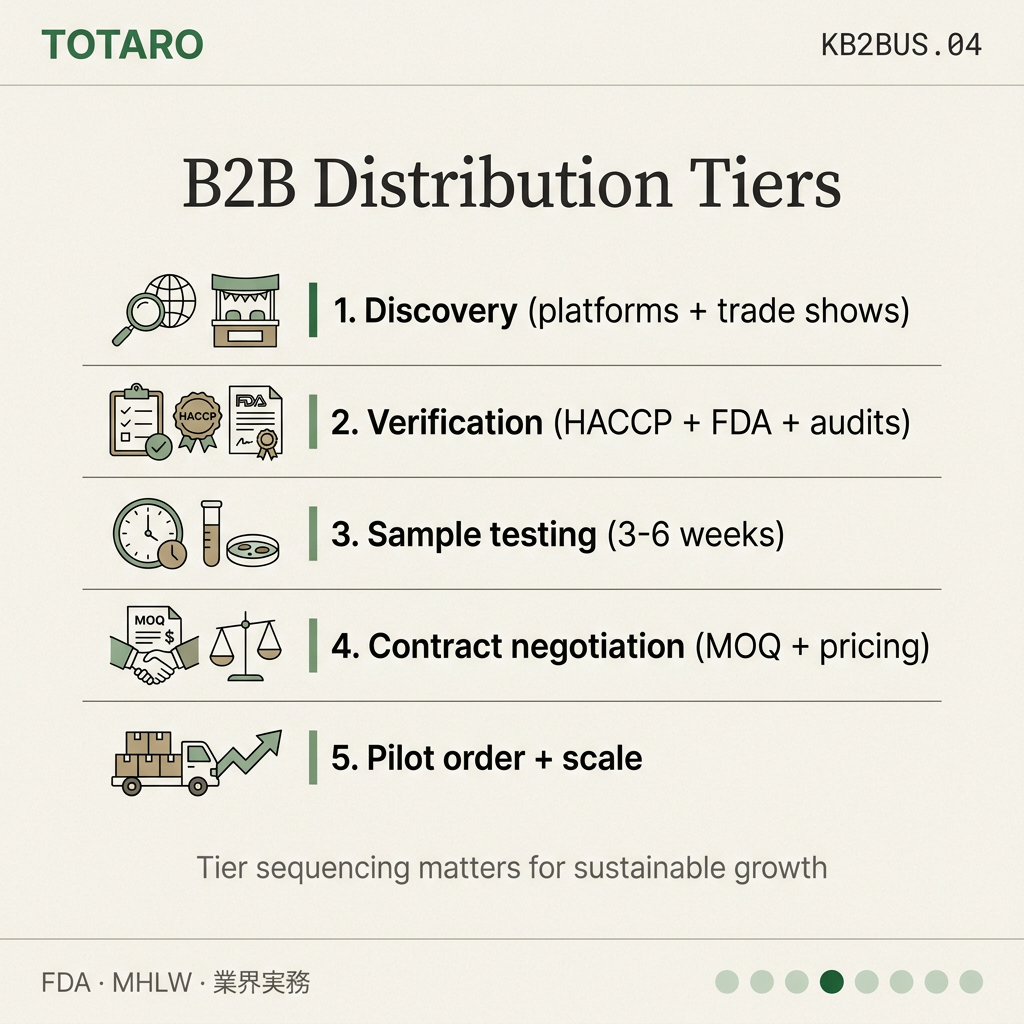
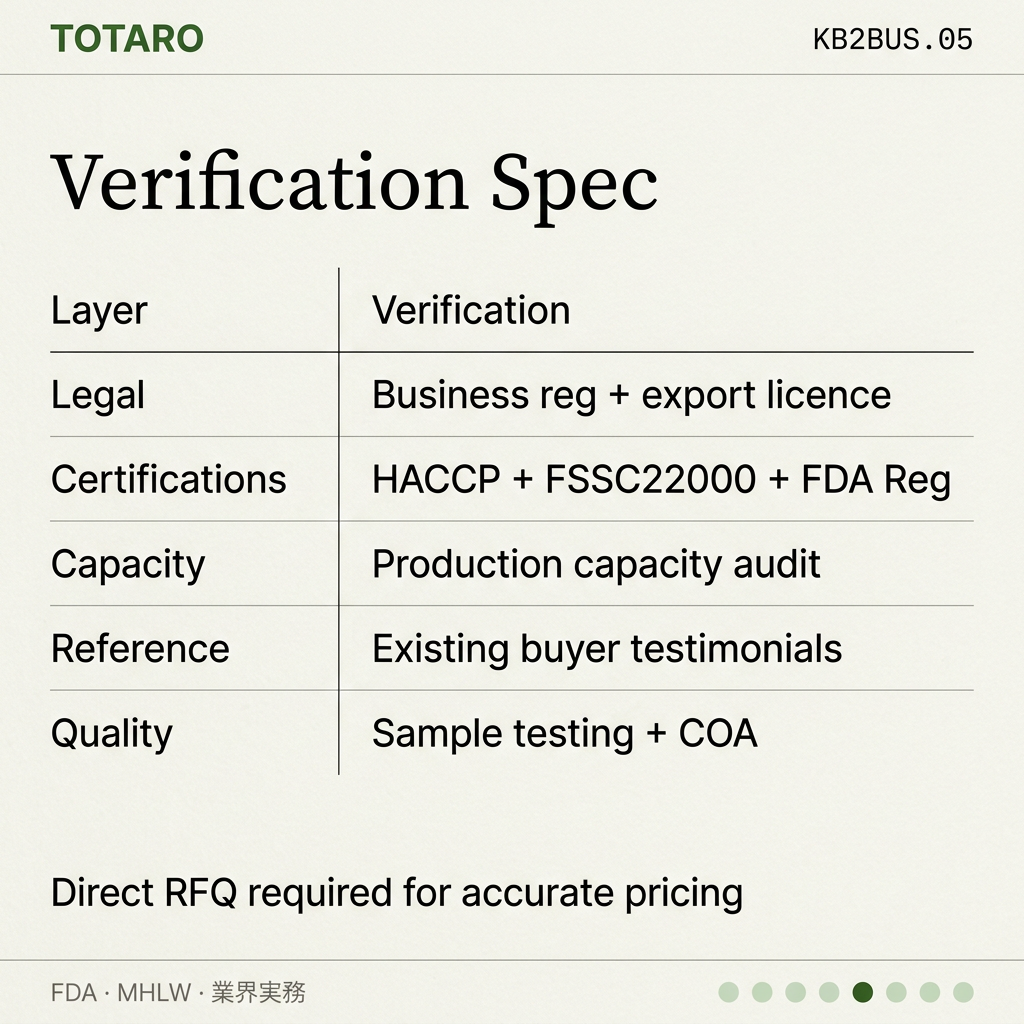
Step 1 — Verify the supplier in 5 minutes
Before any quote request, verify in this order:
- Business registration — search the company's Korean business registration number (사업자등록번호) on NTS Hometax. Real factories have ≥ 5 years of filings.
- HACCP certification — verify directly on MFDS. The certificate must list the same factory address (not a head office).
- Export track record — search the Korean Customs Service (UNI-PASS) by HS code + company name. No export history = high risk.
- Facility evidence — request a real-time video walkthrough of the production line. Paper companies cannot do this.
- Financial credibility — KISLINE or NICE credit report for any order over $50k.
For a deeper checklist, see our supplier verification 5-minute checklist.
Step 2 — MOQ realities by category
| Category | Standard MOQ | Negotiable to | Notes |
|---|---|---|---|
| Ramen / instant noodles | 1 × 40HC (~20,000 cases) | 500 cases LCL | Big 3 (Nongshim, Samyang, Ottogi) firm |
| Snacks (Card-news favorites) | 5,000 cartons | 500 cartons | OEM more flexible than brand |
| Gochujang / sauces | 5,000 bottles | 500kg bulk | Private label easier than brand |
| Kimchi (refrigerated) | 1 × 20'RF | 200 cases air | Cold chain limits flexibility |
| K-Health drinks (functional) | 10,000 bottles | 2,000 bottles | Regulatory cost dominates |
MOQ tip: Ask for the first-order MOQ separately. Many factories cut MOQ in half for the first PO if you commit to a second order within 6 months.
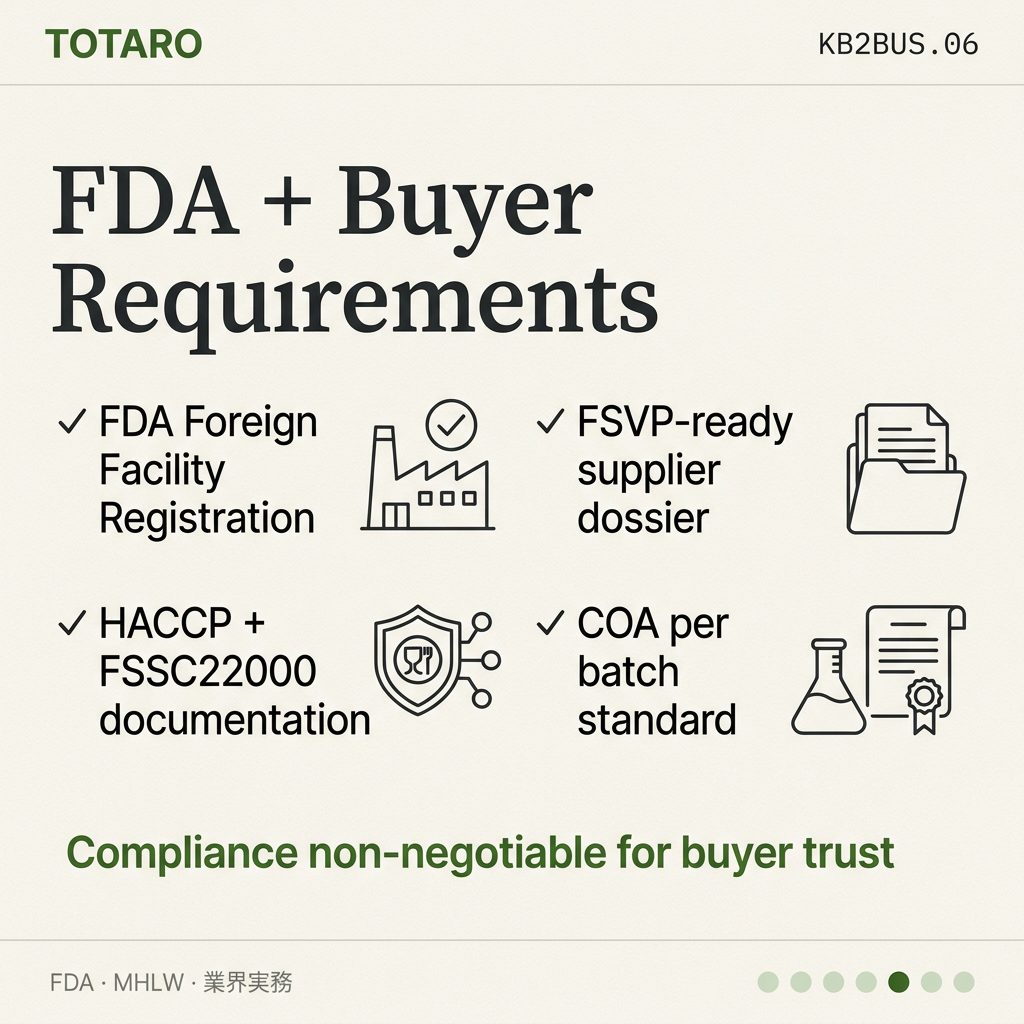
Step 3 — Certifications buyers care about (2026)
| Buyer type | Required | Nice to have |
|---|---|---|
| Whole Foods, Costco US | FSSC 22000, USDA Organic where applicable | Non-GMO Project, Halal |
| Standard US supermarkets | HACCP, FDA registration | Allergen statements |
| EU importers | HACCP, EU FSSC 22000 | Reg. 1169/2011 compliant labels |
| Japan AEON / Don Quijote | JFS-C, FSSC 22000 | Japanese-language packaging |
| Middle East / SEA | HACCP, Halal (KMF or JAKIM) | ISO 22000 |
See the comparison breakdown in HACCP vs FSSC22000 — which to require.
Step 4 — Negotiation tactics that actually work
- Anchor on annual volume, not first PO — Korean factories quote much better unit prices when you commit to 4 POs/year vs. 1 PO/year, even if total volume is the same.
- Pay 30/70, not 100% up-front — standard for established Korean exporters with track record. Insist on it.
- FOB Busan, not EXW factory — you control freight, the factory handles port + Customs export. Lower friction.
- Letter of credit (L/C) for orders > $100k — protects both sides. Many Korean banks offer expedited L/C for K-Food exporters.
- Translation-of-record clause — only the Korean contract version is legally binding in Korea. Add a clause that the English version is the operative one for your jurisdiction.
2026 trends worth watching
- MFDS Differential HACCP scheme (2025) — Korean factories now scored on tiered HACCP performance. Tier 1 = export-ready. Always ask which tier.
- K-Health functional beverage boom — ginseng, collagen, fermented teas. $400M+ category, growing 22%/year. EU EFSA Novel Food approval becoming a competitive moat.
- Halal expansion — Nongshim, Samyang, Daesang now offer dedicated halal SKUs for SEA + Middle East. Production lines separated.
- AI matching — buyers who use AI-powered platforms (like TOTARO) report cutting sourcing time from 3–4 weeks down to under 7 days.
Where TOTARO fits
TOTARO is purpose-built for Korean food B2B. Specifically:
- 44,000+ verified suppliers, food-only (no general goods)
- AI matching against your spec (category, MOQ, certifications, country fit) in seconds
- 30+ buyer countries already onboarded
- Free entry — buyers don't pay platform fees
FAQ
Q. Is Korean food B2B different from Chinese or Japanese B2B? Yes. Korean exporters are smaller-scale than China but more standardized than Japan. Most factories handle one specialty very well; you'll source from 3–5 factories, not one mega-supplier.
Q. What's the minimum budget for a first import? Realistically $5k–10k for an LCL trial order. Full container (20'GP) sourcing starts around $25k–40k landed.
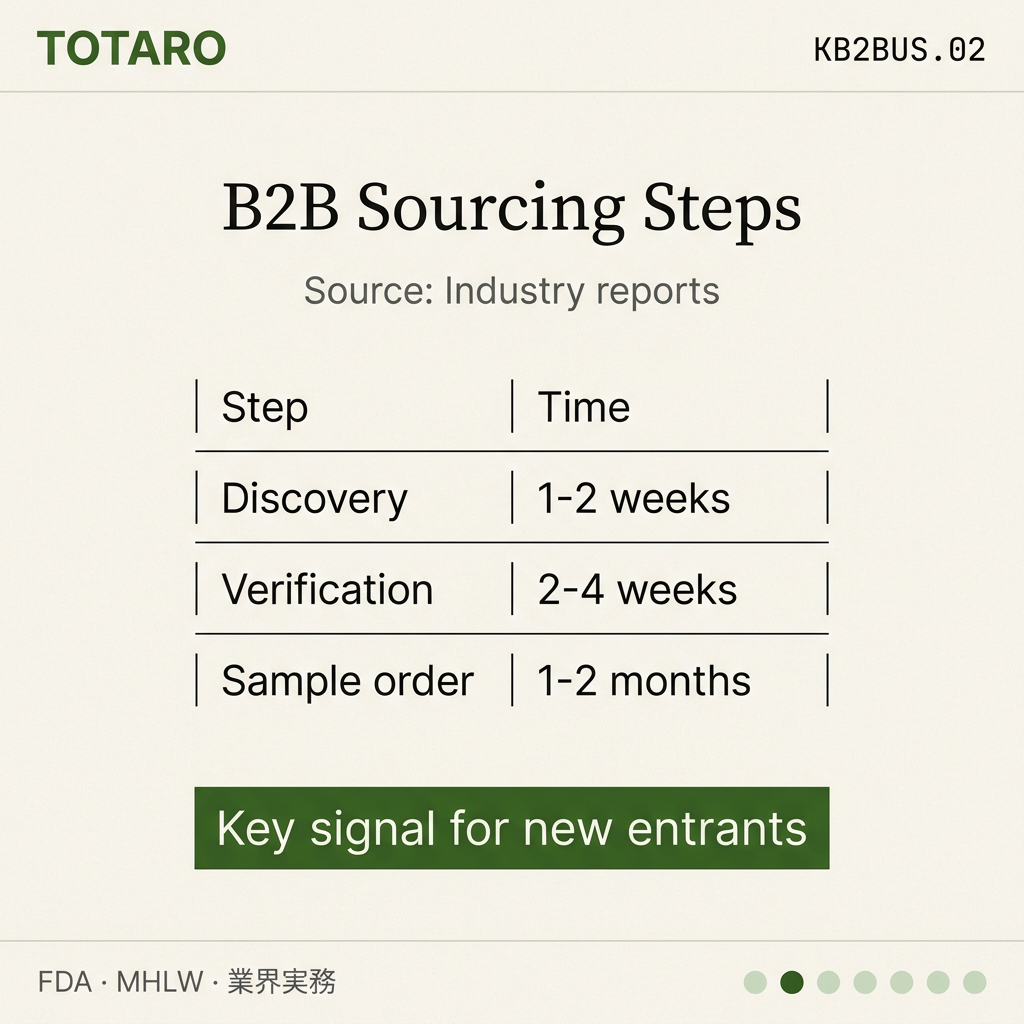
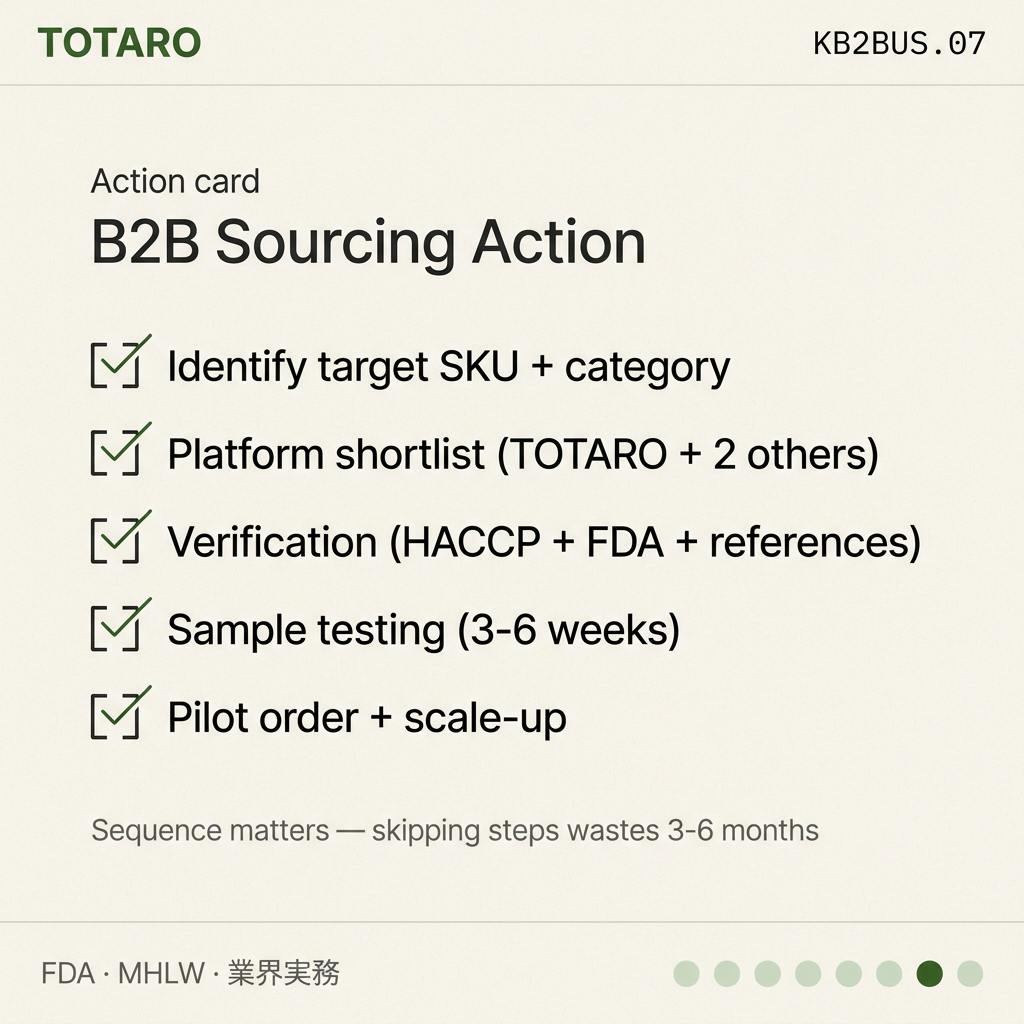
Q. How long does first sourcing take? Without an AI platform: 4–6 weeks (find → verify → quote → sample → contract). With AI matching: typically 7–10 days to verified quotes.
Q. What's the biggest risk? Paper companies and middlemen pretending to be factories. Always verify HACCP cert points to a real production facility, and ask for a video walkthrough.
Related Guides
Ask AI to find your Korean food supplier
Describe what you need in plain language — get matched with verified suppliers in seconds.
Try AI Supplier Search