카드 1 / 8
Korean RTD Cocktails — US B2B Import Guide (Verified)
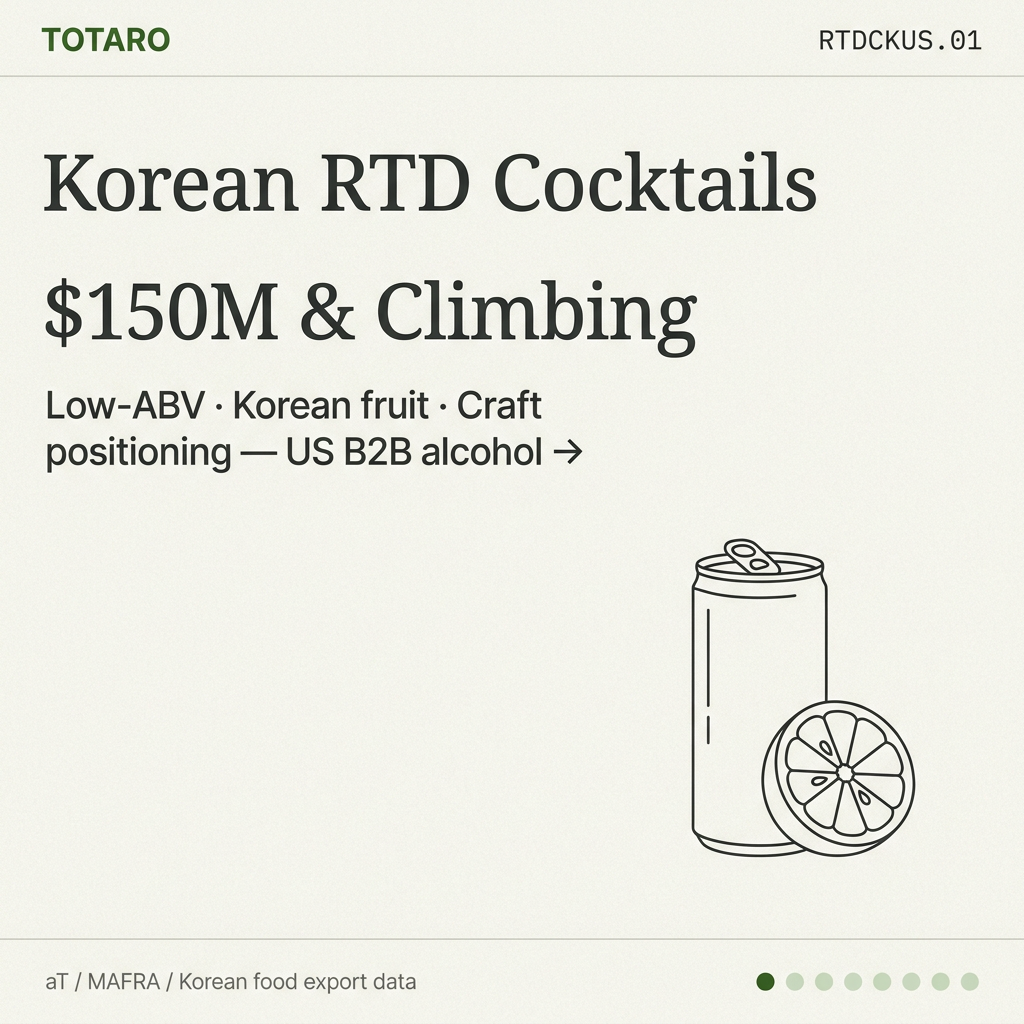
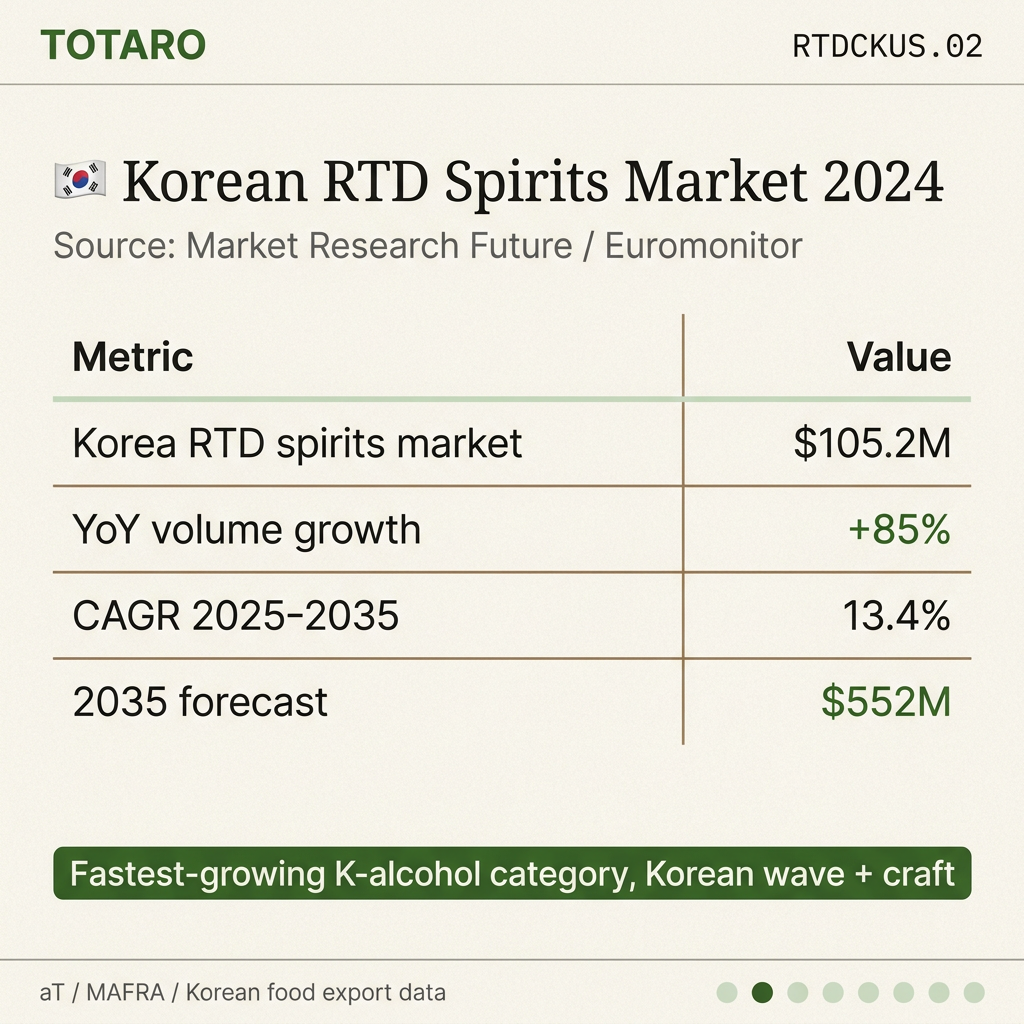
South Korea's RTD spirits market reached $105.2M in 2024 (Market Research Future, 2024) and is projected to grow from $138M in 2025 to $552M by 2035 (CAGR 13.4%). Total RTD volume sales jumped +85% YoY in 2024 (Euromonitor 2024) — making it the fastest-growing category in Korean alcoholic drinks. For US distributors and retailers, Korean RTD offers a Korean Wave-amplified differentiation slot in an increasingly crowded RTD category dominated by High Noon, Truly, and White Claw.
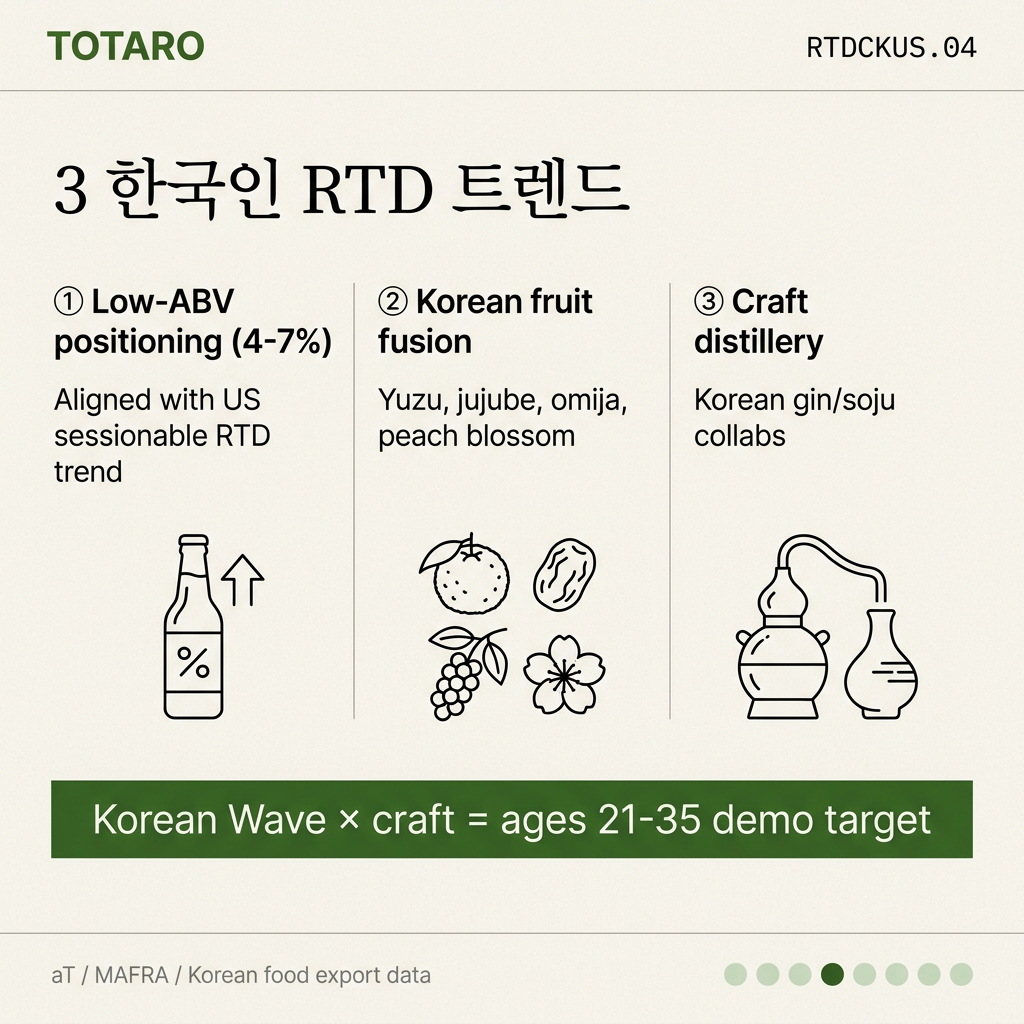
Three Trends in Korean RTD Cocktails
① Low-ABV positioning (4-7%) — matches US 'sessionable' RTD trend, growth driven by younger consumers of legal drinking age (Euromonitor 2024). ② Korean fruit fusion (yuzu, jujube, peach blossom, omija) — provides differentiation from US fruit RTDs. ③ Craft distillery collaborations — Korean gin and soju from emerging distilleries positioned as premium ABV/craft category.
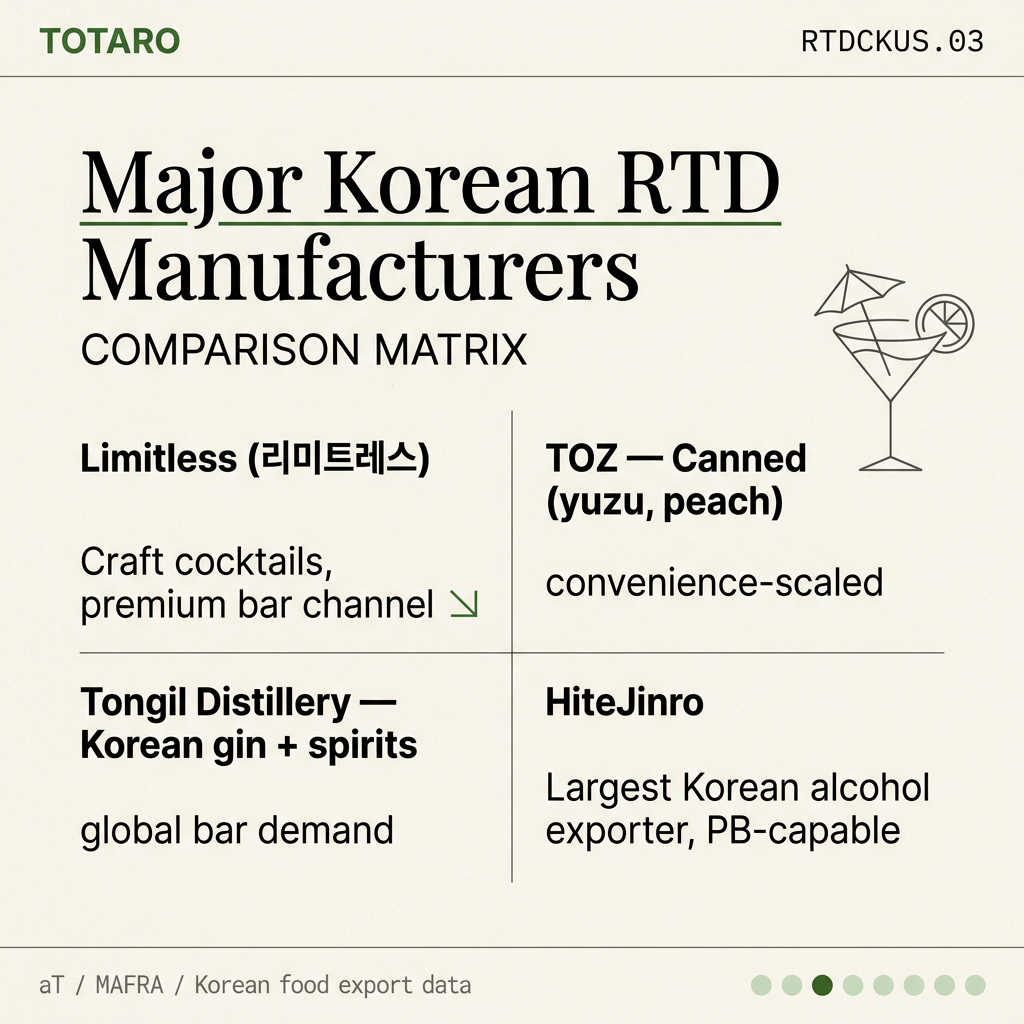
Major Korean Manufacturers
| Manufacturer | Specialty | Position |
|---|---|---|
| Limitless (리미트레스) | Craft cocktails | Premium, design-led, bar-channel |
| TOZ | Canned (yuzu, peach) | Convenience-channel scaled |
| Tongil Distillery | Korean gin + spirits | Spirits base, global bar demand |
| Jeju Beer | Craft beer cocktails | Jeju Island brand, export-strong |
| HiteJinro | Major RTD soju cocktails | Largest Korean alcohol exporter, PB-capable |
(Manufacturer details — brand websites not yet primary-verified for spec data; treat MOQ ranges below as industry estimates pending direct supplier quotes.)
US Federal Regulatory + Excise Tax Structure
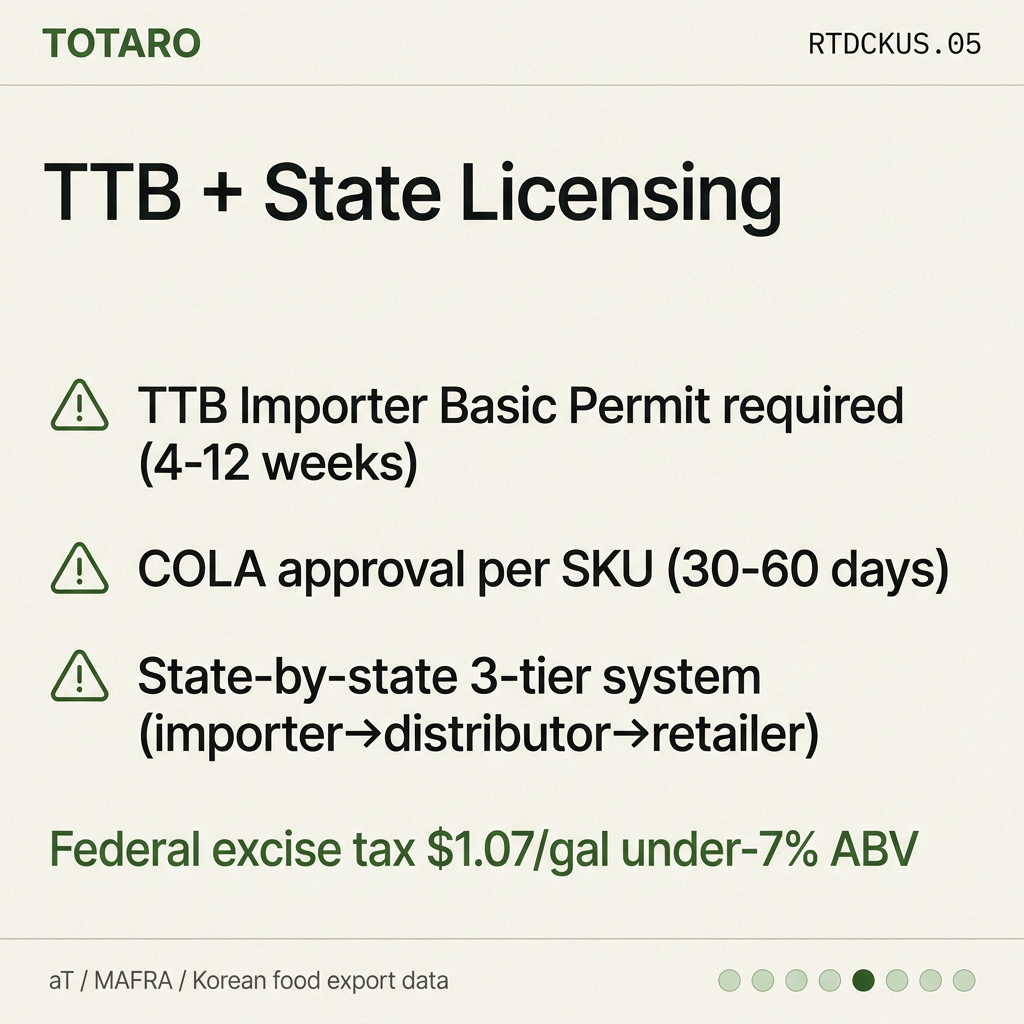
US alcohol import requires: ① TTB (Tax and Trade Bureau) Importer Basic Permit (federal), ② Certificate of Label Approval (COLA) for each SKU, ③ state-by-state licensing under three-tier system (importer → distributor → retailer) in most states.
Federal Excise Tax — Varies by Base Type
Source: TTB Tax Rates 2018-Present (official)
| Base Type | General Rate | CBMA Reduced (First Tier) |
|---|---|---|
| Distilled spirits (soju, gin, vodka base) | $13.50/proof gallon | $2.70/proof gal (first 100,000) |
| Beer-based RTD (malt) | $18.00/barrel | $3.50/barrel (first 60,000) |
| Wine-based (≤16% ABV) | $1.07/gallon | $0.07/gal effective (first 30,000) |
| Sparkling wine | $3.40/gallon | $2.40/gal effective (first 30,000) |
Most Korean RTDs use spirits base (soju, gin, vodka) — assume $13.50/proof gallon general rate unless CBMA reduced rate is appropriately assigned to your importer per Craft Beverage Modernization Act provisions.
Note: Federal excise tax applies per proof gallon of pure alcohol, not per finished volume. A 355ml can at 8% ABV contains ~0.0075 proof gallons → ~$0.10/can FET at general spirits rate.
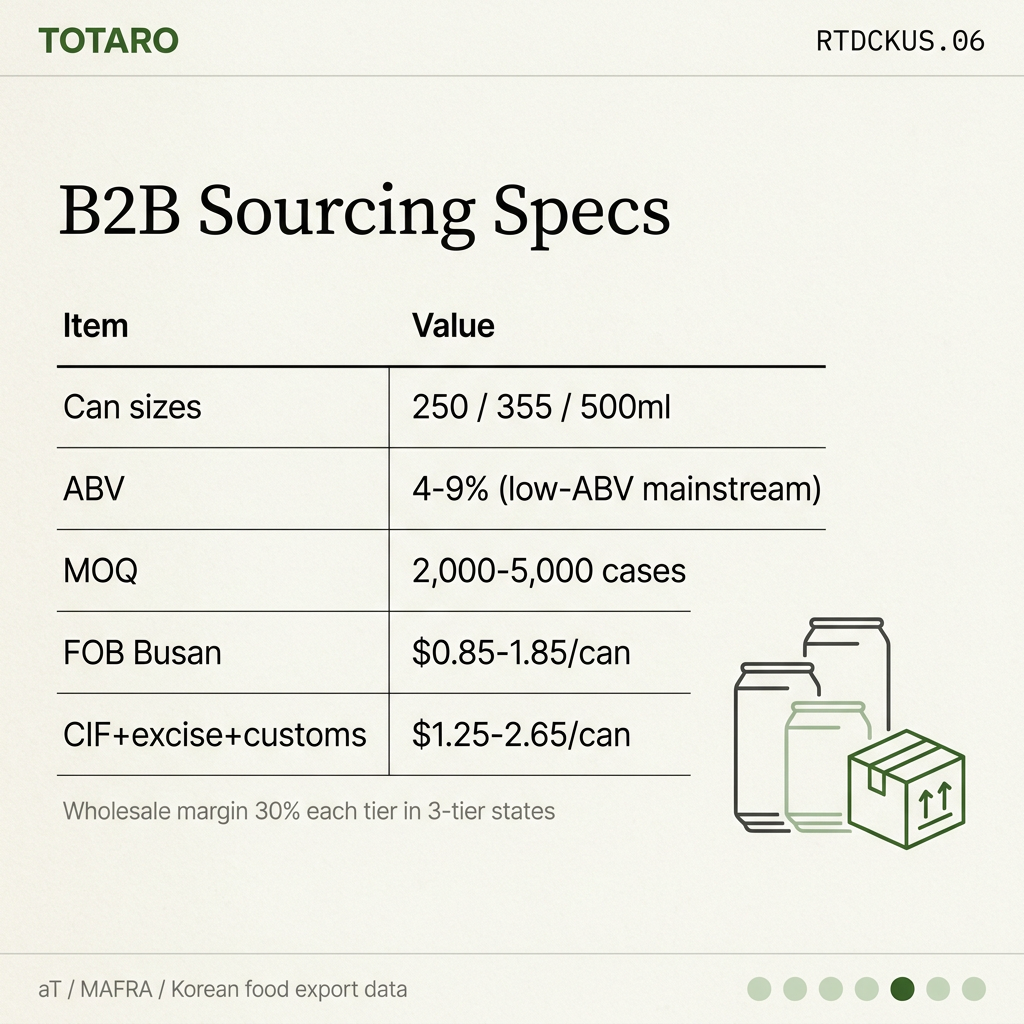
B2B Sourcing Specs (Industry Estimates)
| Item | Value |
|---|---|
| Can sizes | 250 / 355 / 500ml |
| ABV range | 4-9% (low-ABV mainstream) |
| MOQ | 2,000-5,000 cases (industry estimate) |
| FOB Busan | $0.85-1.85/can (estimate, requires direct supplier quote) |
| CIF+excise+customs | $1.25-2.65/can (calculation depends on base type) |
(MOQ and FOB ranges marked as estimates per the harness rule — verify directly with each Korean supplier.)
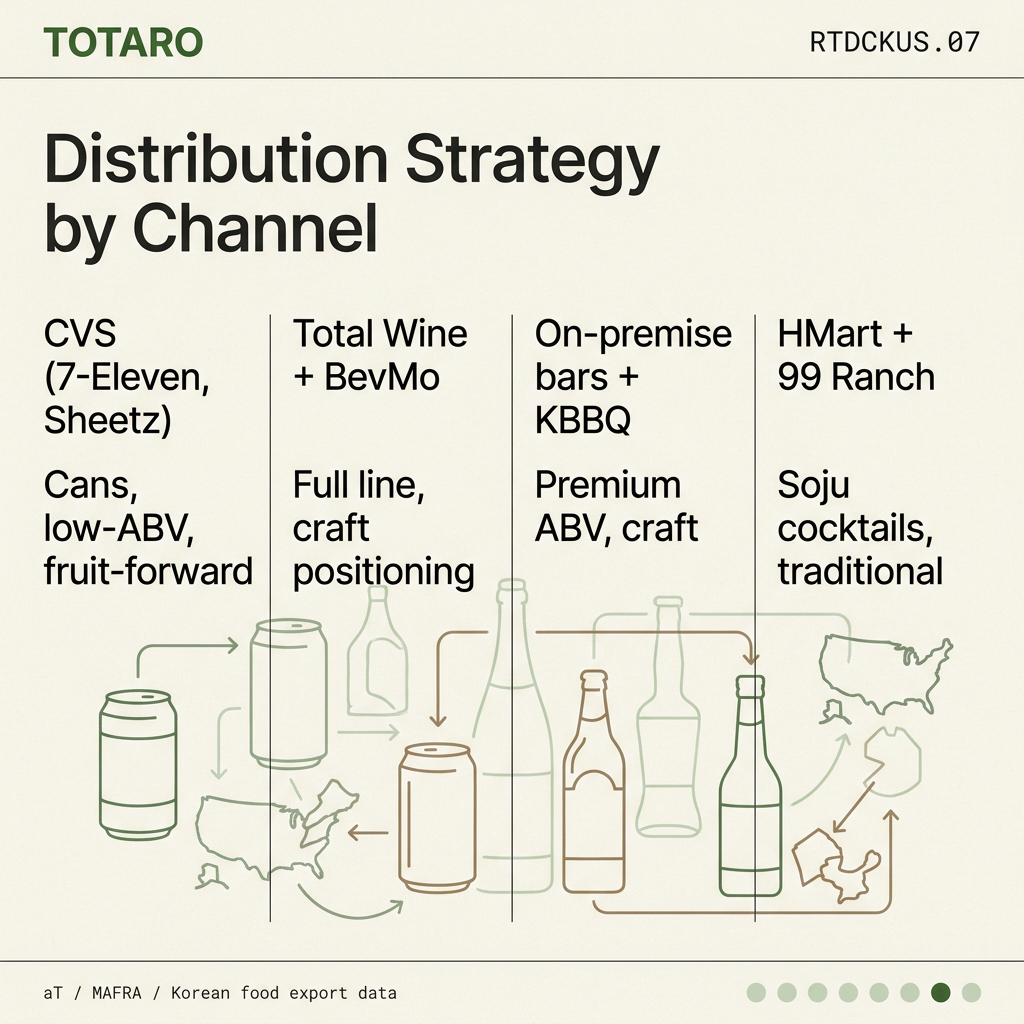
US Distribution Channel Strategy
| Channel | SKU Approach |
|---|---|
| Convenience (7-Eleven, Sheetz) | Cans, low-ABV, fruit-forward |
| Off-premise specialty (Total Wine) | Full line, craft positioning |
| On-premise bars/KBBQ | Premium ABV, craft, design-led |
| Asian-American grocery (HMart) | Soju cocktails, traditional appeal |
State-by-state three-tier markup ~30% per tier in most states.
State Tax Classification Considerations
States classify RTD by base alcohol type with substantial variation. Spirits-based RTDs typically face higher state excise + retail restrictions than malt-based. See Avalara RTD classification guide (2023) for state-by-state breakdown.
Recent federal tax reform discussion: Tax Foundation Alcohol Tax Modernization analysis — note potential rate changes pending congressional action.
FAQ
Q1. How long does TTB Importer Basic Permit take? A. Application processing typically 4-12 weeks per TTB (verify current timeline at TTB Importer Permits). Requires business registration, owner background check, and bond posting. Engage a beverage law specialist firm.
Q2. Is the COLA process per-SKU? How long? A. Yes, each unique label requires COLA approval. Processing typically 30-60 business days from submission per TTB. Korean manufacturers can prepare US-compliant labels for review.
Q3. CBMA reduced rate — how to claim? A. Foreign producer must assign reduced rate to US importer via TTB-prescribed forms. Importer files for refund after import. See TTB CBMA implementation for current refund procedures.
Q4. Low-ABV (under 0.5%) non-alcoholic versions — regulatory path? A. Under 0.5% ABV is regulated as a beverage (not alcohol) and bypasses TTB licensing. Korean manufacturers offer 'adult non-alcoholic' positioning lines — relevant for sober-curious consumer markets.
This article verified with TTB, Market Research Future, Euromonitor, Avalara, and Tax Foundation 1차 sources. MOQ/FOB ranges marked as industry estimates pending direct supplier quotation.
Sources
Related Guides
Ask AI to find your Korean food brand
Describe what you need in plain language — get matched with verified brands in seconds.
Try AI Brand Search