카드 1 / 8
Korean RTD Beverage Import: FDA Rules & Bulk Sourcing
The US RTD (ready-to-drink) beverage market hit $36.8 billion in 2023, and Korean RTD products—especially barley tea, yuzu drinks, sparkling yogurt, and aloe vera juice—are claiming shelf space in Whole Foods, H Mart, and independent grocery chains across the country. For US importers and distributors, Korean RTD beverages offer proven consumer appeal, clean-label positioning, and healthy margins. But bulk sourcing means navigating FDA beverage rules, container logistics, and Korean supplier MOQs that often start at 1,000 cases.
This guide covers the regulatory framework, sourcing structure, shipping logistics, and supplier landscape for US buyers importing Korean RTD beverages at scale.
Why Korean RTD Beverages Are Growing in the US Market
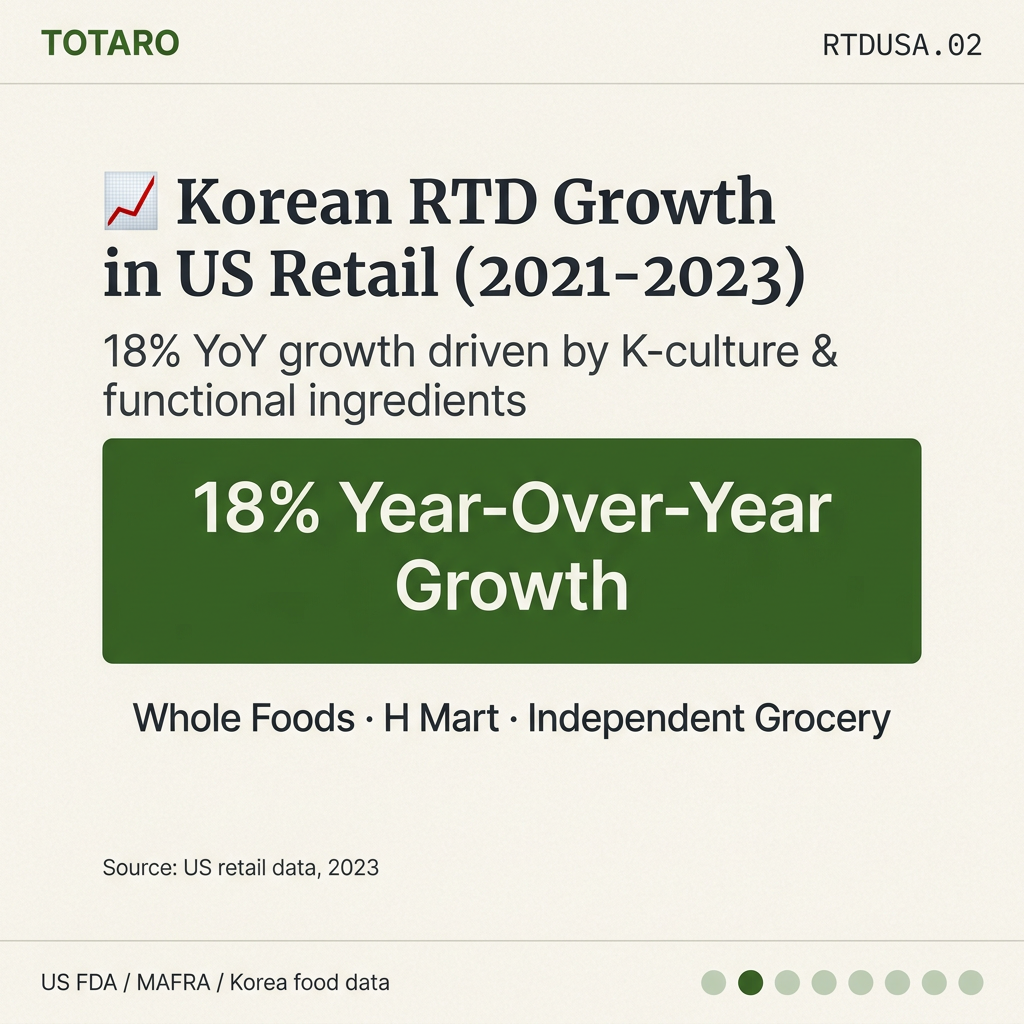
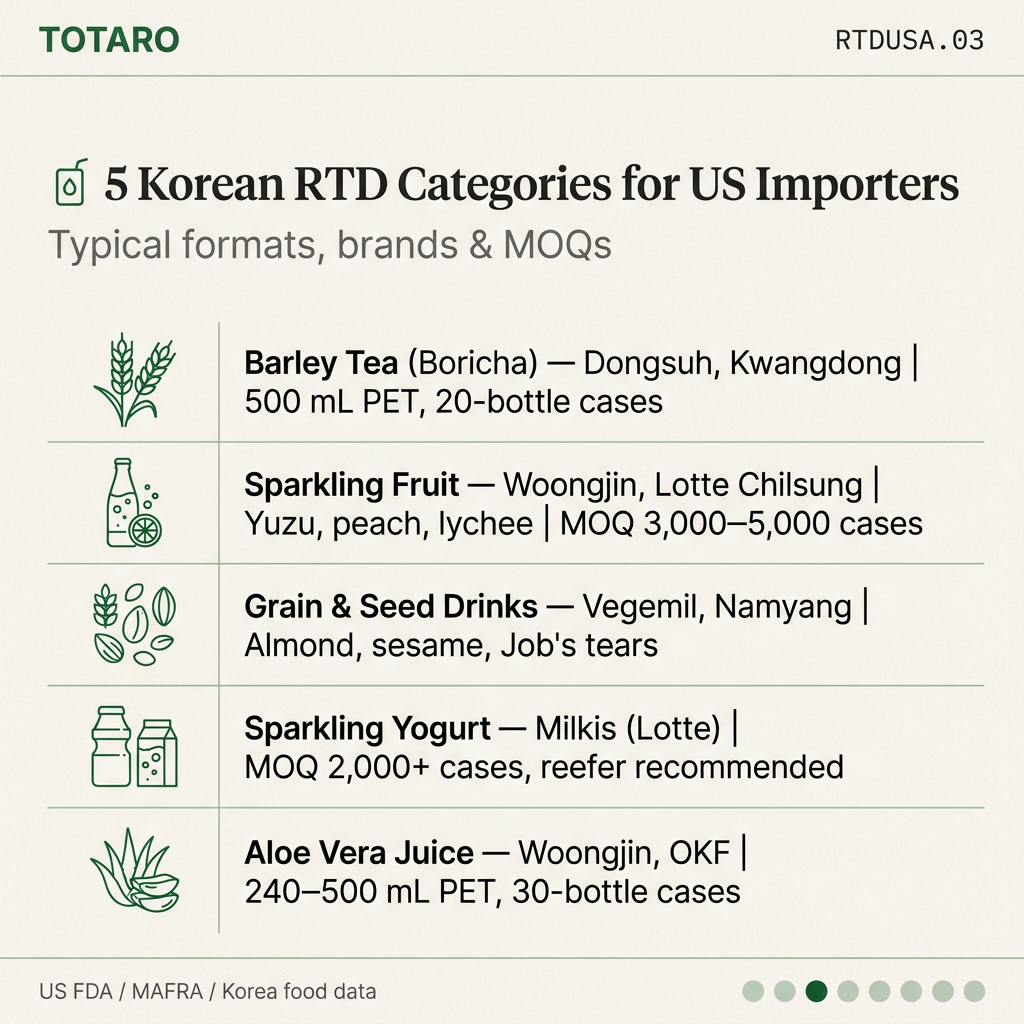
Korean RTD beverages grew 18% year-over-year in US retail between 2021 and 2023, driven by K-culture awareness and functional ingredient trends. Popular categories include:
Barley tea (boricha): Unsweetened, zero-calorie, shelf-stable. Brands like Dongsuh and Kwangdong dominate. Typical retail format: 500 mL PET bottle, 20-bottle cases.
Fruit-flavored sparkling drinks: Yuzu, peach, lychee. Woongjin and Lotte Chilsung lead. MOQ typically 3,000–5,000 cases per SKU.
Grain & seed drinks: Almond, black sesame, Job's tears. Vegemil and Namyang are the legacy producers. These require ambient or cold-chain depending on formulation.
Sparkling yogurt drinks: Milkis (Lotte), Yakult-style formats. MOQ 2,000+ cases, reefer container recommended for long transit.
Aloe vera juice: Woongjin Aloe and OKF dominate US distribution. Shelf-stable PET bottles, 240 mL or 500 mL, 30-bottle cases common.
US buyers value Korean RTD for clean labels, low or zero sugar options, and functional positioning—terms like "roasted barley," "fermented," and "collagen" resonate with health-conscious consumers.
FDA Beverage Regulations for Korean RTD Imports
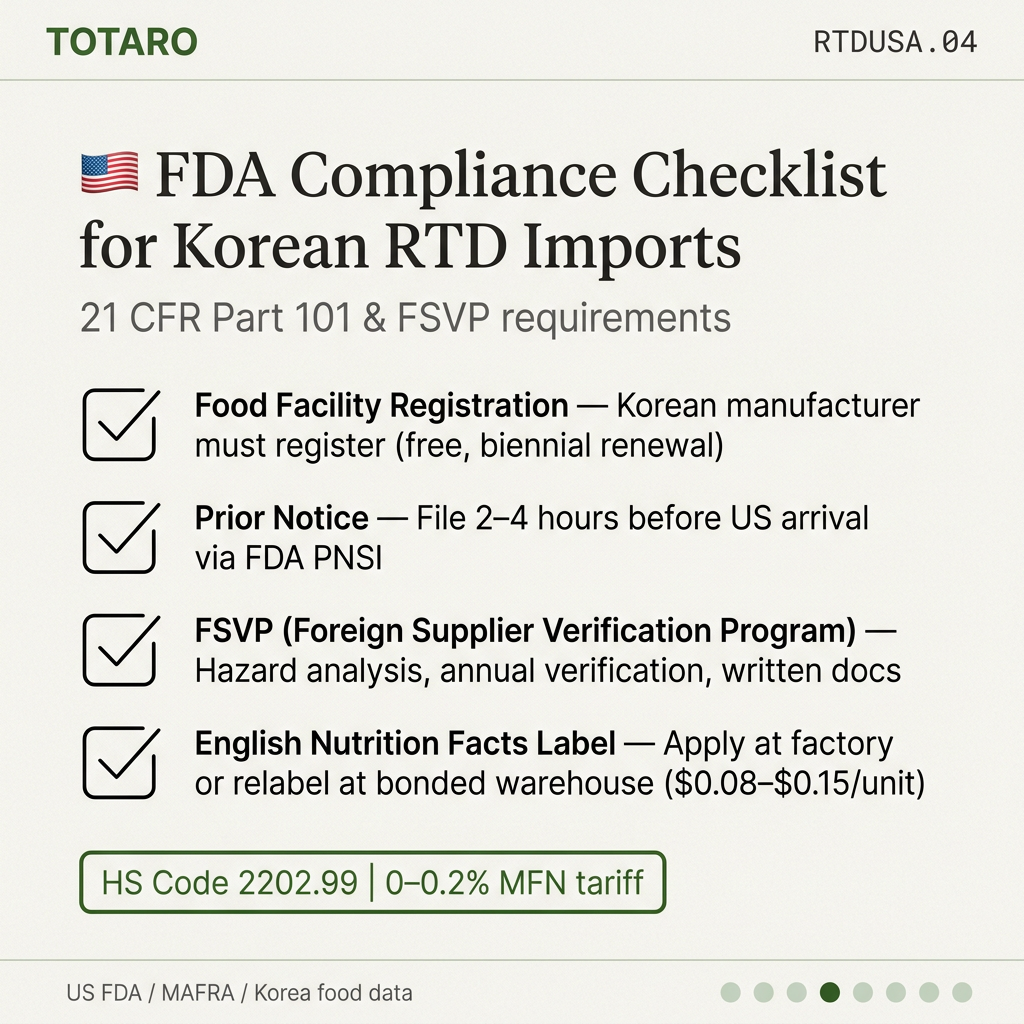
All Korean RTD beverages entering the US must comply with FDA food facility registration, prior notice, FSVP (Foreign Supplier Verification Program), and labeling rules under 21 CFR Part 101.
Food Facility Registration & Prior Notice
The Korean manufacturer or co-packer must register with FDA as a food facility. Registration is free and valid for biennial renewal. The US importer (or customs broker) submits prior notice via the FDA Prior Notice System Interface (PNSI) at least 2 hours before arrival (for truck) or 4 hours (for ocean freight at US port).
FSVP Requirements
As the US importer of record, you must establish a Foreign Supplier Verification Program under 21 CFR Part 117 Subpart G. This means:
- Hazard analysis of the product and supplier
- Annual supplier verification (audits, certificates of analysis, or sampling)
- Written FSVP documentation
Most mid-size importers hire a third-party FSVP agent (cost: $500–$1,500/year per supplier). Large Korean RTD manufacturers—Lotte Chilsung, Woongjin, Namyang—typically hold FSSC 22000 or ISO 22000 certification, which satisfies most FSVP verification requirements.
Nutrition Labeling & Ingredient Compliance
Korean RTD beverages must carry a compliant Nutrition Facts label in English before entering US commerce. The Korean exporter can apply bilingual labels at the factory, or the US importer can relabel at a bonded warehouse or port facility (cost: $0.08–$0.15 per unit).
Key compliance points:
- Sugar content: If the product uses sweeteners (stevia, erythritol, allulose), the label must reflect updated FDA sugar and added sugar definitions.
- Color additives: Korean products sometimes use caramel color or gardenia extract. Verify FDA color additive approval (21 CFR Part 73, 74).
- Health claims: Terms like "probiotic," "antioxidant," or "immune support" require FDA substantiation. Most importers avoid structure/function claims and stick to nutrient content claims ("zero sugar," "high fiber").
HS code for most Korean RTD beverages: 2202.99 (non-alcoholic beverages, not fruit/vegetable juice). Standard MFN tariff: 0%–0.2% depending on sweetener content. Always confirm with your customs broker.
Bulk Sourcing Structure: MOQs, Pricing, and Payment Terms
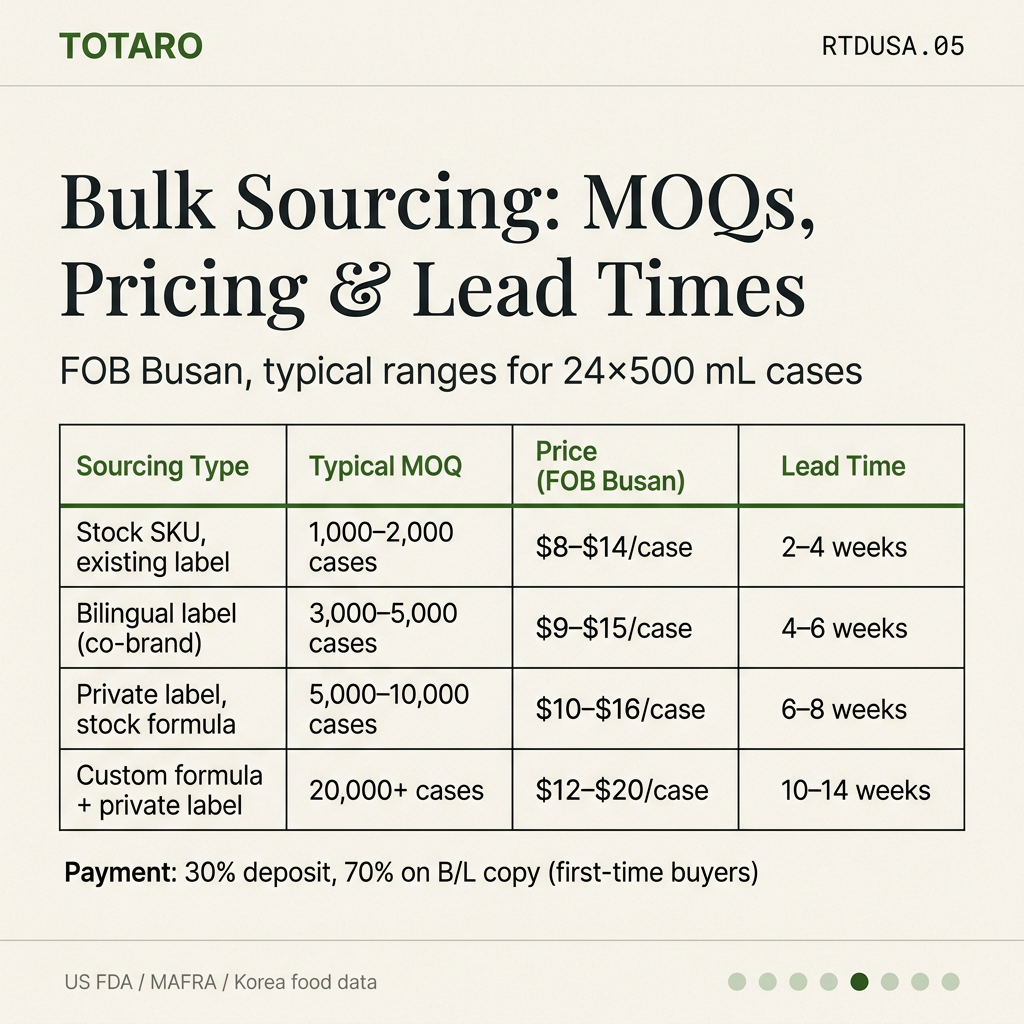
Korean RTD beverage suppliers operate on a tiered MOQ structure. Minimum order quantities increase when you request private label or formula customization.
| Sourcing Type | Typical MOQ | Price Range (FOB Busan) | Lead Time |
|---|---|---|---|
| Stock SKU, existing label | 1,000–2,000 cases | $8–$14 per case (24×500 mL) | 2–4 weeks |
| Bilingual label (co-branding) | 3,000–5,000 cases | $9–$15 per case | 4–6 weeks |
| Private label, stock formula | 5,000–10,000 cases | $10–$16 per case | 6–8 weeks |
| Custom formula + private label | 20,000+ cases | $12–$20 per case | 10–14 weeks |
Payment terms for first-time buyers: 30% deposit, 70% balance against copy of Bill of Lading (B/L). Repeat customers with established credit may negotiate net 30 or 60 days after shipment. Letter of Credit (LC) is common for orders above $50,000.
Sample orders: Most suppliers will ship 5–10 cases via DHL or FedEx ($150–$300 freight) for initial product evaluation. Request Certificates of Analysis (COA) and English-language spec sheets at this stage.
Container Logistics: Reefer vs Dry, Lead Times, Port Selection
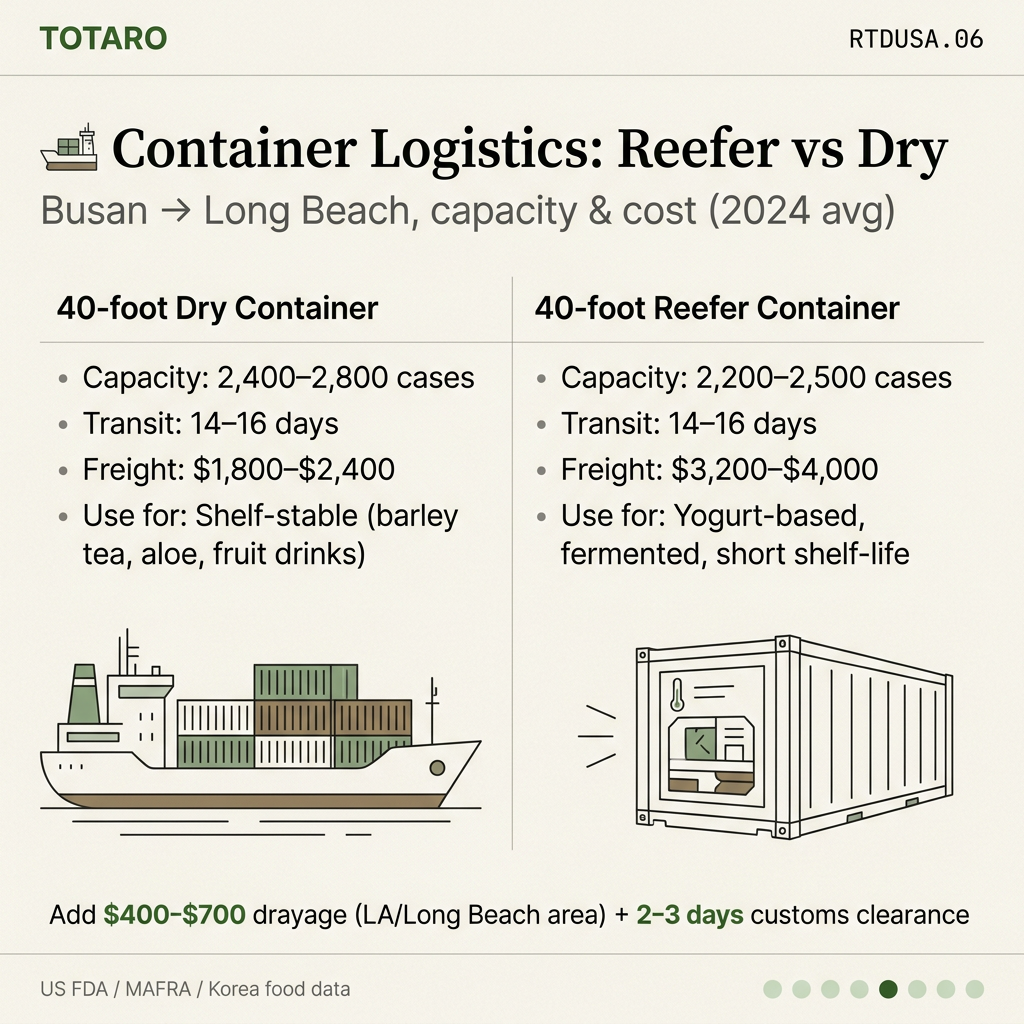
Korean RTD beverages ship in either 20-foot or 40-foot dry containers (for shelf-stable products) or reefer containers (for yogurt-based or short-shelf-life drinks).
Container Capacity & Transit Time
- 20-foot dry container: ~1,200–1,400 cases (24×500 mL bottles), depending on pallet configuration and case weight.
- 40-foot HC (high-cube) dry: ~2,400–2,800 cases.
- 40-foot reefer: ~2,200–2,500 cases (lower cube due to refrigeration unit).
Busan → Long Beach: 14–16 days ocean transit.
Busan → Savannah / New York: 24–28 days ocean transit.
Most Korean RTD exporters use CJ Logistics, Hyundai Merchant Marine (HMM), or ONE (Ocean Network Express) for container shipment. FOB Busan is the standard Incoterm; CIF or DDP quotes are available for larger accounts.
Freight cost (2024 average):
- Busan → Long Beach, 40-foot dry: $1,800–$2,400
- Busan → Long Beach, 40-foot reefer: $3,200–$4,000
Add $400–$700 for drayage to your warehouse (Los Angeles/Long Beach area). East Coast ports add 7–10 days transit and $500–$800 more in freight.
Customs Clearance & Bonded Warehousing
Plan 2–3 days for customs clearance at the port. If your product requires relabeling or quality inspection, use a bonded warehouse near the port (e.g., Commerce, CA; Elizabeth, NJ). Cost: $25–$40 per pallet per month, plus $0.08–$0.15 per unit for label application.
Major Korean RTD Beverage Suppliers for US Importers
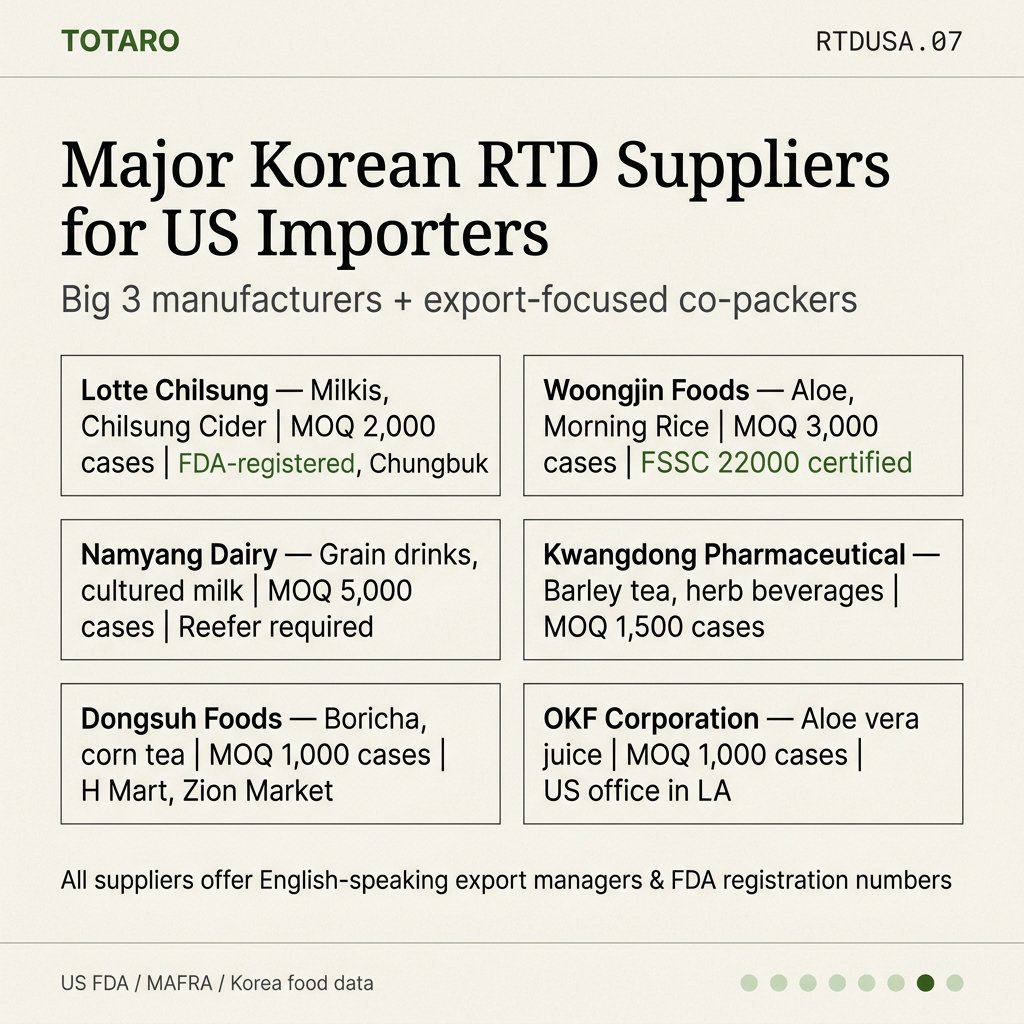
The Korean RTD beverage industry is dominated by three conglomerates and a handful of specialized co-packers.
Big 3 Beverage Manufacturers
Lotte Chilsung Beverage: Produces Milkis (sparkling yogurt drink), Chilsung Cider (lemon-lime soda), and Lotte Hot6 (energy drink). Established US distribution but open to private-label discussions for orders above 10,000 cases. MOQ for existing SKU: 2,000 cases. FDA-registered facilities in Chungbuk.
Woongjin Foods: Known for Woongjin Aloe and Woongjin Morning Rice. High-volume capacity, export-focused. Minimum 3,000 cases for stock SKU, 10,000 cases for private label. FSSC 22000 certified. Strong track record with US importers.
Namyang Dairy Products: Produces grain-based drinks (French Café, Vegetable Time) and cultured milk. Private-label MOQ: 5,000 cases. Reefer container required for yogurt-based formats.
Mid-Tier & Co-Packers
Kwangdong Pharmaceutical: Barley tea and medicinal herb beverages. MOQ 1,500 cases. Export department responds quickly to inquiries.
Dongsuh Foods: Barley tea (Dongsuh Boricha), corn tea. Stock SKU MOQ: 1,000 cases. Commonly found in H Mart and Zion Market.
OKF Corporation: Aloe vera juice and fruit-flavored drinks. Export-driven, with US office in Los Angeles. MOQ 1,000 cases for existing SKU, 5,000 for private label. FDA-compliant labeling available.
Pulmuone Foods USA: While Pulmuone's US subsidiary focuses on tofu and fresh noodles, their Korea HQ operates a beverage co-packing arm for soy milk and plant-based drinks. MOQ 5,000+ cases, lead time 8 weeks.
Most suppliers have English-speaking export managers and can provide FDA registration numbers, FSSC 22000 certificates, and product spec sheets in English.
Pricing Breakdown: From FOB to Landed Cost
Understanding landed cost is essential for margin planning. Here's a typical cost structure for a 40-foot container of Korean barley tea (2,500 cases × 24 bottles).
| Cost Component | Amount (USD) | Per-Case Cost |
|---|---|---|
| FOB Busan (product) | $25,000 | $10.00 |
| Ocean freight (Busan → LA) | $2,200 | $0.88 |
| Marine insurance (0.5% CIF) | $136 | $0.05 |
| Customs brokerage & entry fees | $350 | $0.14 |
| Drayage (port → warehouse) | $600 | $0.24 |
| Duties (HS 2202.99, 0% MFN) | $0 | $0.00 |
| Total Landed Cost | $28,286 | $11.31 |
Retail price at $3.99 per bottle (500 mL) × 24 = $95.76 per case. Distributor buys at $48–$55 per case, leaving a gross margin of 76–79% for the importer before storage, fulfillment, and sales costs.
Quality Control & Shelf-Life Management
Korean RTD beverages typically carry a 12–18 month shelf life from production date. Request production within 30 days of shipment to maximize US shelf time.
Pre-Shipment Inspection
For orders above $30,000, hire a third-party inspection company (SGS, Bureau Veritas, Intertek) to conduct pre-shipment inspection in Korea. Cost: $350–$600. Inspectors verify:
- Case count and pallet integrity
- Label accuracy (English Nutrition Facts, lot code, expiration date)
- Carton condition and pallet wrapping
- Random bottle sampling for leaks or defects
Post-Arrival Testing
Upon container arrival, pull 5–10 sample units for microbial and heavy metal testing if you're entering a new supplier relationship. US labs (Eurofins, Merieux NutriSciences) charge $400–$800 for a standard beverage panel (total plate count, yeast/mold, E. coli, lead, cadmium).
Key Takeaways for US Buyers
- FDA compliance starts with the supplier: Confirm FDA food facility registration, FSSC 22000 or ISO 22000 certification, and English-language COA before placing your first order.
- MOQs are negotiable: Stock SKUs start at 1,000 cases; private label requires 5,000–10,000 cases. Multi-SKU orders can lower per-SKU MOQ.
- Freight and lead time matter: West Coast ports cut 10 days and $500–$800 per container vs. East Coast. Plan 6–8 weeks dock-to-door for first orders.
- Landed cost calculation is non-negotiable: Factor ocean freight, drayage, customs brokerage, and potential relabeling before quoting to distributors.
- Supplier reputation beats price: The Big 3 (Lotte Chilsung, Woongjin, Namyang) and established exporters (OKF, Kwangdong, Dongsuh) offer reliability and FDA readiness. Smaller co-packers can be cost-effective but require extra due diligence.
Korean RTD beverages deliver strong velocity in Asian grocery, natural/organic retail, and foodservice. With the right supplier partnership and solid grasp of FDA rules, US importers can build profitable, repeatable programs in a category that's still early in its growth curve.
FAQ
What FDA approvals do I need to import Korean RTD beverages?
You don't need pre-market FDA approval for most RTD beverages. You do need: (1) the Korean manufacturer's FDA food facility registration, (2) prior notice filed 2–4 hours before US arrival, (3) a Foreign Supplier Verification Program (FSVP) as the US importer, and (4) compliant English Nutrition Facts labeling under 21 CFR 101. If the product contains novel ingredients or makes health claims, consult an FDA regulatory attorney.
What's the typical MOQ for private-label Korean RTD beverages?
For private label with a stock formula, expect 5,000–10,000 cases per SKU. Custom formula development pushes MOQ to 20,000+ cases and adds 10–14 weeks lead time. If you're testing the market, start with 1,000–2,000 cases of an existing branded SKU and apply a bilingual sticker label in the US (cost ~$0.10 per unit).
Should I ship Korean RTD beverages in a reefer or dry container?
Shelf-stable products—barley tea, aloe juice, fruit drinks in PET bottles—ship in dry containers (lower cost, simpler logistics). Yogurt-based or fermented RTD beverages with short shelf life or "keep refrigerated" instructions require reefer containers. Check the product spec sheet; if storage temp is 1–10°C, you need reefer. If ambient (15–25°C), dry container is fine.
How long does it take to land a container of Korean RTD beverages in the US?
Busan to Long Beach averages 14–16 days ocean transit, plus 2–3 days customs clearance, plus 1–2 days drayage to your warehouse. Total dock-to-door: 18–21 days if everything moves smoothly. Add 1–2 weeks for East Coast ports (Savannah, Newark, New York). First-time shipments can take longer due to FDA inspection or documentation issues, so plan 6–8 weeks lead time for your initial order.
Related Guides
Ask AI to find your Korean food supplier
Describe what you need in plain language — get matched with verified suppliers in seconds.
Try AI Supplier Search