카드 1 / 8
Korean Plant-Based Grain Butter — US Wholesale & Foodservice
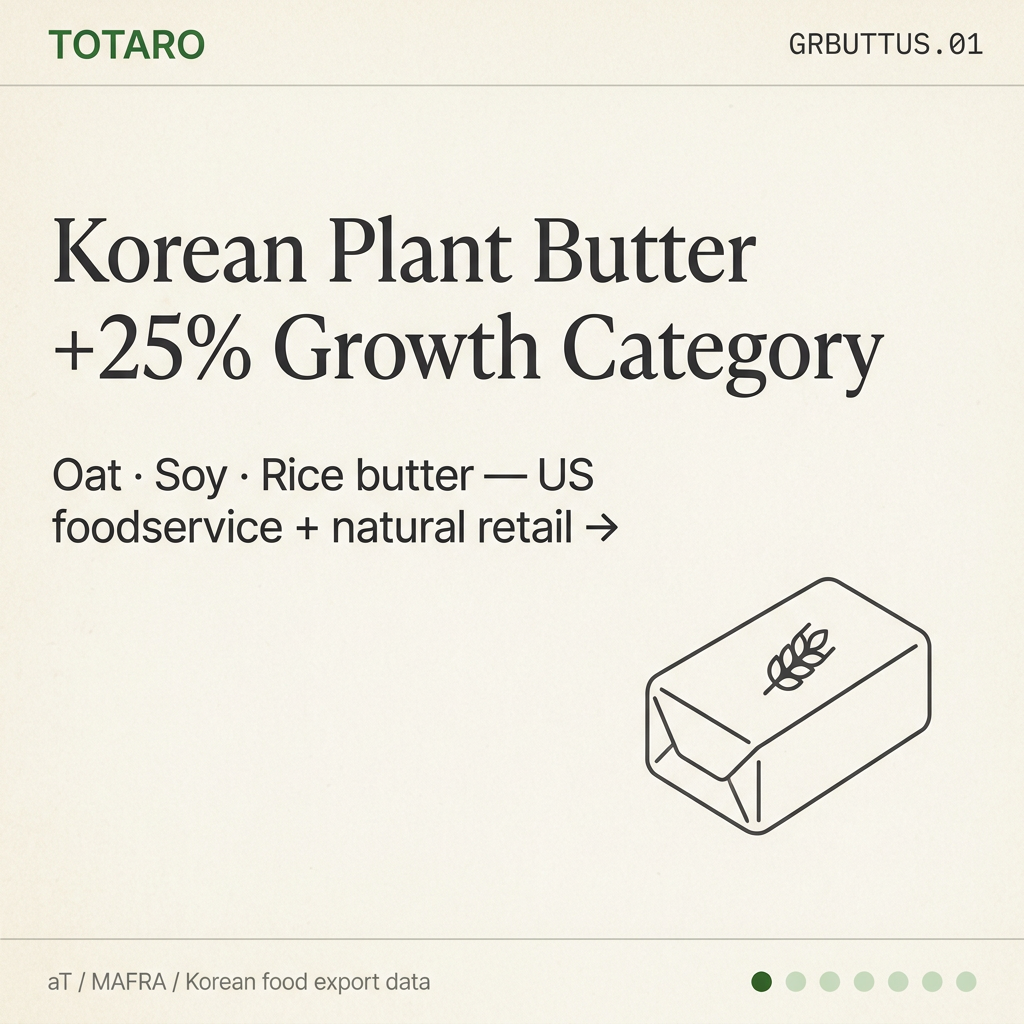
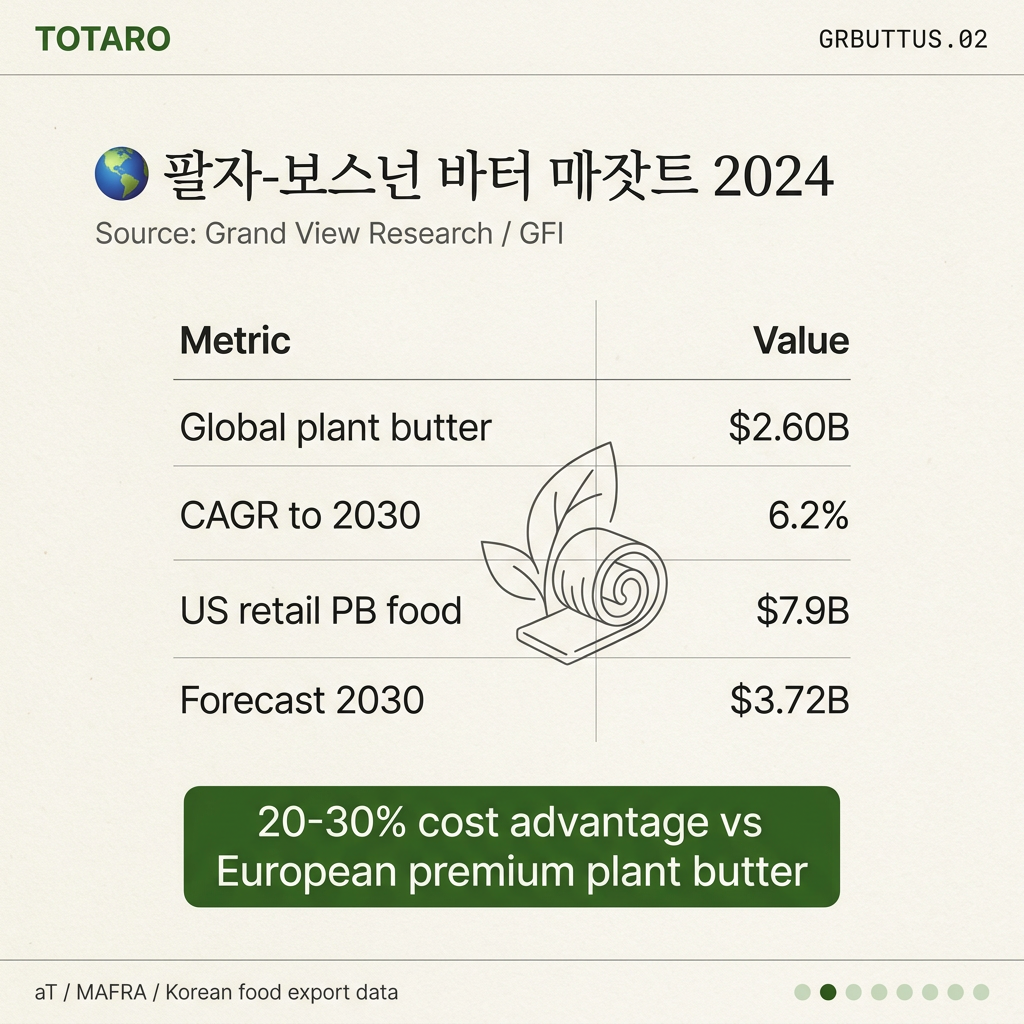
The global plant-based butter market reached $2.60 billion in 2024 and is projected to grow at 6.2% CAGR to $3.72 billion by 2030 (Grand View Research, 2024). US retail plant-based food category sits at $7.9 billion (Good Food Institute, 2024) with continued growth despite slight 2024 unit dip. Korean plant-based grain butter (oat, soy, rice, multigrain blends) offers a distinct sub-category position for US foodservice and natural retail — clean-label, no palm oil, no emulsifiers, with 20-30% cost advantage over European premium plant butter.
Korean Grain Butter Product Design
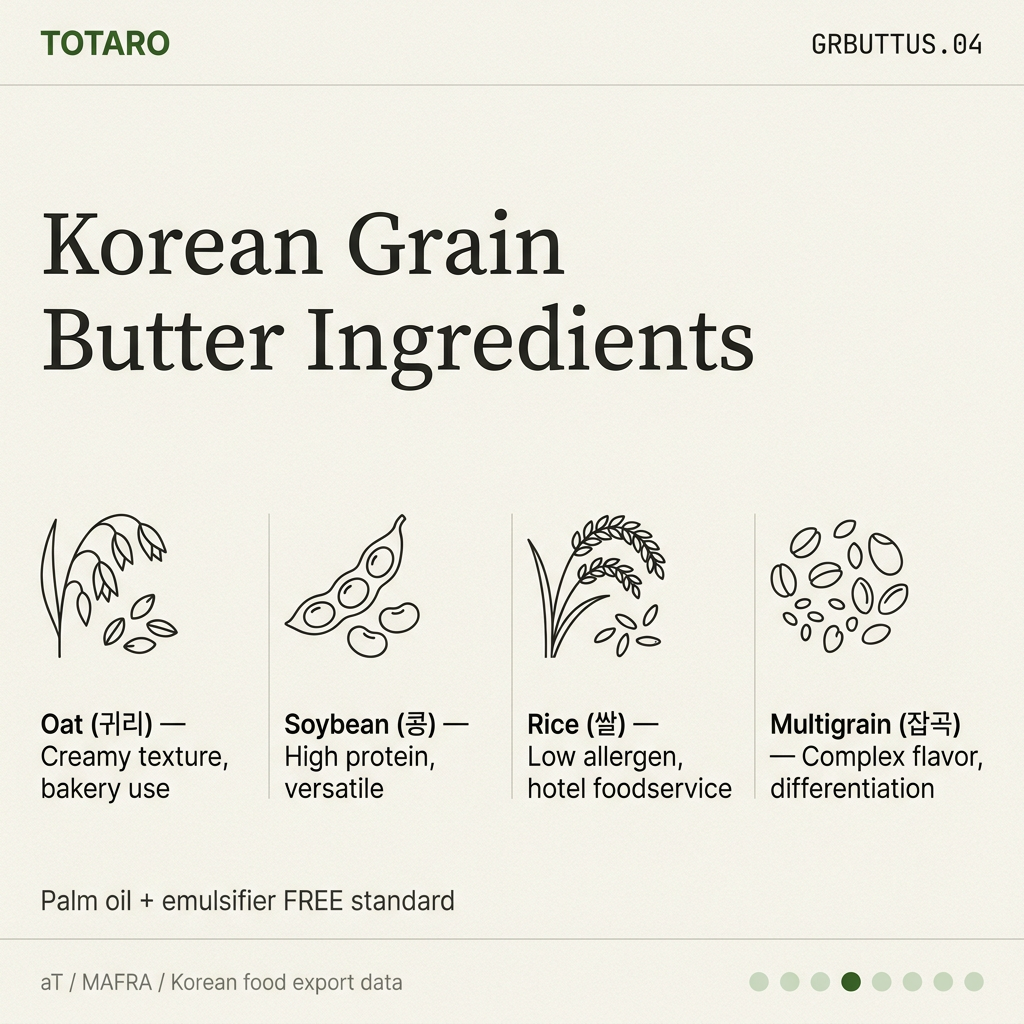
Korean plant butter manufacturers source domestic Korean grains as the key differentiation:
- Oat butter (귀리) — creamy texture, bakery use
- Soybean butter (콩) — high protein, versatile
- Rice butter (쌀) — low-allergen, hotel foodservice
- Multigrain blends (잡곡) — complex flavor, differentiation
Standard formulation excludes palm oil, emulsifiers, and trans fats — using coconut oil base. Several brands source from specific Korean provinces (Jeju oats, Chungcheong rice) for traceability premium.
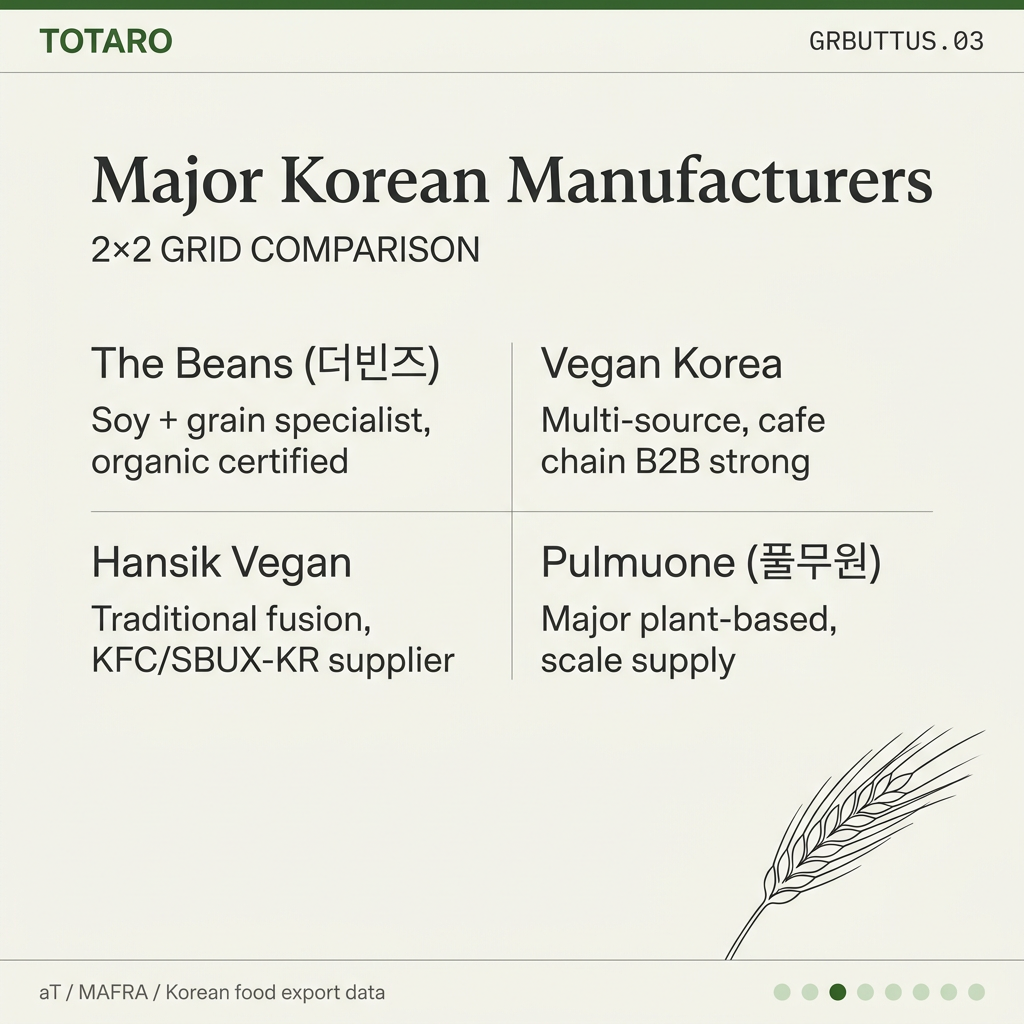
Major Korean Manufacturers
| Manufacturer | Specialty | Position |
|---|---|---|
| The Beans (더빈즈) | Soybean + grain butter | Plant-based specialist, organic-certified line |
| Vegan Korea | Multi-source butter | Cafe chain B2B |
| Hansik Vegan | Traditional Korean fusion | KFC and Starbucks Korea supplier |
| 자연주의 (Naturalism) | Premium organic | Hotel + high-end foodservice |
| Pulmuone (풀무원) (pulmuone.com) | Major plant-based brand | Scale supply, US export experience |
US Market Opportunity
US plant-based butter sub-category (within $7.9B retail PB total) is led by Miyoko's, Earth Balance, and Country Crock Plant Butter. Korean plant butter differentiation:
- Cost advantage: 20-30% below European premium (Anchor, Présent)
- Cleaner ingredient story: No palm oil, no emulsifiers, multi-grain
- Asian-origin narrative: Emerging Asian-fusion bakery and DTC brands
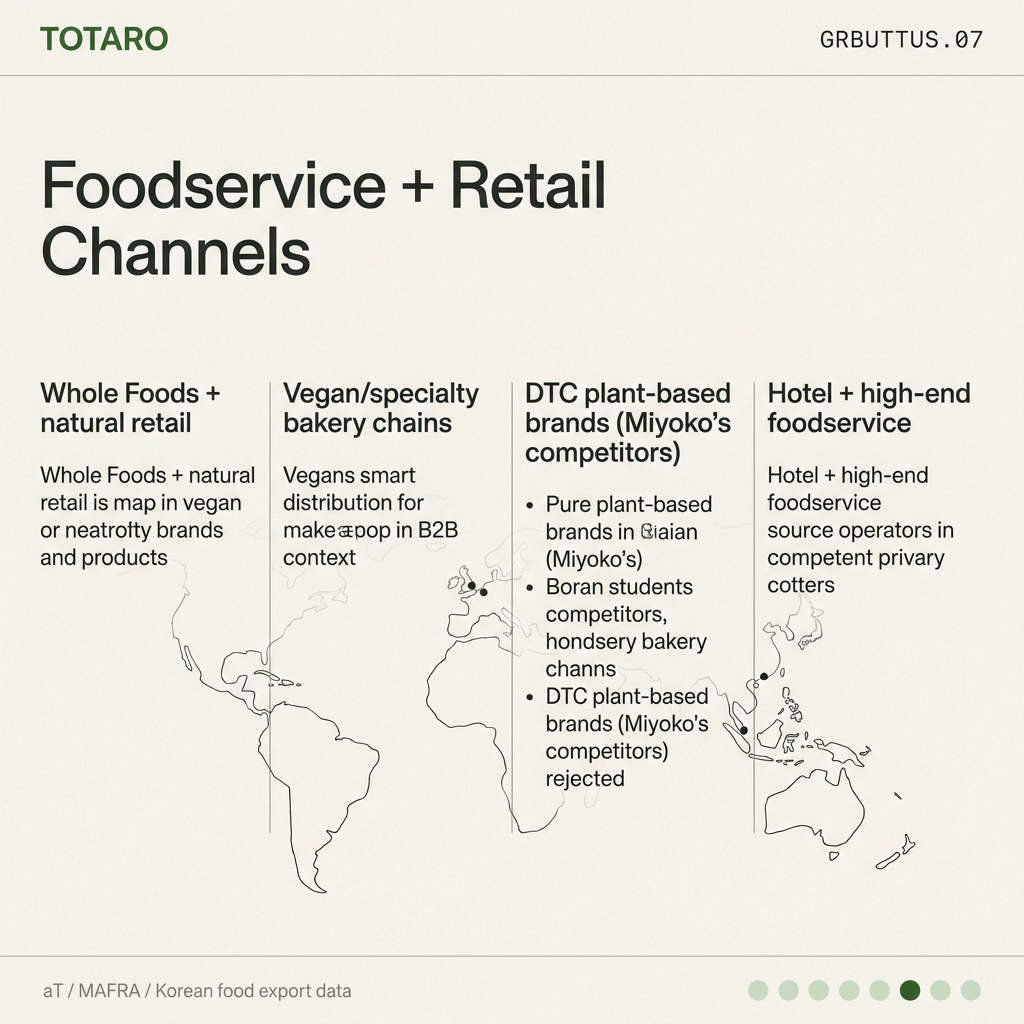
Key US channels: Whole Foods + natural retail, vegan/specialty bakery chains, plant-based DTC brands (Miyoko's category competitors), hotel + high-end foodservice.
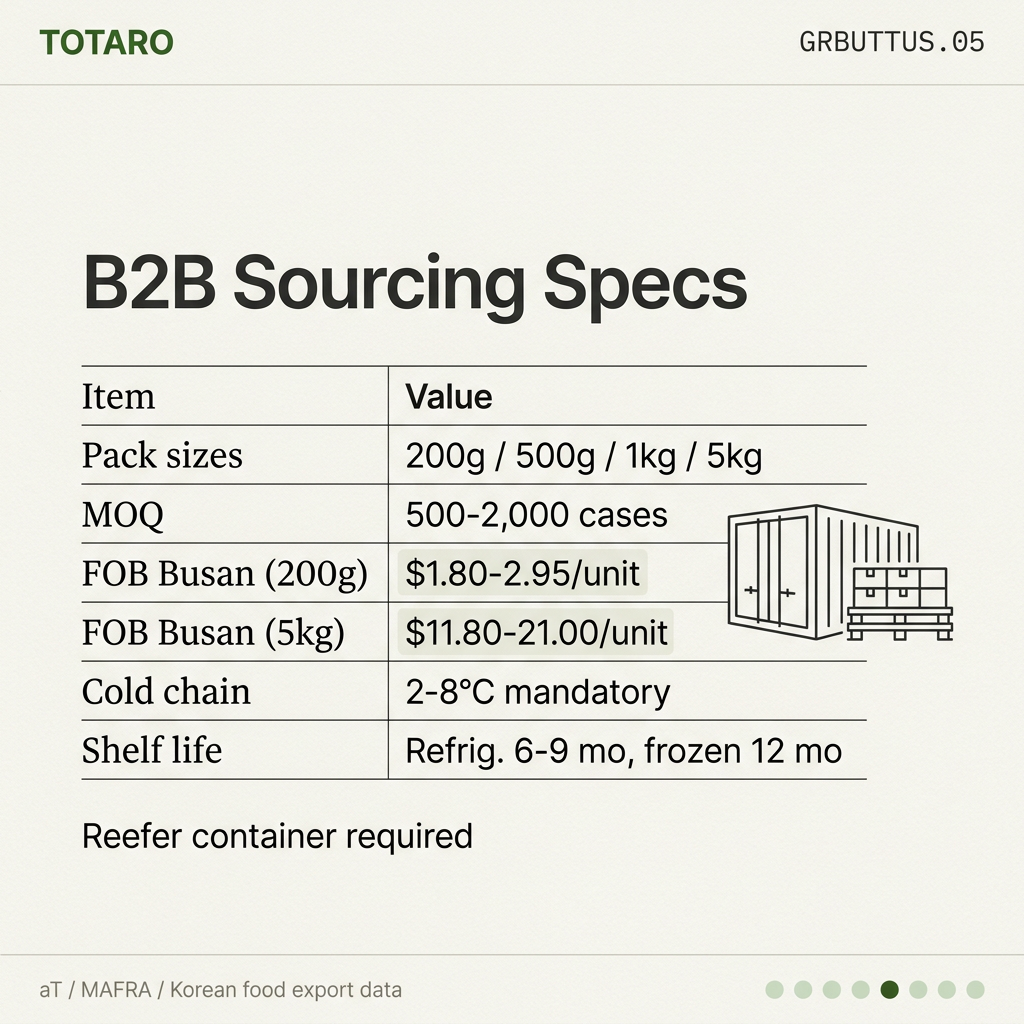
B2B Sourcing Specs (Industry Estimates)
| Spec | Standard |
|---|---|
| Pack sizes | 200g / 500g retail; 5kg foodservice bulk |
| MOQ | 500-2,000 cases (industry estimate, requires RFQ) |
| FOB Busan (200g) | $1.80-2.95/unit (industry estimate) |
| FOB Busan (5kg) | $11.80-21.00/unit (industry estimate) |
| Cold chain | 2-8°C refrigerated, mandatory |
| Shelf life | Refrigerated 6-9 months, frozen 12 months |
| Lead time | Busan → Long Beach 14 days; → NY 28 days |
Reefer container required. FDA Cold Chain Refrigerated Foods Guidance requires cold-chain integrity documentation.
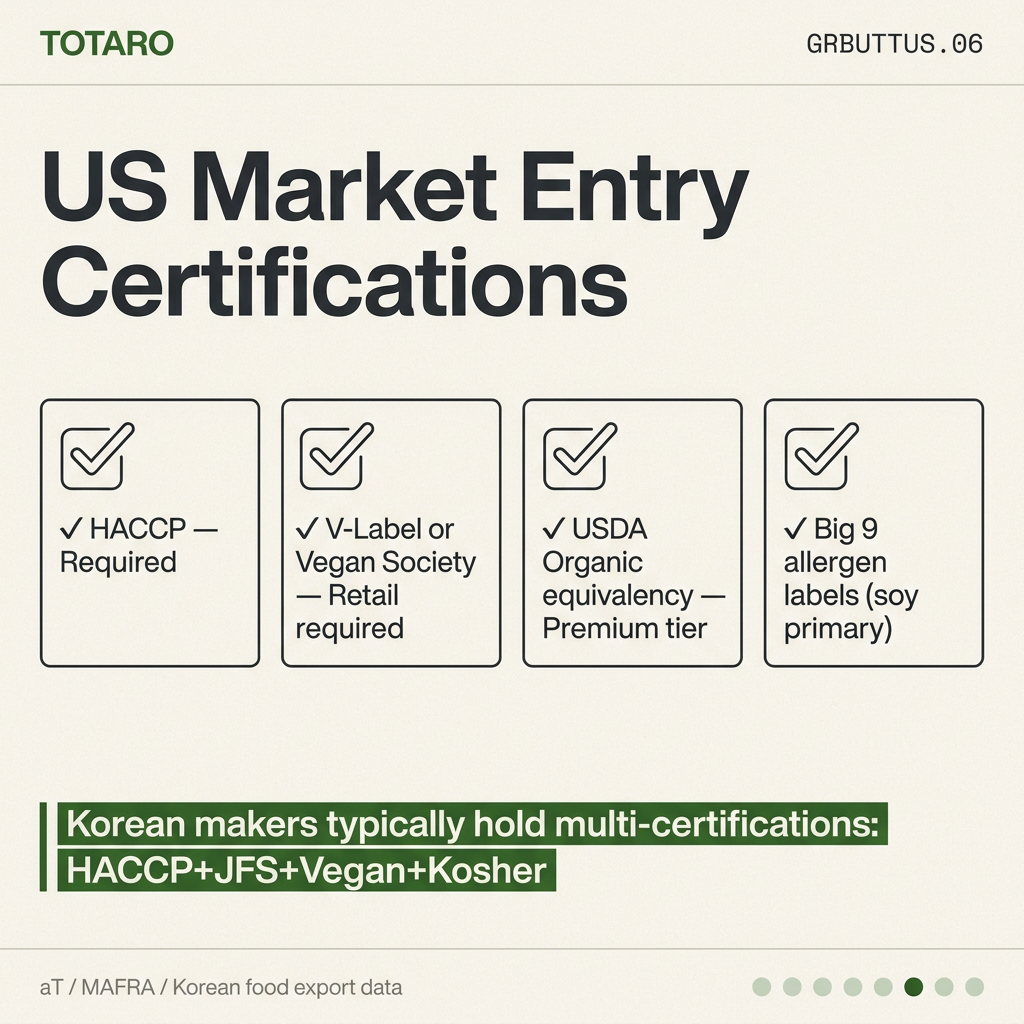
Certifications and US Compliance
For US market entry:
- FDA Food Facility Registration (FDA Food Facility Registration) — Korean facility + US importer
- FSVP (FDA FSVP page)
- USDA Organic equivalency for premium positioning (Korean organic certification → US equivalency process: 4-8 months, $5K-15K industry estimate)
- Big 9 allergen labeling per 21 CFR 101.91 — soy is the primary Korean grain butter allergen
- Vegan certification (V-Label or Vegan Society) — required for plant-based retail positioning
Korean manufacturers typically hold multi-certifications (HACCP, JFS-B, Vegan, often Kosher/Halal) — useful for US specialty retail buyer trust.
FAQ
Q1. What spec works best for US foodservice bakery chains? A. 5kg block format with 32-36°C melt point optimized for laminated pastry work. Korean manufacturers are developing 'pastry-grade' specifications for export-bakery accounts. Verify melt point spec with direct supplier RFQ.
Q2. How do we verify no palm oil in the supply chain? A. Major manufacturers (The Beans, Vegan Korea) provide ingredient traceability certificates. Some hold RSPO certification as palm-free attestation. Request full supply chain documentation in supplier RFQ.
Q3. Premium tier (Korean-sourced grains) vs standard line — pricing? A. Industry pattern: Korean-sourced grain butter runs +25-40% vs standard. Premium foodservice and hotel accounts absorb this; volume retail typically cannot. Verify with direct quotation.
Q4. Sample evaluation to first volume contract — timeline? A. Industry-typical 4-6 months: 2-3 weeks for samples, 2-4 weeks for sensory and lab analysis, 8-10 weeks for FSVP and label preparation, 6-8 weeks for first production. Confirm with each supplier.
This article verified with Grand View Research, Good Food Institute, FDA, and CFR primary sources. MOQ, FOB, and timeline ranges marked as industry estimates pending direct supplier RFQ.
Sources
Related Guides
Ask AI to find your Korean food supplier
Describe what you need in plain language — get matched with verified suppliers in seconds.
Try AI Supplier Search