카드 1 / 8
Korean Kimchi US Wholesale — $683M Market B2B Sourcing Guide
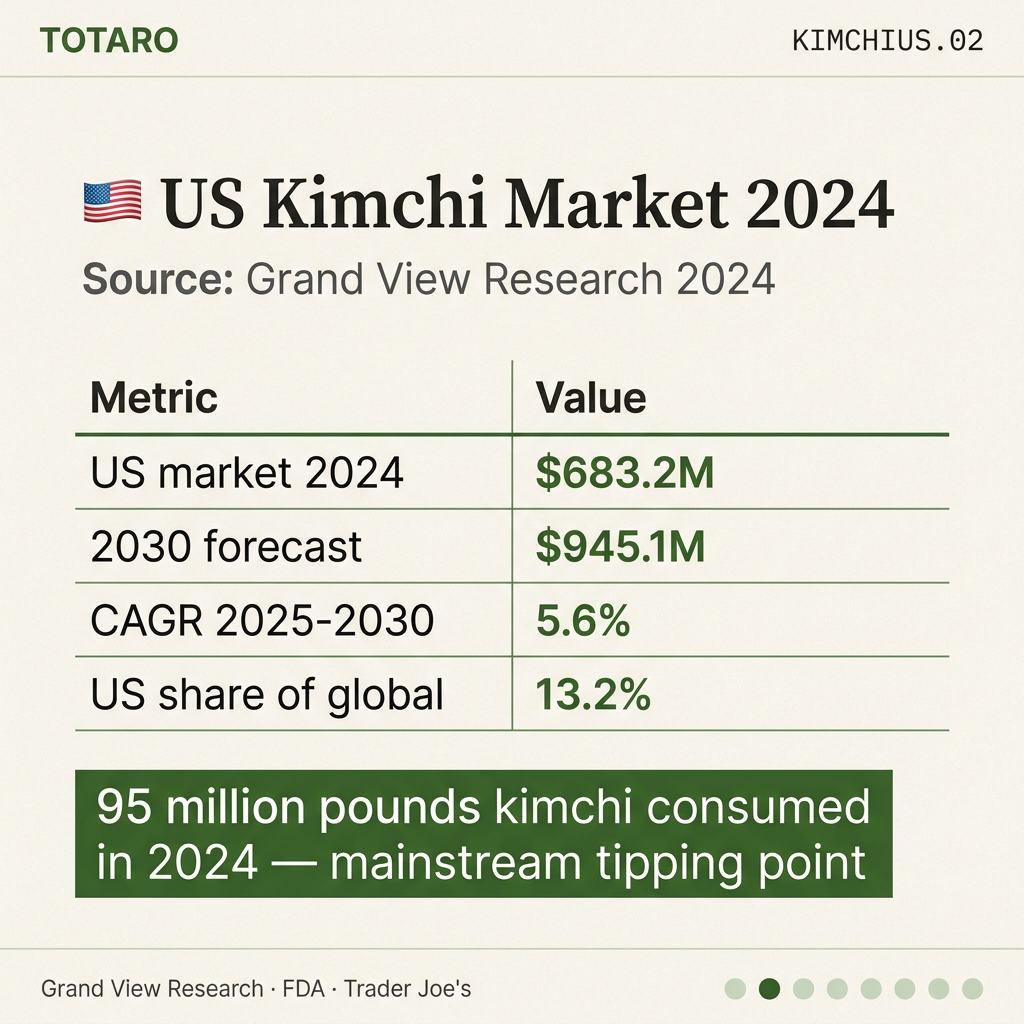
The US kimchi market reached $683.2 million in 2024 and is projected to grow to $945.1 million by 2030 at a 5.6% CAGR (Grand View Research, 2024). The US accounts for 13.2% of the global kimchi market and is the fastest-growing regional market at 6.3% CAGR. American consumers ate over 95 million pounds of kimchi in 2024 (Grand View Research, 2024) — a category mainstream shift from Asian-American grocery to Whole Foods, Costco, and Trader Joe's.
US Kimchi Category — From Ethnic to Mainstream
For decades, kimchi sat in the Asian-American grocery aisle (HMart, 99 Ranch). The category breakout happened in 2020-2024 with gut-health positioning, vegan-compatible options, and Mother In Law's Kimchi landing nationwide distribution. Korean manufacturers now compete for shelf space at Whole Foods (probiotic + fermented section), Sprouts (clean label + gut health), and Trader Joe's (curated Asian SKUs).
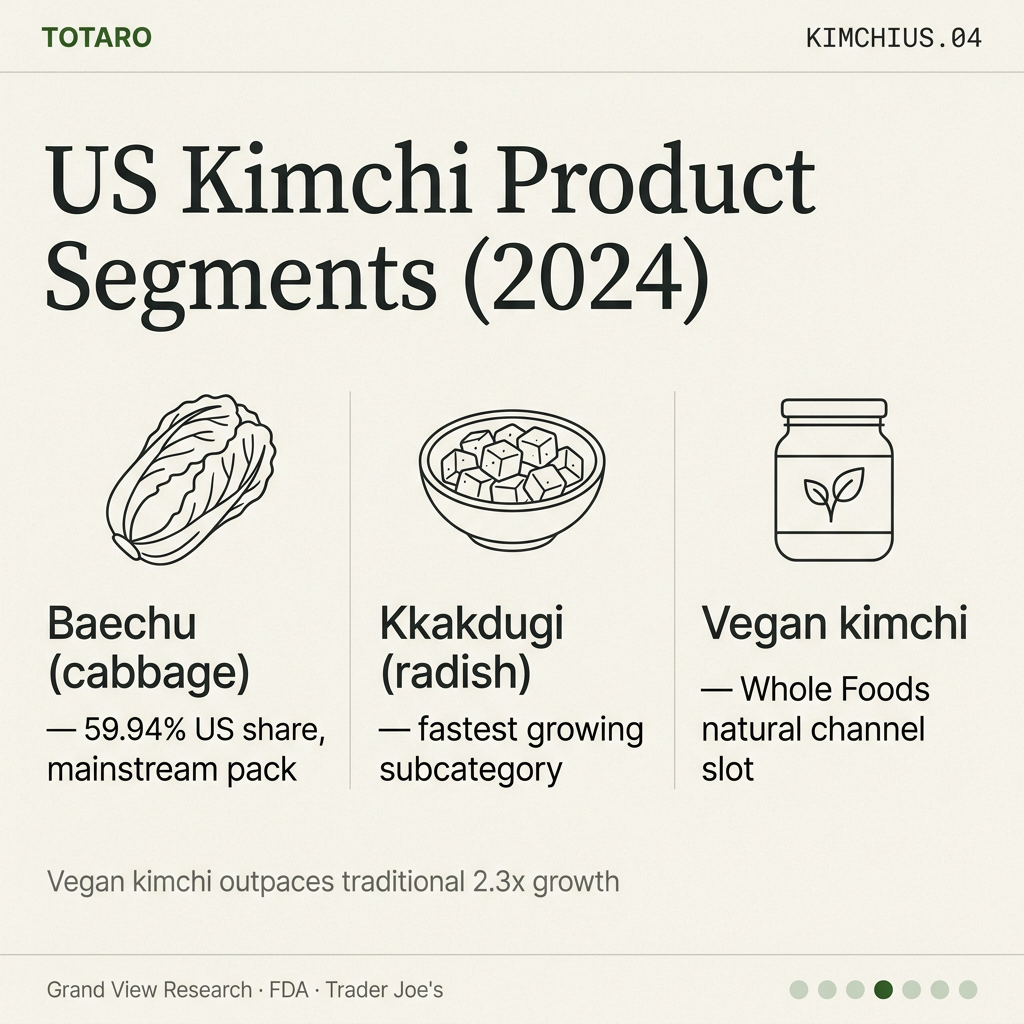
Baechu kimchi (Napa cabbage) holds 59.94% of the US market by revenue. Kkakdugi (radish) is the fastest-growing subcategory. Vegan kimchi (without fish sauce or shrimp paste) is the differentiation slot for Whole Foods and natural channel.
Major Korean Manufacturers (B2B Export-Ready)
| Manufacturer | Specialty | US Position |
|---|---|---|
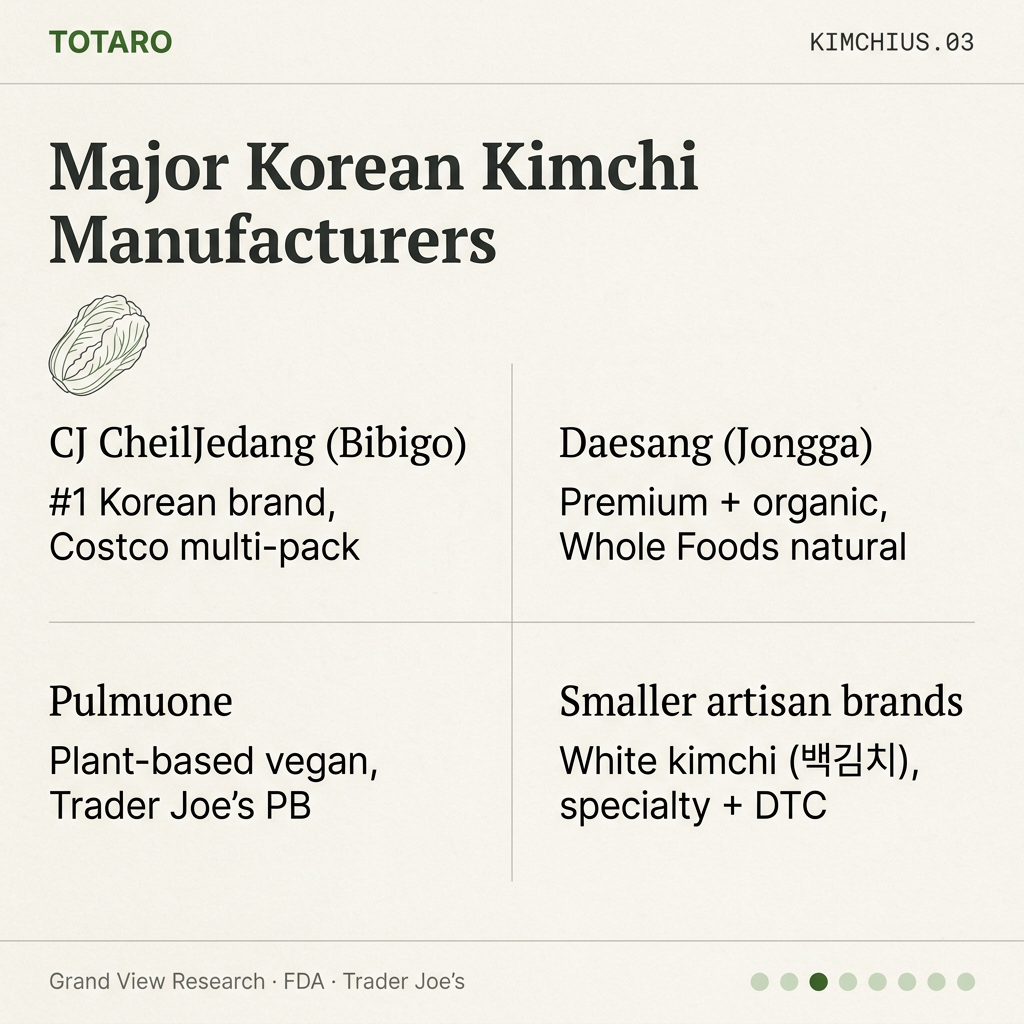
| CJ CheilJedang (Bibigo) | Mass kimchi, vegan kimchi | #1 Korean brand in US, Costco multi-pack |
| Daesang (Jongga) | Premium kimchi, organic | Whole Foods natural channel |
| Pulmuone | Plant-based, vegan kimchi | Trader Joe's PB, Sprouts |
| Hanwoomool | Traditional artisan kimchi | Specialty + premium retail |
| Smaller artisan brands | Regional Korean kimchi, white kimchi (백김치) | Specialty grocers, DTC |
(Manufacturer fit for each US channel verified — but specific MOQs and FOB pricing require direct supplier RFQ.)
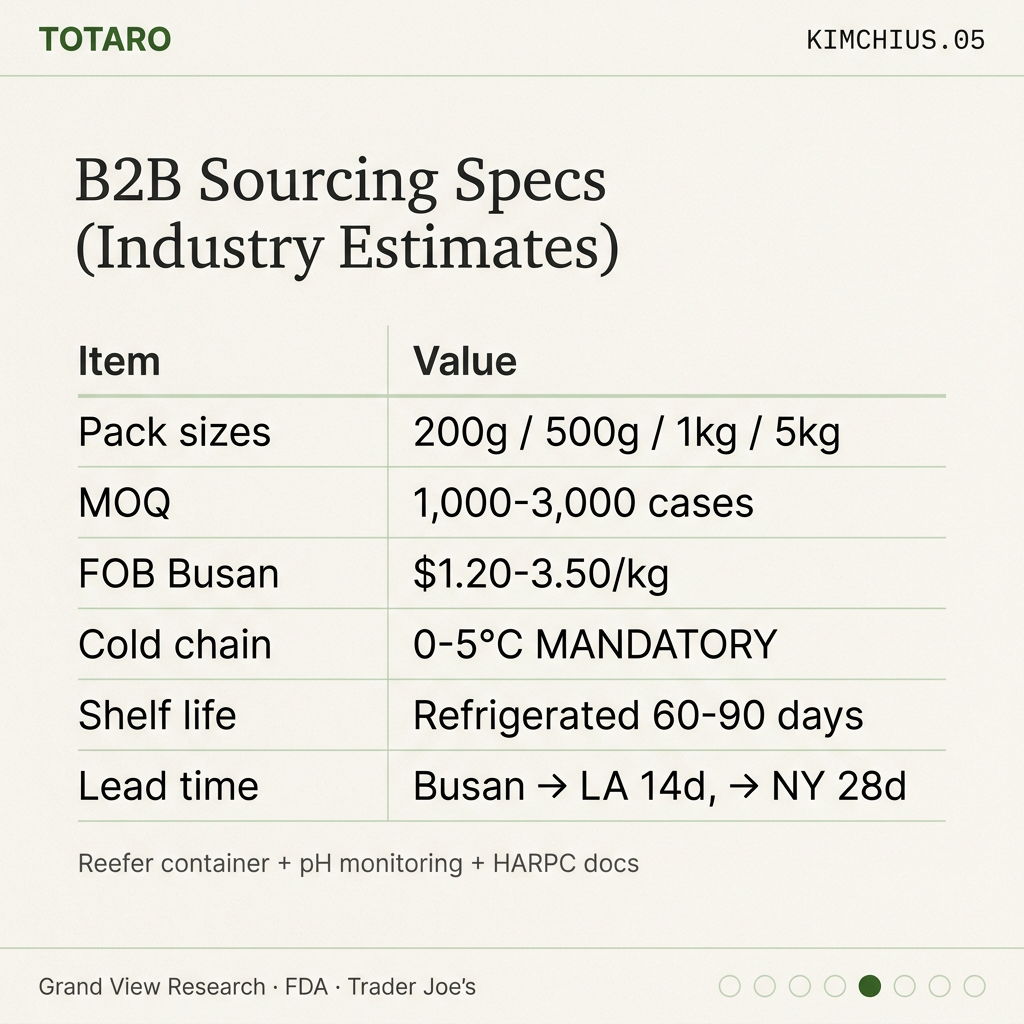
B2B Sourcing Specs (Industry Estimates)
| Spec | Standard |
|---|---|
| Pack sizes | 200g pouch · 500g jar · 1kg jar · 5kg foodservice tub |
| MOQ | 1,000-3,000 cases (industry estimate, requires RFQ) |
| FOB Busan | $1.20-3.50/kg (industry estimate) |
| Cold chain | 0-5°C refrigerated mandatory (fermentation continues) |
| Shelf life | Refrigerated 60-90 days, key is pH and active fermentation control |
| Lead time | Busan → Long Beach 14 days, → NY 28 days |
Reefer container required throughout. FDA requires Hazard Analysis and Risk-Based Preventive Controls (HARPC) per 21 CFR 117 for fermented food imports.
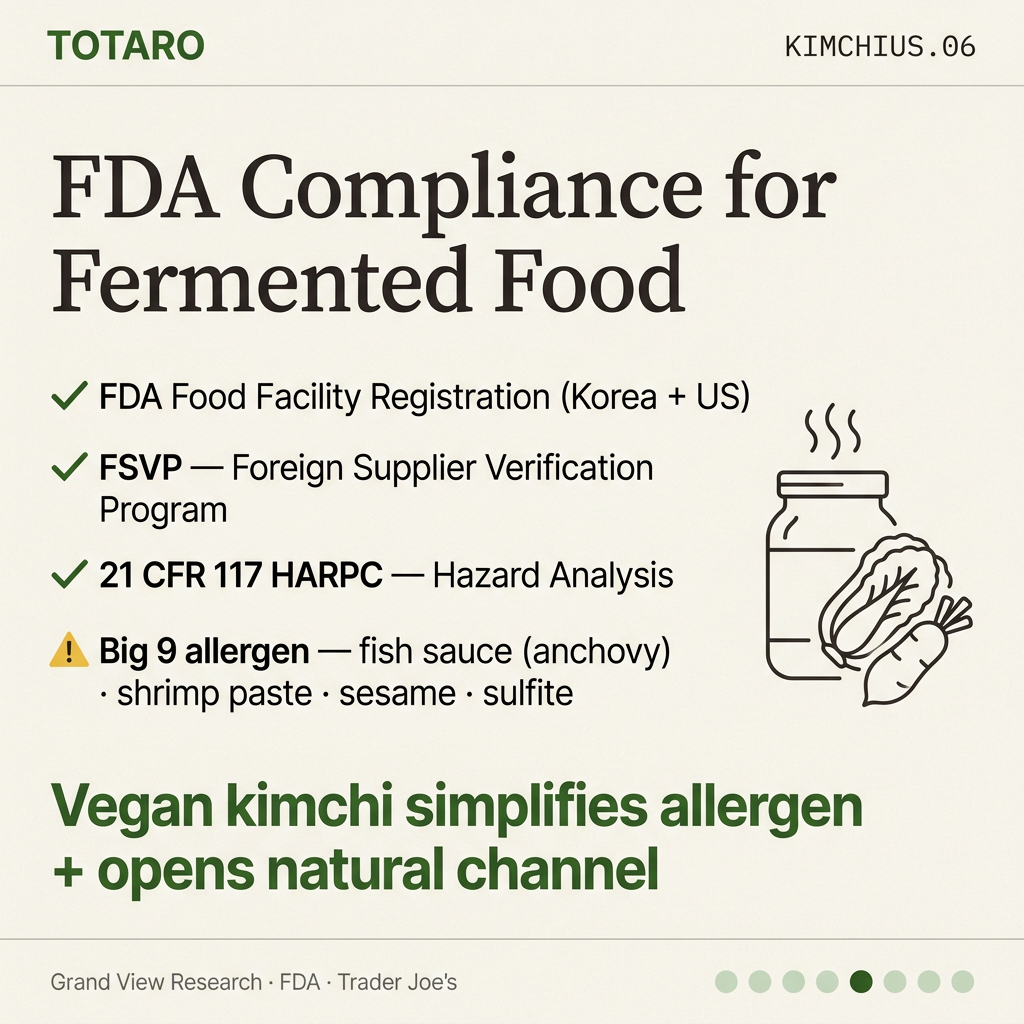
FDA Compliance for Fermented Foods
FDA Food Facility Registration mandatory (FDA Food Facility Registration) — both Korean facility and US importer.
FSVP (FDA FSVP Program) — Foreign Supplier Verification Program. Korean kimchi exporters need FSVP-ready documentation including HACCP plans, pH monitoring records, and microbial testing.
Acidified vs Fermented food classification: Kimchi typically classifies as fermented food (not acidified), but pH must remain ≤4.6 for shelf-stable claim. Some Korean manufacturers ship at pH 3.8-4.2 active fermentation; others stabilize at pH 4.4 for longer shelf life.
Allergen labeling per 21 CFR 101.91: fish sauce contains anchovy (Big 9 allergen), shrimp paste contains shellfish. Vegan kimchi avoids both, simplifies labeling.
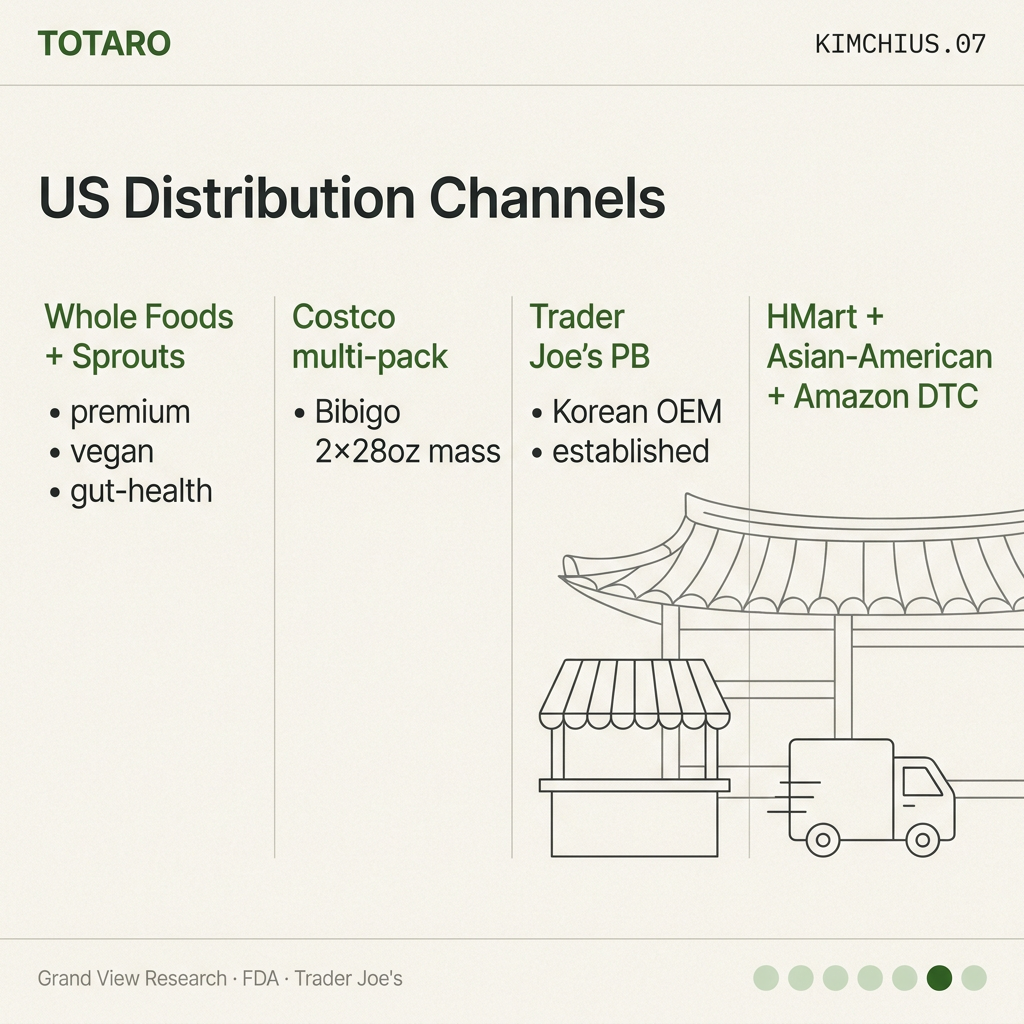
US Distribution Channels
| Channel | SKU Approach | Notes |
|---|---|---|
| Whole Foods Market | Premium · vegan · organic · probiotic positioning | 200g-500g jars · clean label · gut health story |
| Sprouts Farmers Market | Natural + functional positioning | Vegan kimchi + probiotic angle |
| Costco Wholesale | Multi-pack (2x 28oz Bibigo) | Mass + family-pack format |
| Trader Joe's | Private label or curated Korean | TJ's own brand kimchi from Korean supplier |
| HMart + 99 Ranch | Full traditional range | Asian-American consumer, multiple SKUs |
| Amazon DTC | Vegan + gut health DTC brands | Subscribe & Save model |
FAQ
Q1. Can fermented kimchi ship at ambient temperature? A. No. Korean kimchi is live-fermented and must maintain 0-5°C cold chain throughout import to retain quality and meet FDA microbial standards. Reefer container is mandatory.
Q2. What's the typical MOQ for US private label kimchi? A. Industry pattern: 5,000-10,000 cases minimum for PB. Custom recipe (vegan, mild, traditional) requires 6-8 week development. Verify with each manufacturer via direct RFQ.
Q3. How does Korean kimchi differ from US-made kimchi (Mother In Law's, Cleveland Kimchi)? A. Korean origin offers authenticity story, traditional fermentation methods, and 3-5x ingredient diversity. US-made kimchi typically uses simplified recipes for shelf stability. Whole Foods natural buyers increasingly prefer Korean origin for premium tier.
Q4. Vegan kimchi market growth? A. Fastest-growing kimchi subsegment in US. Whole Foods reports vegan kimchi outpacing traditional kimchi sales growth 2.3x. Major Korean exporters (CJ Bibigo, Pulmuone) now offer dedicated vegan SKUs for US export.
This article verified with Grand View Research, FDA, and CFR primary sources. MOQ, FOB, and channel performance ranges marked as industry estimates pending direct supplier RFQ.
Sources
Related Guides
Ask AI to find your Korean food supplier
Describe what you need in plain language — get matched with verified suppliers in seconds.
Try AI Supplier Search