카드 1 / 8
Korean Health Food Raw Material Suppliers for US Imports
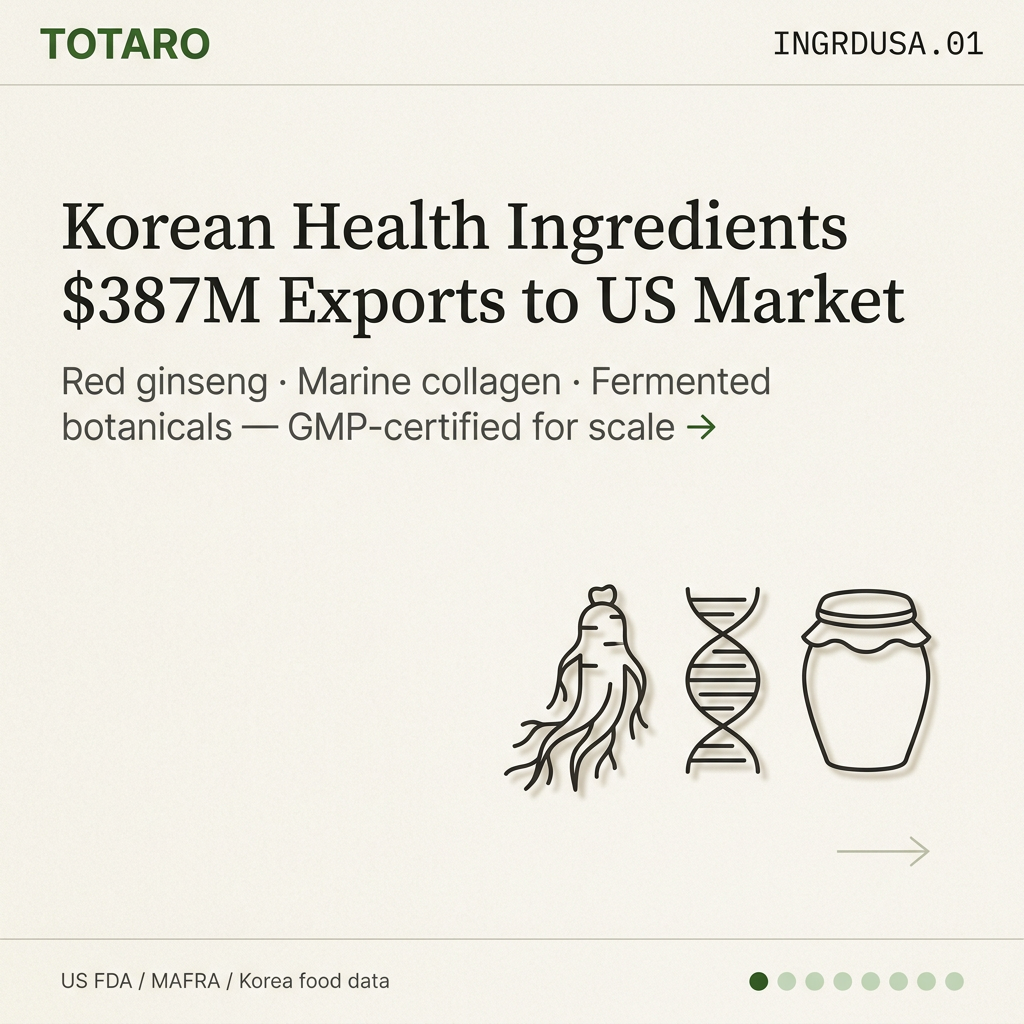
The US functional food and dietary supplement market reached $53.8 billion in 2023, and Korean health food raw materials—particularly red ginseng extract, marine collagen peptides, and fermented botanicals—are climbing the ingredient buyer's radar. For US importers, distributors, and private-label formulators, Korea offers certified GMP facilities, clinical research backing, and competitive MOQs that slot between China's bulk commodities and Japan's premium extracts.
This guide walks through the key raw material categories, compliance requirements, supplier selection criteria, pricing structures, and logistics realities for US buyers sourcing functional food ingredients from Korea at scale.
Why Korean Health Food Raw Materials Stand Out
Korea's health food ingredient sector is anchored by three competitive advantages: government-backed R&D through the Korea Institute of Science and Technology (KIST), decades of red ginseng standardization under the Korea Ginseng Corporation monopoly (ended in 1996, opening private production), and a robust domestic "health functional food" regulatory category that pre-qualifies ingredients for export documentation.
Market size and export trajectory:
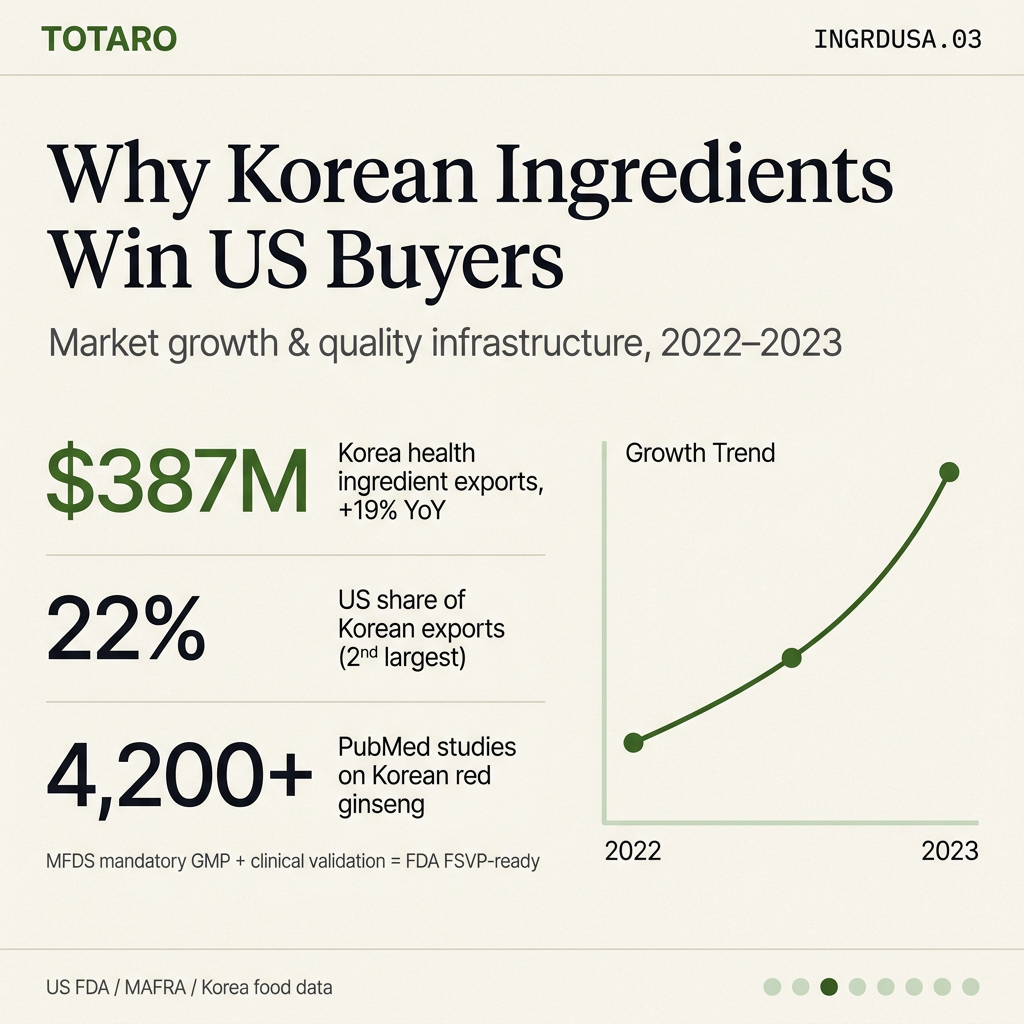
Korea exported $387 million in health functional food ingredients in 2022, up 19% year-over-year. The US accounted for 22% of that volume, trailing only China and Japan. Red ginseng extracts, hyaluronic acid, and fermented plant powders drove growth.
Quality infrastructure:
The Ministry of Food and Drug Safety (MFDS) operates a mandatory GMP system for health functional food manufacturers. Any Korean supplier shipping raw materials classified under the MFDS "health functional food" list must hold current GMP certification, which simplifies FDA FSVP audits for US buyers.
Clinical validation:
Korean red ginseng enjoys over 4,200 peer-reviewed studies indexed in PubMed, with human trials on cognitive function, immune modulation, and glycemic control. Marine collagen from Korean facilities often includes published bioavailability data, a selling point for US brands marketing evidence-backed formulas.
Core Korean Health Food Raw Material Categories
US buyers typically source five ingredient families from Korea. Each has distinct supply-chain characteristics, MOQ norms, and regulatory wrinkles.
Red Ginseng Extract (Panax ginseng)
Specification range:
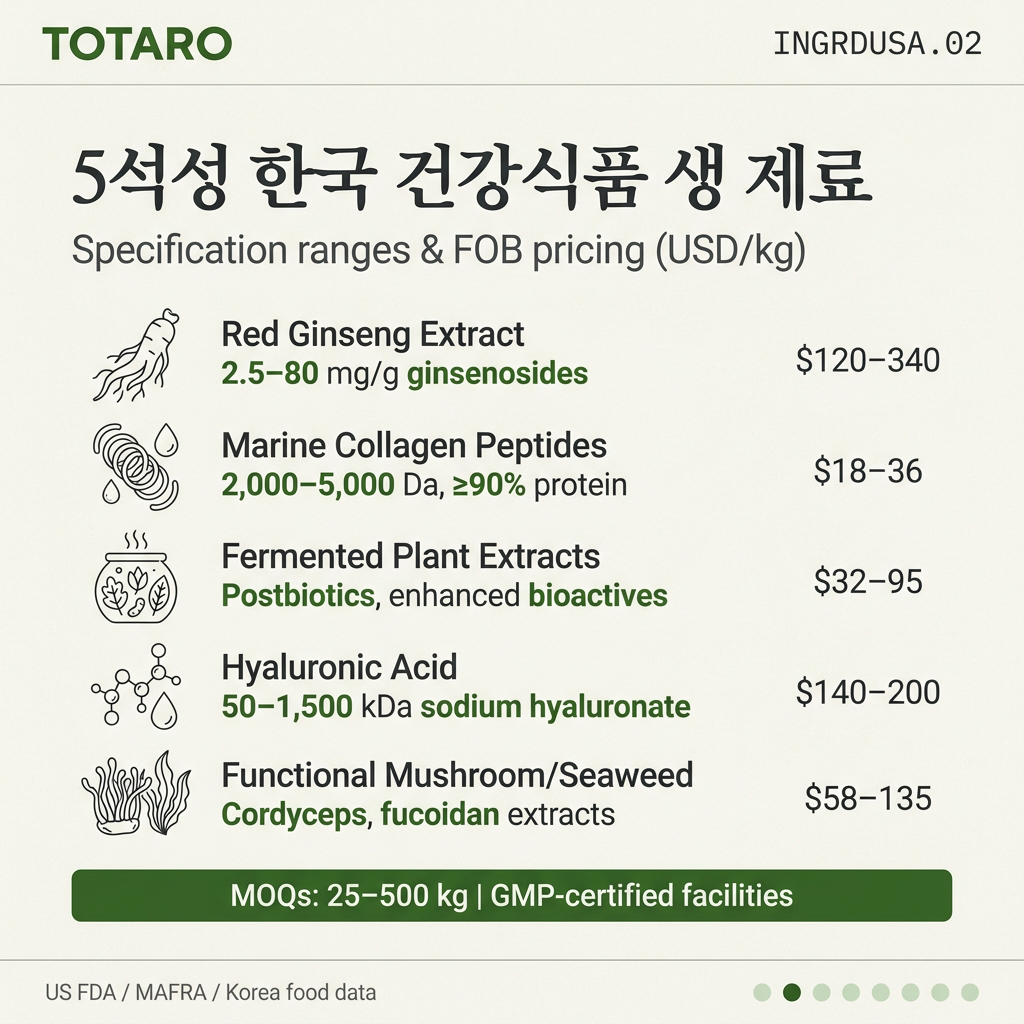
Standardized to 2.5–80 mg/g total ginsenosides (Rg1 + Rb1 + Rg3), delivered as spray-dried powder, liquid concentrate, or soft-extract paste.
Key suppliers:
Korea Ginseng Corporation (KGC), Geumsan County co-ops, and private processors like Daehan Ginseng and Hansung Ginseng. KGC controls approximately 30% of global red ginseng extract exports.
MOQ and pricing:
Powder extract (10% ginsenosides): MOQ 100 kg, FOB Incheon $120–160/kg. High-potency 80 mg/g concentrate: MOQ 50 kg, $280–340/kg. Volume discounts kick in above 500 kg.
US import notes:
HS code 1211.20.60 (ginseng roots, dried) or 1302.19.91 (extracts). Duty-free under MFN. Requires FDA prior notice, FSVP, and supplier GMP certificate. KGC exports include Certificate of Analysis (CoA) with ginsenoside HPLC chromatogram and heavy-metal screen (Pb, As, Cd, Hg).
Marine Collagen Peptides
Specification range:
Type I collagen, molecular weight 2,000–5,000 Da, sourced from wild Alaska pollock or farmed tilapia skins processed in Korea. Protein content ≥90%, delivered as white to off-white powder.
Key suppliers:
Jellice Co., Harim Group (Harim Bio), and Lotte Fine Chemical. Harim Bio operates a 1,200-ton annual capacity line in Iksan, Jeollabuk-do, certified NSF GMP and Halal.
MOQ and pricing:
Standard peptide powder: MOQ 500 kg, FOB Busan $18–26/kg. Premium low-MW (<3,000 Da) with bioavailability studies: $28–36/kg. Full 20' container (10–12 MT) drops unit cost 15–20%.
US import notes:
HS code 3503.00.40 (gelatin and derivatives). 1.8% MFN duty. FDA classifies as GRAS for collagen from fish; supplier must provide species documentation and country-of-origin for fish raw material. Reefer container not required—stable at ambient.
Fermented Plant Extracts & Postbiotics
Examples:
Fermented red ginseng (enhanced Rg3/Rh2 content), fermented black garlic powder, kimchi-derived Lactobacillus plantarum lysate, and kombucha SCOBY extracts.
Key suppliers:
CJ CheilJedang (CJ Bioscience division), Huons Global, and regional co-ops in Jangheung (shiitake) and Damyang (bamboo).
MOQ and pricing:
Fermented black garlic 20:1 powder: MOQ 200 kg, $32–48/kg FOB. Lactobacillus plantarum heat-killed cell powder (1×10¹⁰ CFU/g): MOQ 50 kg, $65–95/kg.
US import notes:
HS code varies—1302.19 (plant extracts), 2106.90 (food preparations). Postbiotic ingredients (heat-killed bacteria) fall under FDA's NDI (New Dietary Ingredient) notification if no pre-1994 US market history. Korean suppliers can provide Korean MFDS approval documents as supporting evidence but cannot substitute for FDA NDI filing.
Hyaluronic Acid & Collagen Boosters
Specification:
Sodium hyaluronate powder, 50–1,500 kDa molecular weight. Often co-formulated with ceramides or peptides for skin-health claims.
Key suppliers:
LG Chem Life Sciences, Bloomage Biotech Korea (Humedix acquisition), and SunBio.
MOQ and pricing:
Food-grade sodium hyaluronate (800 kDa): MOQ 25 kg, FOB $140–200/kg. Cosmetic grade tighter, but food/supplement spec accepts ≥90% purity, moisture <10%, microbial <1,000 CFU/g.
US import notes:
HS code 3913.90.50 (natural polymers). Duty 4.2%. FDA GRAS notice GRN 471 covers sodium hyaluronate for oral use up to 200 mg/day. Buyer should confirm supplier references this notice in technical documentation.
Functional Mushroom & Seaweed Powders
Examples:
Cordyceps militaris fruiting body extract (0.3–1% cordycepin), lion's mane 30% polysaccharides, Korean kelp (Saccharina japonica) fucoidan extract.
Key suppliers:
Mycel Co. (Cordyceps), Bioland Co. (mushrooms), and Jeju Technopark-licensed seaweed processors.
MOQ and pricing:
Cordyceps militaris 10:1 extract: MOQ 100 kg, $95–135/kg FOB. Fucoidan 85% powder: MOQ 200 kg, $58–80/kg.
US import notes:
HS code 1212.21 (seaweeds), 2106.90 (mushroom extracts). MFN duty-free to 6.4%. Fucoidan claims ("immune support") may trigger FDA structure/function scrutiny; ensure supplier provides non-disease-claim language for labels.
Supplier Selection & Audit Checklist
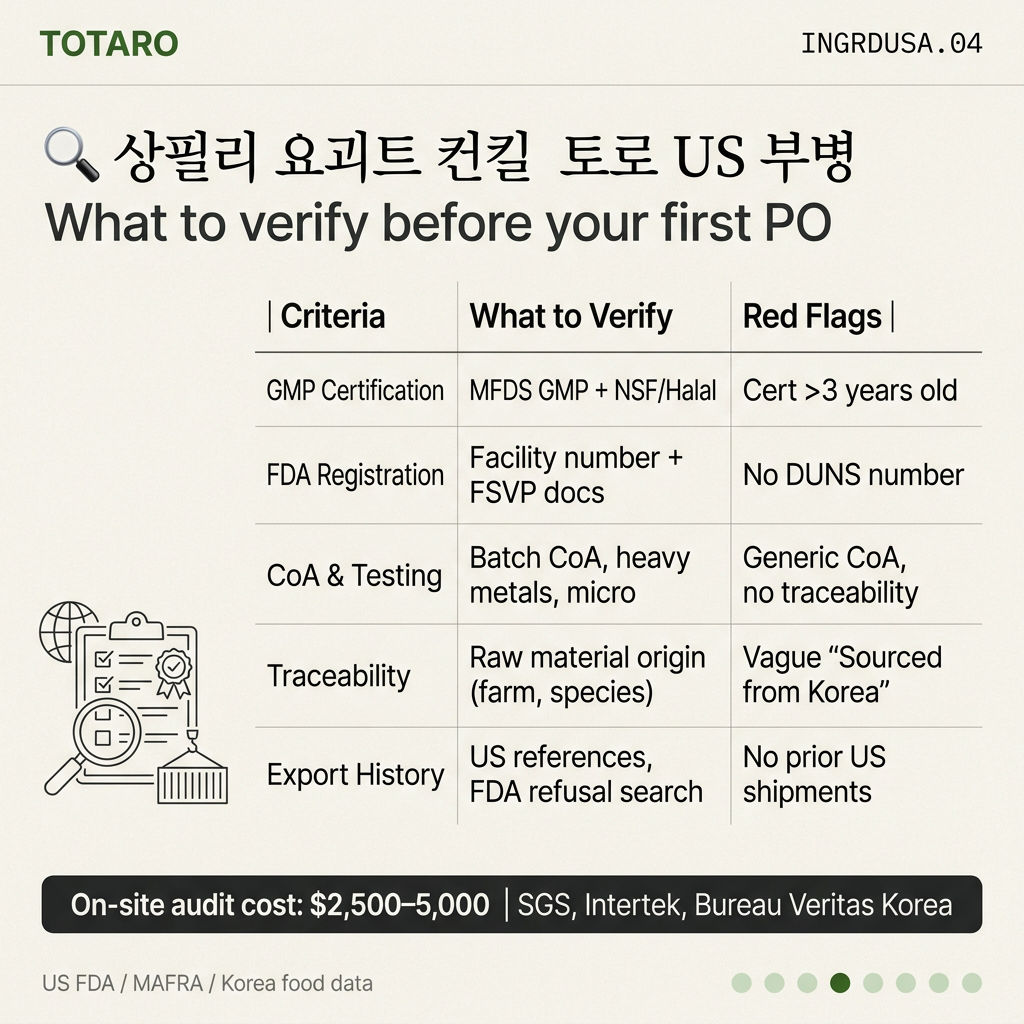
Korean ingredient suppliers range from listed conglomerates (CJ, LG) to regional co-ops. US buyers should vet the following before issuing a first PO:
| Criteria | What to verify | Red flags |
|---|---|---|
| GMP certification | MFDS GMP (Korea) + NSF, Informed Choice, or Halal if targeting those segments | Certificate older than 3 years, no audit reports |
| FDA registration | Supplier registered as food facility (if finished goods) or listed in FSVP docs | No DUNS number, vague facility address |
| CoA & testing | Batch CoA with identity, potency, heavy metals, micro, pesticides (if botanical) | Generic CoA, no batch traceability |
| Traceability | Raw material origin (ginseng farm co-op, fish species & catch area) | "Sourced from Korea" without specifics |
| Minimum order | Explicit MOQ in kg, lead time, payment terms (T/T, LC at sight, CAD) | "Negotiable" with no baseline |
| Export history | US client references, FDA refusal search (FDA Import Refusal Reports) | No prior US shipments, detention history |
On-site audits:
For orders above $50,000 annual spend, budget a Korea facility visit. Incheon International Airport offers direct connections to Busan, Geumsan (ginseng belt), and Jeju. Alternatively, hire a third-party auditor—SGS Korea, Intertek, and Bureau Veritas operate Korea offices with GMP audit teams. Cost: $2,500–5,000 per site.
FDA & USDA Compliance for Korean Ingredient Imports
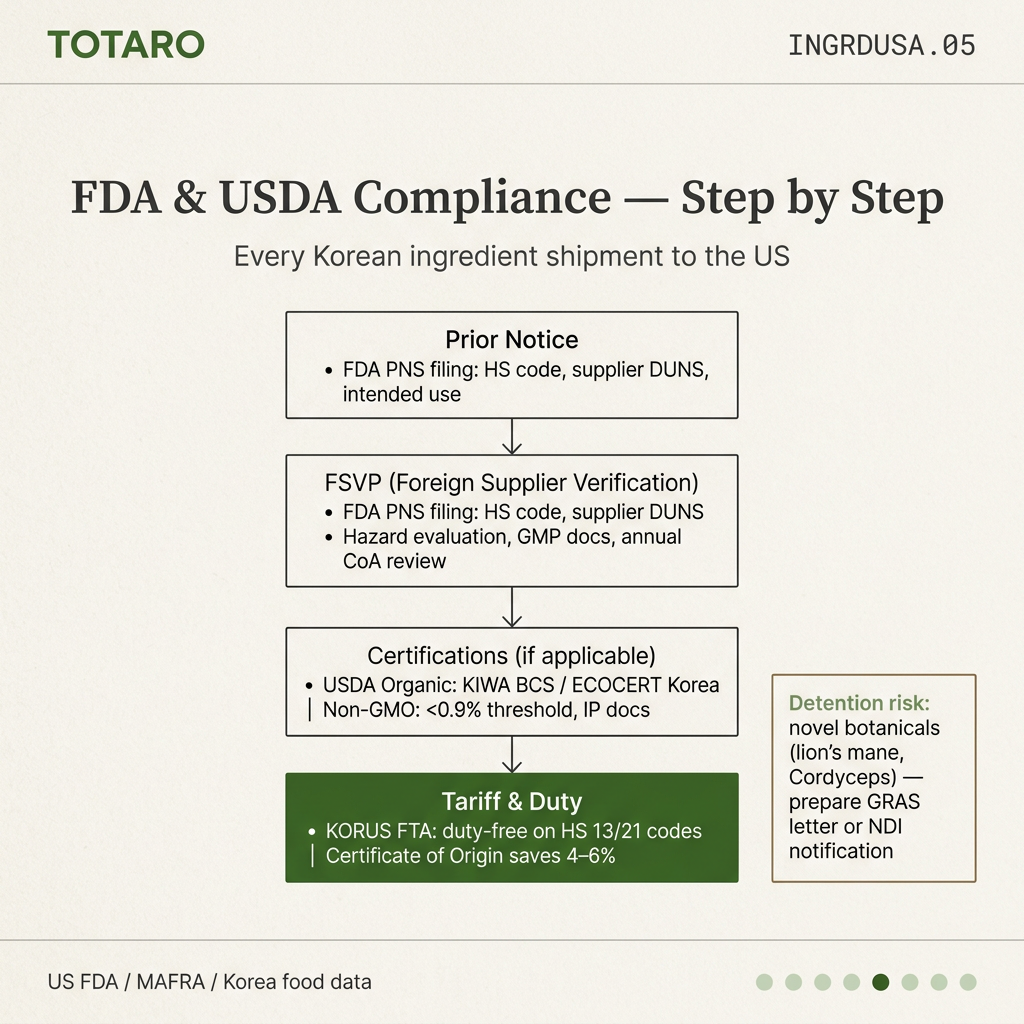
Prior Notice & FSVP
Every shipment of food-grade raw materials requires FDA Prior Notice filed via the Prior Notice System Interface (FDA PNS) or broker ABI. Include HS code, supplier DUNS, intended use ("ingredient for dietary supplement manufacture"), and US consignee address.
Under FSVP (Foreign Supplier Verification Program), the US importer must:
- Evaluate hazards (allergens, heavy metals, pathogens).
- Document supplier GMP and testing.
- Conduct verification activities (annual CoA review, on-site audit every 1–3 years, or third-party certification).
For red ginseng and fermented ingredients, key hazards are pesticide residues (Korea Maximum Residue Limits often stricter than EPA tolerances) and microbial contamination. Request supplier's HACCP plan and annual third-party micro testing.
USDA Organic & Non-GMO Certification
If marketing "USDA Organic," the Korean supplier must hold certification from a USDA-accredited body operating in Korea—examples include KIWA BCS Korea and ECOCERT Korea. Organic red ginseng acreage in Geumsan and Punggi counties has grown 30% since 2020, driven by US and EU demand.
For Non-GMO Project Verification, Korean suppliers of soy-derived lecithin or corn maltodextrin must provide IP (Identity Preserved) documentation and annual testing <0.9% GMO threshold. Korea produces minimal GMO crops domestically, but imported corn and soy for processing require traceability.
Tariff & Duty
Most Korean health food raw materials enter duty-free or low-duty under MFN (Most Favored Nation) rates. The US–Korea Free Trade Agreement (KORUS FTA, effective 2012) eliminated tariffs on many HS 13 (lac, gums, resins, extracts) and HS 21 (miscellaneous edible preparations) codes. Confirm eligibility by ensuring the Korean supplier provides a KORUS Certificate of Origin; this can save 4–6% on dutiable items.
Pricing, MOQs & Container Economics
Korean ingredient suppliers typically quote FOB Busan or FOB Incheon. Freight, insurance, and customs are buyer's responsibility.
Container options:
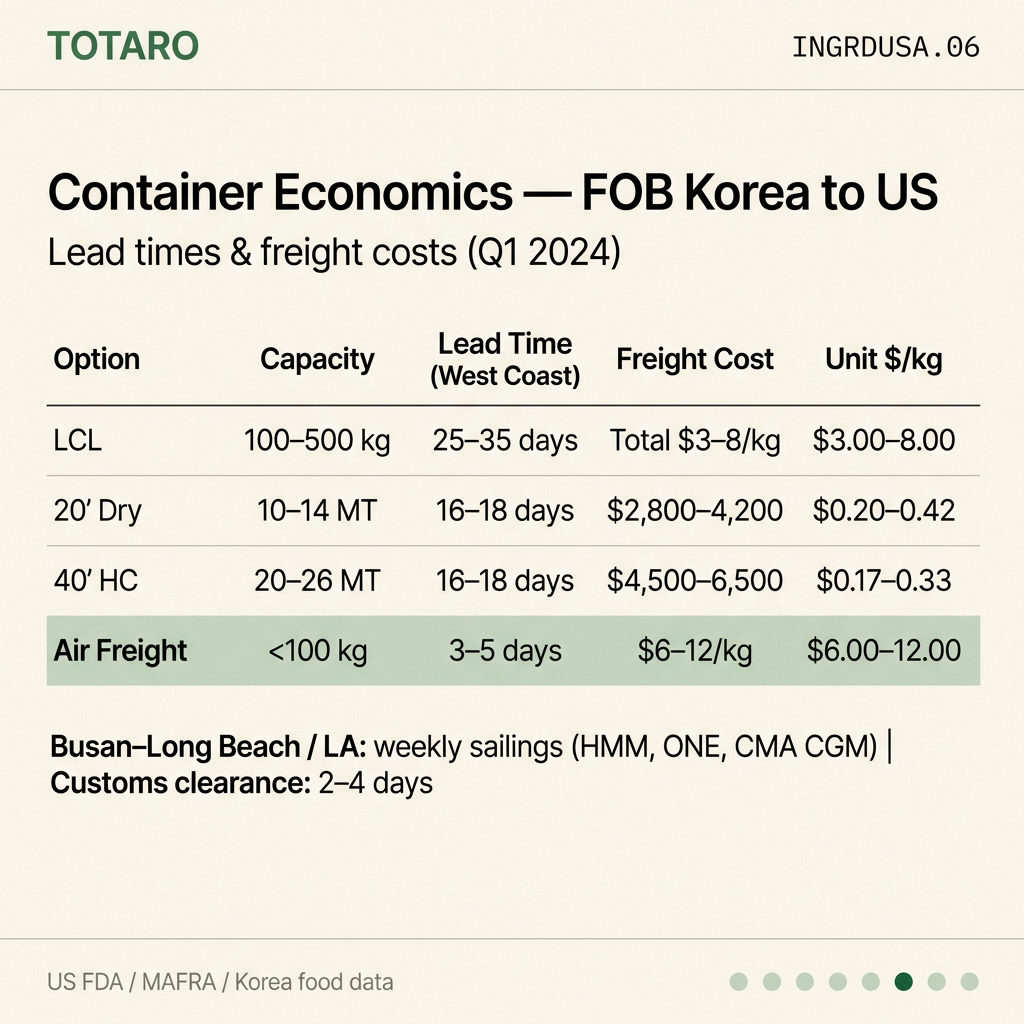
- LCL (Less-than-Container Load): 100–500 kg. Consolidation via Busan or Incheon. Lead time 25–35 days to US West Coast, 40–50 days to East Coast. Freight $3–8/kg.
- 20' dry container: 10–14 MT (pallet config). Busan–Long Beach 16–18 days, all-in freight $2,800–4,200 (as of Q1 2024). Unit freight $0.20–0.42/kg.
- 40' HC dry: 20–26 MT. Preferred for powders. Freight $4,500–6,500. Unit cost drops to $0.17–0.33/kg.
Payment terms:
First orders: 30–50% deposit, balance against copy of B/L (Bill of Lading).
Established accounts: Net 30–60, or Letter of Credit (LC) at sight for orders >$100,000. Korean banks (KEB Hana, Shinhan) issue LCs accepted by US correspondent banks.
Price stability:
Red ginseng extract prices spiked 22% in 2021–2022 due to poor harvests in Geumsan; stabilized in 2023. Marine collagen peptides track Alaska pollock quotas (managed by NOAA)—2024 Bering Sea quota up 15%, supporting price softness.
Logistics & Lead Times
Port pairs:
- Busan–Long Beach/LA: 14–18 days ocean, weekly sailings (HMM, ONE, CMA CGM).
- Busan–Tacoma: 16–19 days; less congestion than LA in 2023.
- Incheon–Newark/Savannah: 28–35 days; transshipment via Busan common.
Air freight:
For trial orders (<100 kg) or time-sensitive launches, Incheon–LAX or Incheon–JFK air freight runs $6–12/kg, 3–5 days door-to-door. Korean Air Cargo and Asiana Cargo offer pharma/temp-controlled options for probiotics or enzyme blends.
Customs clearance:
Budget 2–4 days at US port. Ingredient shipments rarely trigger FDA sampling if supplier has clean import history. Detention risk higher for novel botanicals (lion's mane, Cordyceps) if FDA questions GRAS status—prepare a GRAS self-determination letter or NDI notification before first import.
Working with Korean Ingredient Platforms & Agents
Many mid-sized Korean suppliers do not maintain US sales staff. Three pathways for US buyers:
-
Direct contact: Supplier websites often list English inquiry forms. Response time 24–48 hours. Expect initial quotes in USD FOB, with technical data sheets (TDS) in English and Korean.
-
Korean trade missions: Korea Agro-Fisheries & Food Trade Corporation (aT Center) organizes US buyer delegations and hosts Korea pavilions at SupplySide West, Natural Products Expo West, and IFT FIRST. Meetings pre-arranged, samples on-site.
-
B2B sourcing platforms: TOTARO consolidates Korean ingredient suppliers with verified FDA documentation, English CoAs, and transparent MOQs. Buyers request quotes, compare 3–5 suppliers, and book sample shipments in one workflow—cutting diligence time from weeks to days.
FAQ
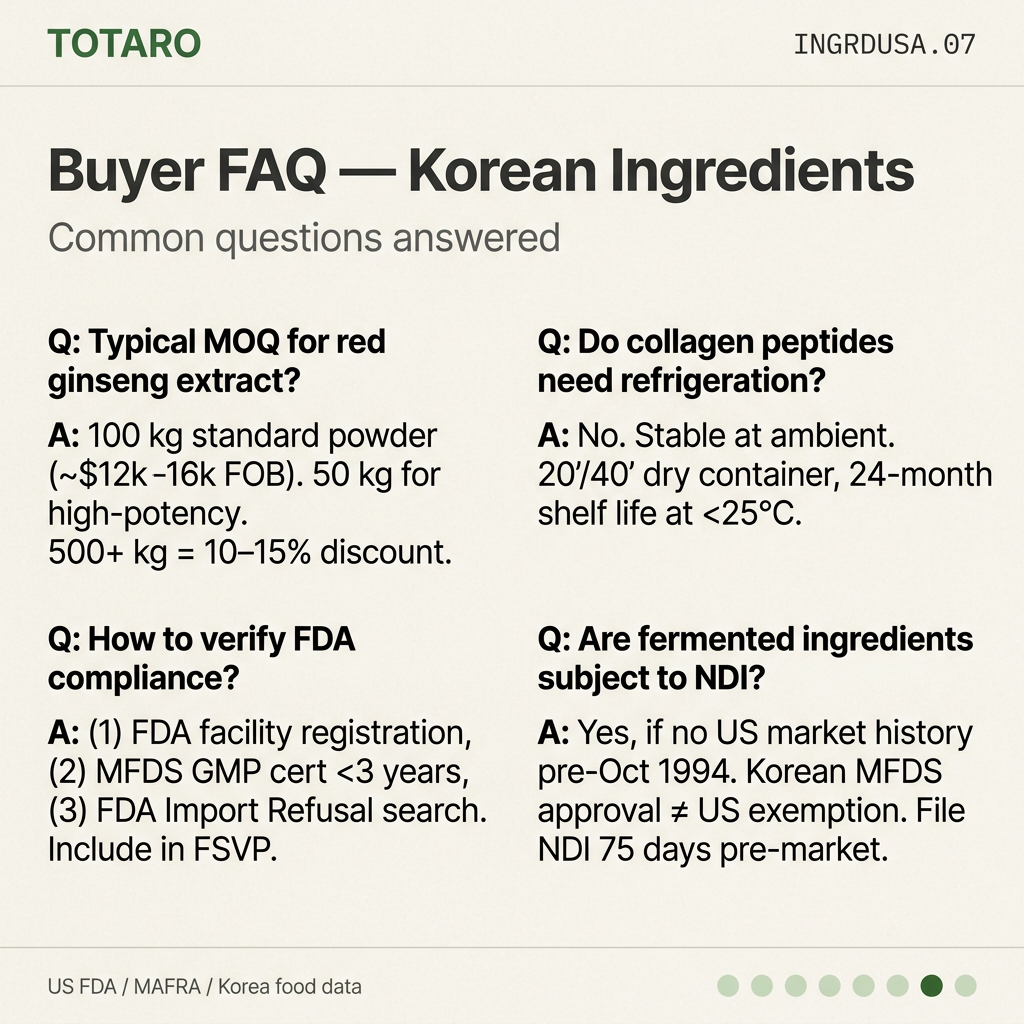
What is the typical MOQ for Korean red ginseng extract?
Standard spray-dried powder (10% ginsenosides) starts at 100 kg, roughly $12,000–16,000 FOB. High-potency extracts (80 mg/g) may have 50 kg MOQs. Volume buyers ordering 500+ kg annually negotiate 10–15% price reductions and extended payment terms.
Do Korean collagen peptides require refrigeration during shipment?
No. Marine collagen peptides are stable at ambient temperature. Standard 20' or 40' dry containers suffice; no reefer premium. Shelf life typically 24 months in sealed, moisture-barrier packaging when stored below 25°C.
How do I verify a Korean supplier's FDA compliance for ingredient imports?
Check three items: (1) FDA food facility registration number (search the FDA registry at access.fda.gov); (2) current MFDS GMP certificate (request copy, verify date within 3 years); (3) search FDA Import Refusals by firm name and product code to confirm no recent detentions. Include these documents in your FSVP records.
Are Korean fermented ingredients subject to FDA NDI notification?
If the fermented ingredient or postbiotic strain was not marketed in the US before October 15, 1994, it qualifies as a New Dietary Ingredient and requires NDI notification 75 days pre-market. Korean MFDS approval does not exempt US NDI rules. Work with the supplier to determine US market history or file an NDI jointly; many Korean firms partner with US regulatory consultants for this step.
Related Guides
Ask AI to find your Korean food supplier
Describe what you need in plain language — get matched with verified suppliers in seconds.
Try AI Supplier Search