카드 1 / 8
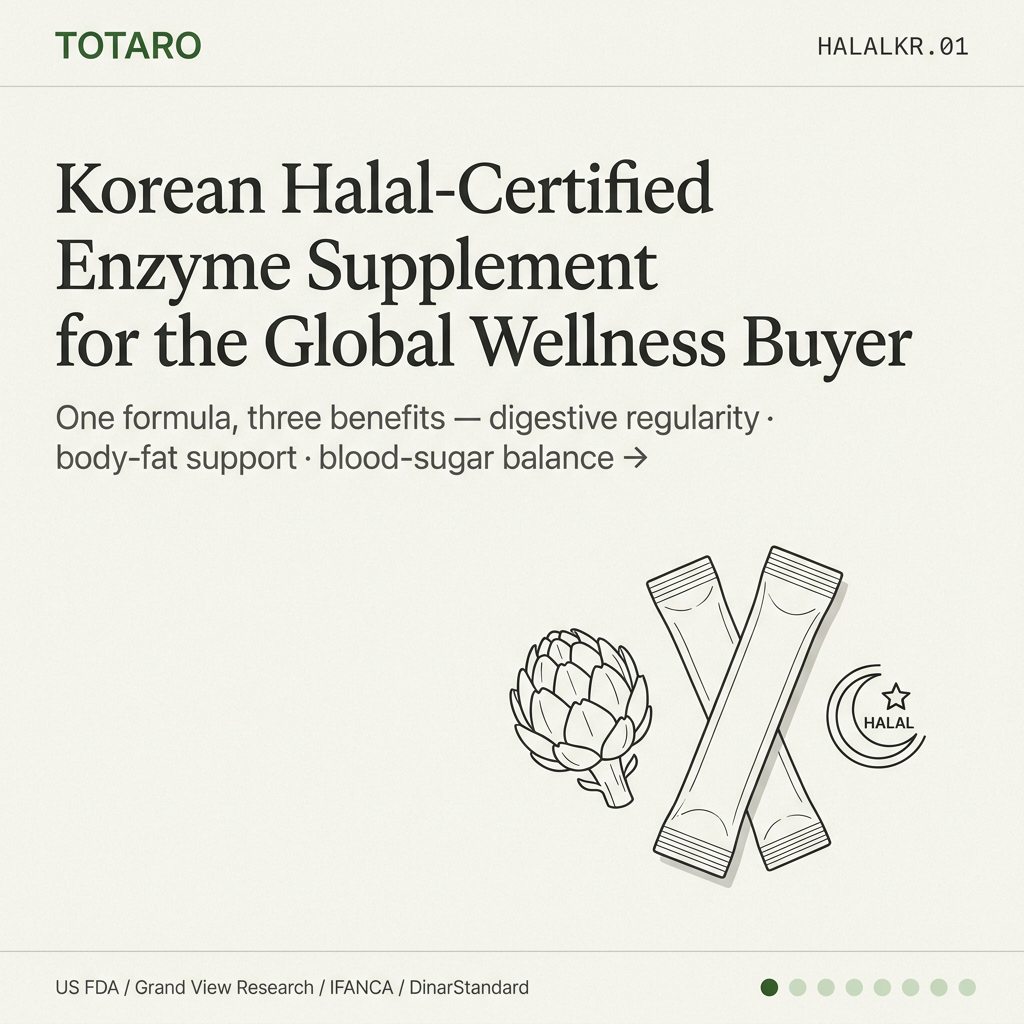
Sourcing Halal-Certified Korean Enzyme Supplements: A Buyer's Guide
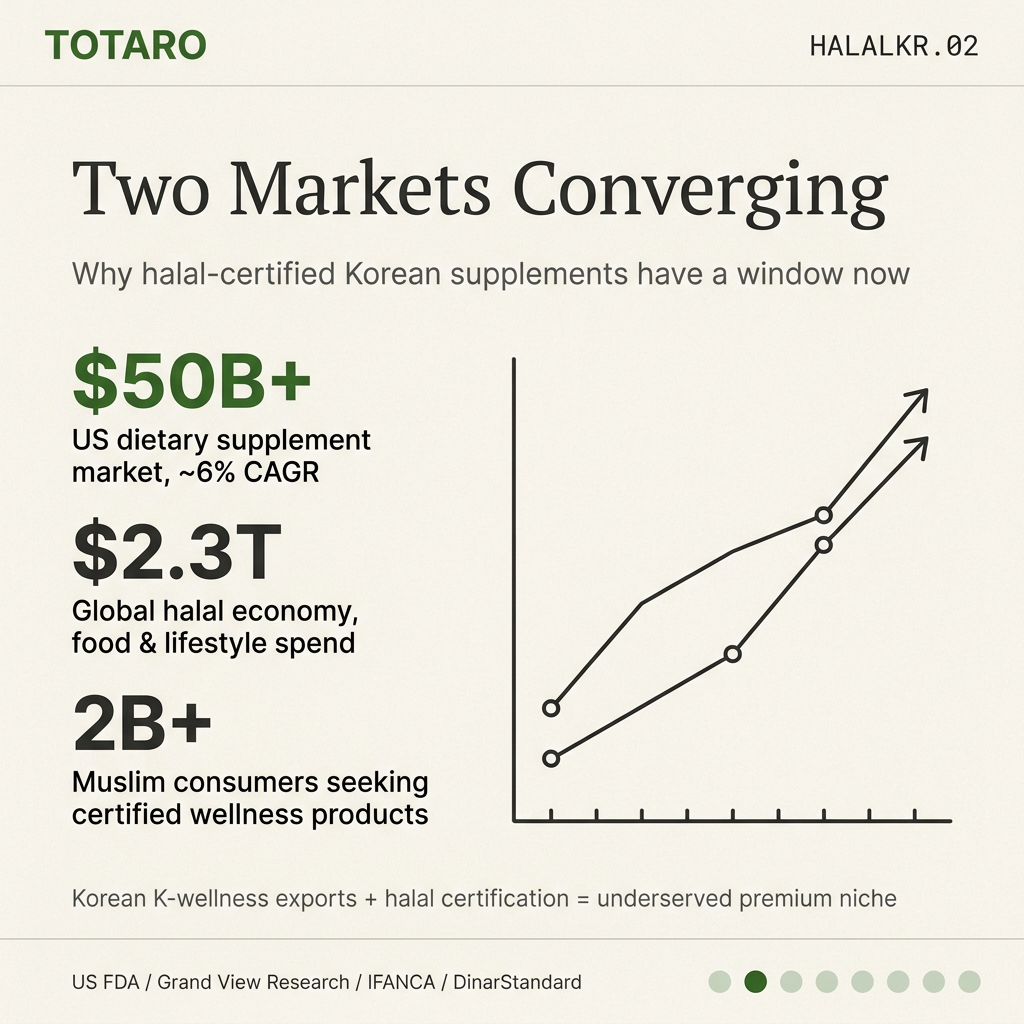
The global wellness shelf is being reshaped by two fast-growing forces: the $50 billion+ US dietary supplement market growing at roughly 6% a year, and the $2.3 trillion global halal economy serving more than two billion consumers who actively seek certified food and lifestyle products. Where those two markets overlap — halal-certified, science-backed functional supplements made in Korea — supply is still thin. That gap is the opportunity for importers, distributors, and private-label brands.
This guide walks through what a buyer needs to evaluate when sourcing a halal-certified Korean enzyme and fiber supplement: the market context, the core ingredients, the dual regulatory path (US FDA plus halal certification), realistic pricing and trade terms, and the distribution channels that actually move product.
Why Halal-Certified Korean Supplements Have a Window
K-wellness rides the same cultural wave as K-beauty and K-food. Korean manufacturers are trusted for clean formulation, consistent GMP quality, and plant-forward functional ingredients. Yet most Korean supplements ship without halal certification, which locks them out of the Middle East, Southeast Asia, and the growing halal-conscious segment in North America and Europe.
A Korean supplement that is both functionally credible and halal-certified can therefore occupy a premium niche with far less competition than a generic US-made fiber capsule. Buyers who secure that supply early build a defensible assortment.
The Product: One Formula, Three Benefits
The category this guide focuses on is a complex enzyme-and-fiber supplement positioned around three everyday wellness concerns:
- Digestive regularity — supporting comfortable, predictable bowel function
- Body-fat support — supporting fat metabolism as part of a calorie-aware routine
- Blood-sugar balance — supporting steady post-meal glucose response
These are structure/function positioning angles, not disease claims. Any importer must keep claims within the rules of the destination market (see the compliance section below).
Core Functional Ingredients
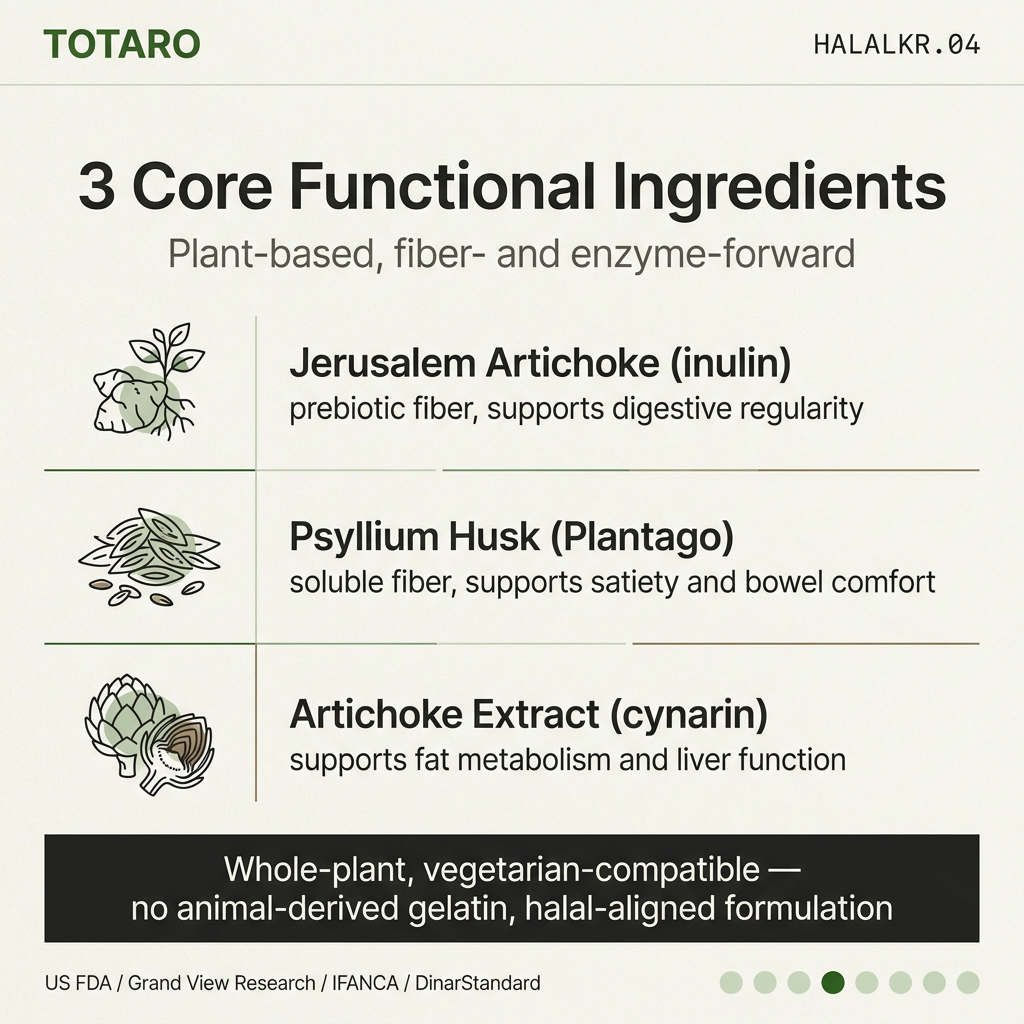
| Ingredient | Source | Functional Role |
|---|---|---|
| Jerusalem artichoke (inulin) | Tuber | Prebiotic soluble fiber; supports gut flora and digestive regularity |
| Psyllium husk | Plantago ovata | Soluble fiber; supports satiety and bowel comfort |
| Artichoke extract (cynarin) | Leaf | Supports fat metabolism and liver function |
The formulation is whole-plant and vegetarian-compatible, avoiding animal-derived gelatin — which simplifies the halal pathway and broadens appeal to vegan and clean-label shoppers as well.
The Maker Landscape
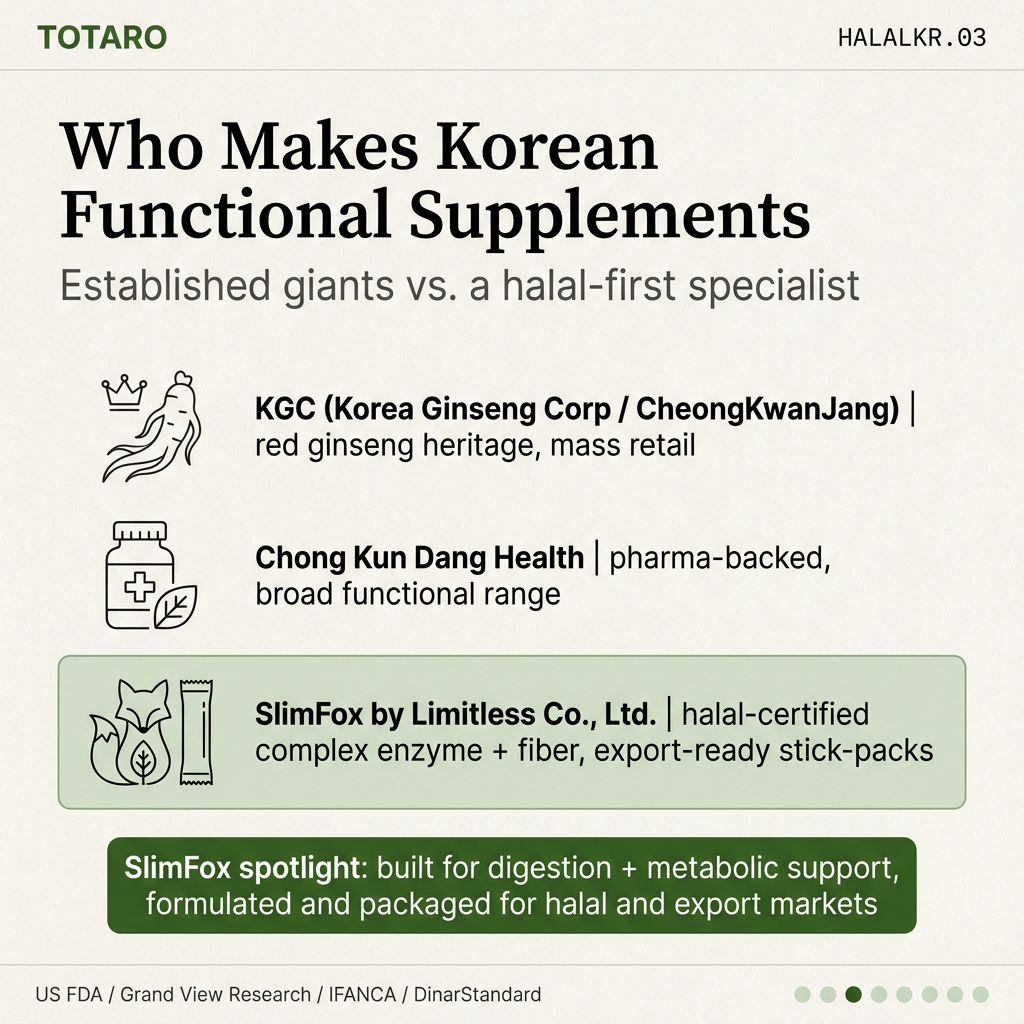
Korea's functional-supplement industry is anchored by large players such as KGC (Korea Ginseng Corporation / CheongKwanJang), known for red ginseng, and Chong Kun Dang Health, a pharma-backed maker with a broad functional range. These giants serve mass retail but rarely build halal-first, export-ready SKUs.
That leaves room for specialists. SlimFox, made by Limitless Co., Ltd. (주리미트리스), is one example positioned specifically around a halal-certified complex enzyme and fiber formula delivered in export-friendly stick-pack sachets. For a buyer, the practical point is that a focused specialist is often more willing to support private-label, English/Arabic labeling, and smaller pilot runs than a mass-market incumbent.
Specs and Trade Terms
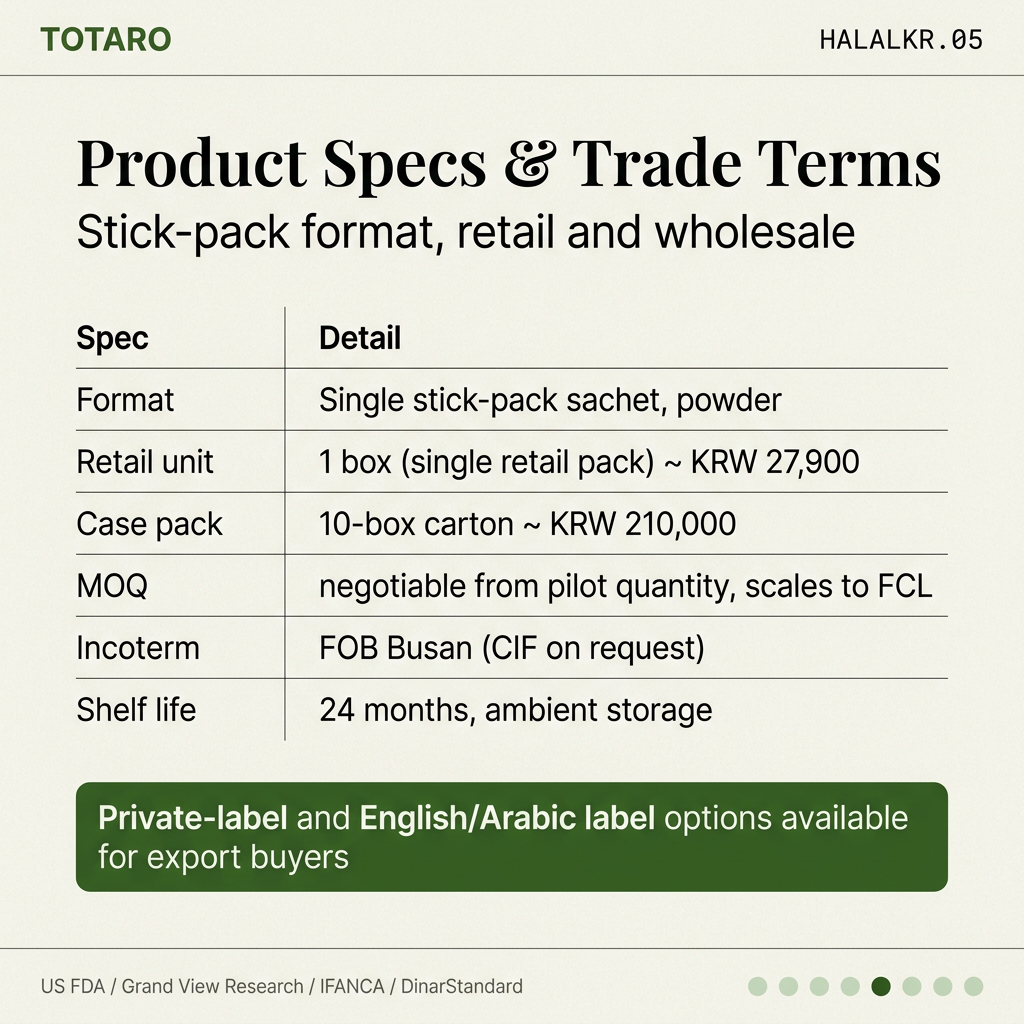
Typical specifications and commercial terms for a stick-pack supplement of this type:
- Format: single-serve stick-pack sachet, powder
- Retail unit: one box (single retail pack), around KRW 27,900
- Case pack: 10-box carton, around KRW 210,000
- MOQ: negotiable from a pilot quantity, scaling up to full container loads
- Incoterm: FOB Busan, with CIF available on request
- Shelf life: 24 months at ambient storage
Private-label and multilingual (English / Arabic) labeling options are commonly available for export buyers, which matters for Middle East retail compliance and shelf presentation.
Compliance: Two Gates Every Shipment Must Clear
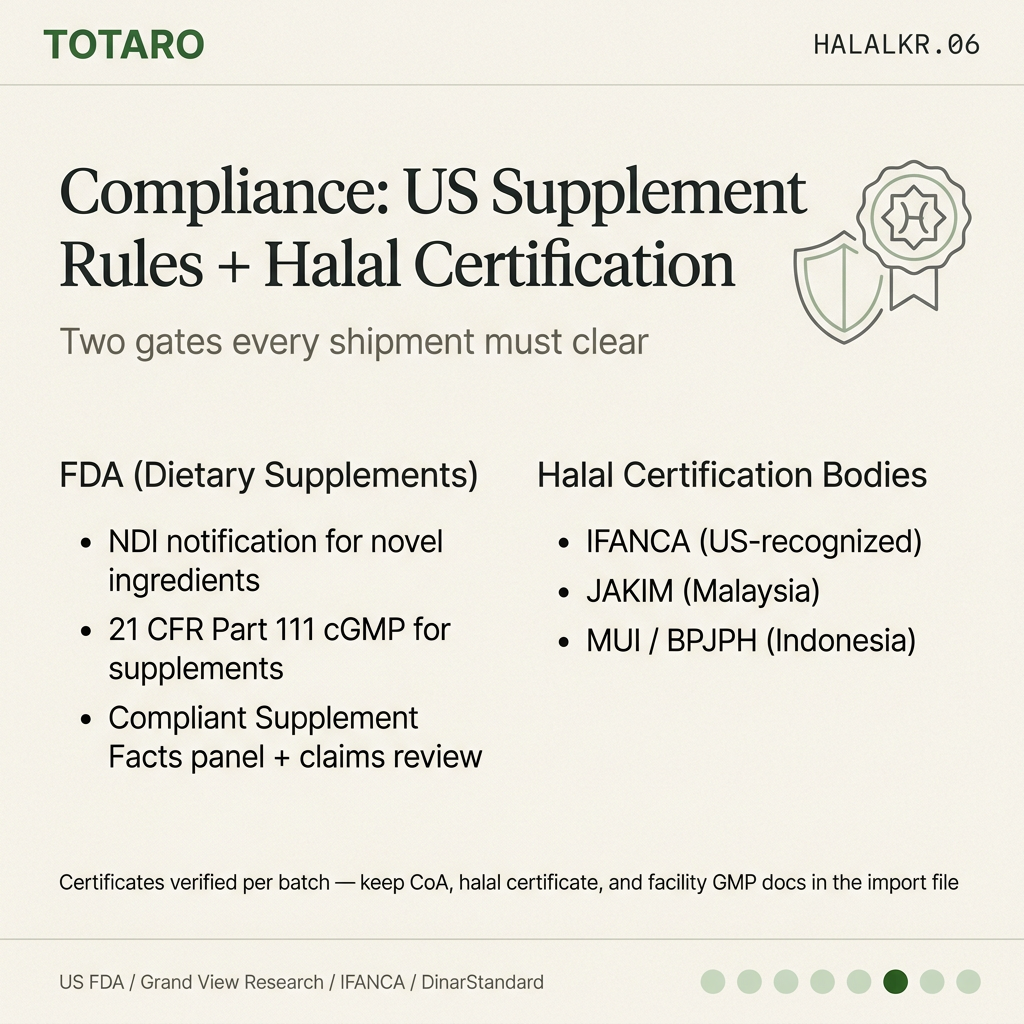
A halal Korean supplement bound for the US faces two parallel regulatory paths. Both must be satisfied.
Gate 1 — US FDA (Dietary Supplements)
- NDI notification: if the product contains a new dietary ingredient without a US marketing history before October 1994, a New Dietary Ingredient notification may be required at least 75 days before marketing.
- 21 CFR Part 111 cGMP: the manufacturing facility must meet current Good Manufacturing Practice for dietary supplements. Keep facility GMP documentation in the import file.
- Labeling and claims: a compliant Supplement Facts panel is required, and all claims must stay within permitted structure/function language — no disease-treatment claims.
Gate 2 — Halal Certification
Halal status is established by a recognized certifying body. The most relevant for Korean exporters serving global buyers include:
- IFANCA — widely recognized in the US market
- JAKIM — Malaysia's national authority
- MUI / BPJPH — Indonesia's certification and halal-assurance bodies
Verify certificates per batch and keep the Certificate of Analysis (CoA), the halal certificate, and the facility GMP documentation together in the import file. A halal certificate that does not match the production batch is a red flag at customs and with retail buyers alike.
Distribution Channels That Move Product
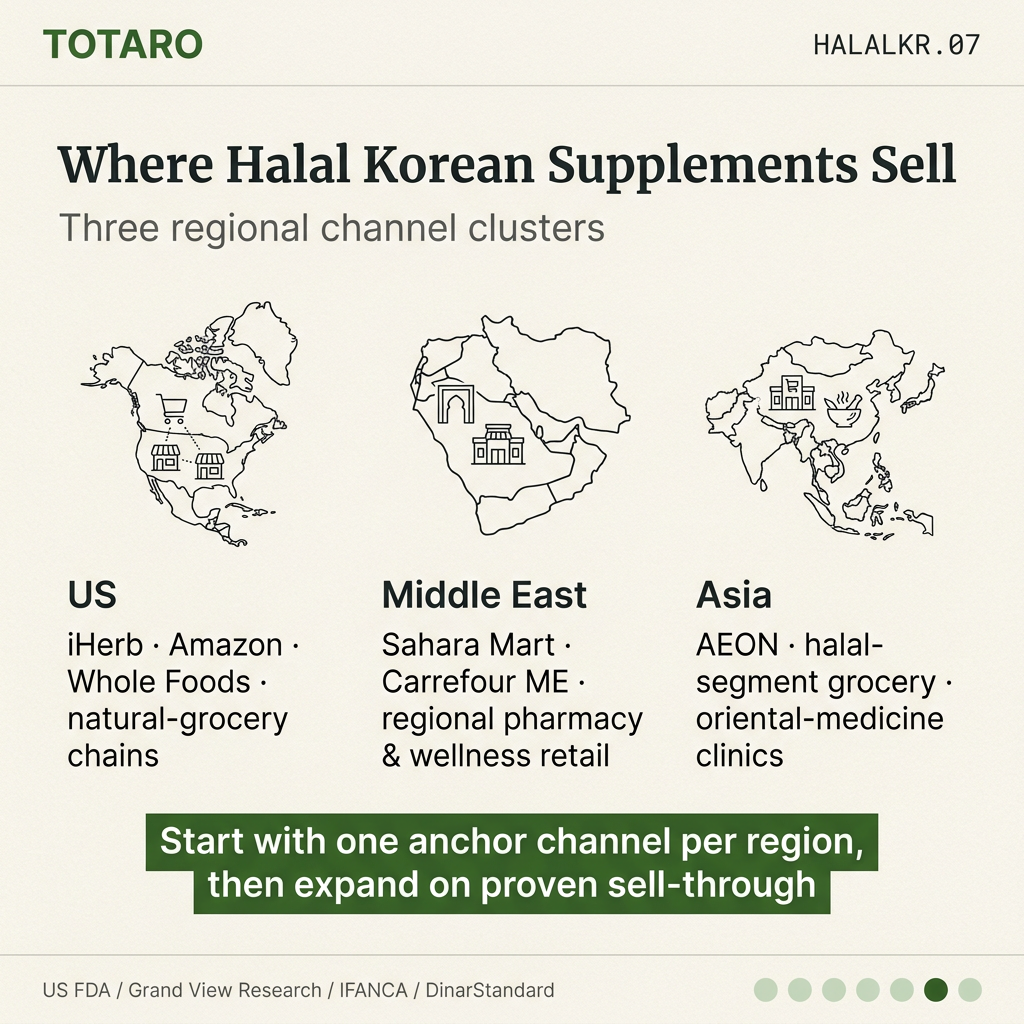
The addressable channels cluster into three regions:
- United States: iHerb, Amazon, Whole Foods, and natural-grocery chains
- Middle East: Sahara Mart, Carrefour Middle East, and regional pharmacy and wellness retail
- Asia: AEON, halal-segment grocery, and oriental-medicine (한의원) clinics
The practical strategy is to anchor one strong channel per region first, prove sell-through, then expand. Spreading thin across many retailers before you have velocity data burns marketing budget and inventory.
A Buyer's Starting Checklist
- Confirm the halal certifying body and that the certificate is current and batch-matched.
- Confirm facility GMP (21 CFR Part 111 for US) and request a recent CoA.
- Clarify whether any ingredient triggers an NDI notification for your market.
- Lock format, retail/case-pack pricing, and MOQ for a pilot order.
- Decide FOB vs. CIF and confirm labeling (English/Arabic, private label) needs early.
- Choose one anchor retail channel per target region for the launch.
FAQ
Is a halal certificate alone enough to import into the US?
No. Halal certification governs religious compliance and market acceptance, but US import still requires FDA dietary-supplement compliance — cGMP manufacturing under 21 CFR Part 111, compliant labeling, and an NDI notification where applicable. The two are independent gates.
Which halal certifier should I ask for?
It depends on your destination. IFANCA is widely recognized in the US, JAKIM for Malaysia, and MUI/BPJPH for Indonesia. Ask the manufacturer which bodies they are certified by and request the certificate to confirm scope and validity dates.
Can I private-label a Korean halal supplement?
Frequently yes, especially with specialist makers. Confirm minimum order quantities for custom labeling, lead times, and whether English/Arabic label artwork is supported in-house or must be supplied by you.
What MOQ should I expect for a first order?
Specialist makers often support a pilot quantity well below a full container, then scale to FCL once sell-through is proven. Negotiate the pilot MOQ and a follow-on volume price break in the same conversation.
Related Guides
Ask AI to find your Korean food supplier
Describe what you need in plain language — get matched with verified suppliers in seconds.
Try AI Supplier Search