카드 1 / 8
Korean Frozen Food US Wholesale: Mandu, Kimbap & HMR Guide
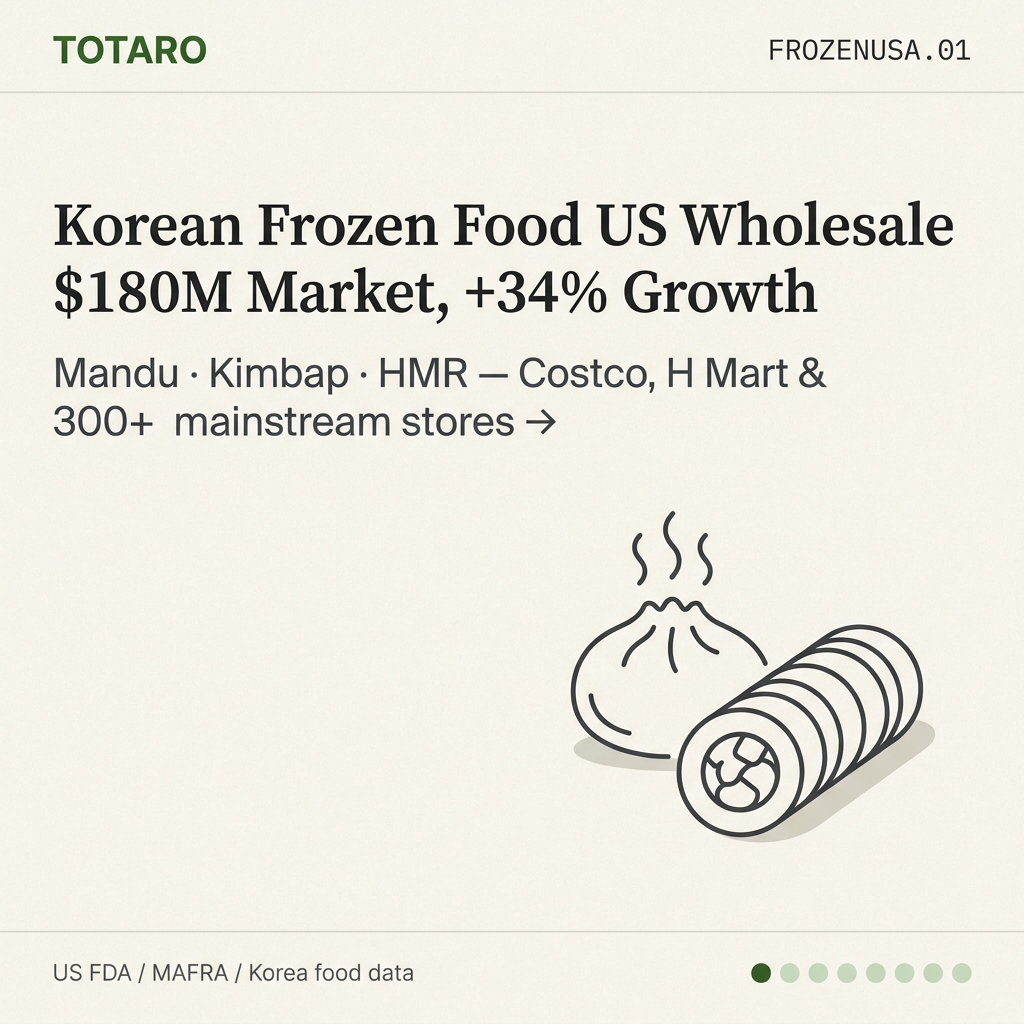
US demand for Korean frozen food — mandu (dumplings), kimbap (rice rolls), and heat-and-eat HMR (home meal replacement) — grew 34% from 2020 to 2023, according to KATI (Korea Agro-Trade Investments). The category now accounts for over $180 million in annual import value, driven by H Mart expansion, Costco's Korea Week promotions, and mainstream grocers adding Korean freezer sections.
For importers and distributors, frozen Korean food offers high-margin SKUs with 12–18 month shelf life and predictable landed costs. But cold-chain import is technical: you need reefer containers at -18 °C, FDA Food Facility Registration, FSVP compliance, and suppliers who can hit MOQ 1–2 containers (roughly 1,200–2,400 cases per SKU).
This guide covers the full workflow — product categories, supplier tiers, container logistics, regulatory steps, and wholesale pricing structure — for US buyers sourcing Korean frozen food at scale in 2024.
Why Korean Frozen Food Is Hot in US Wholesale
Three forces converged in the past four years.
Retail footprint. H Mart operates 97 US stores as of Q1 2024, up from 72 in 2020. Each new store stocks 80–120 frozen SKUs. Costco ran Korea-themed promotions in 600+ locations in 2023, featuring Bibigo mandu, CJ CheilJedang frozen rice, and Pulmuone kimbap. Kroger, Safeway, and Whole Foods added Korean frozen sections in 300+ stores combined.
Pandemic buying habits. US households bought 22% more frozen meals in 2020–2021 than in 2019, per Nielsen. Once shoppers tried frozen mandu and tteokbokki, repeat rates hit 40–50% (KATI data). The format — portion-controlled, microwaveable, no prep — stuck.
Production capacity. Korea's Big 3 frozen-food manufacturers — CJ CheilJedang (Bibigo brand), Pulmuone, and Dongwon F&B — added six new export-certified lines between 2019 and 2023. Combined annual capacity now exceeds 280,000 tons. MOQs dropped from 3–4 containers to 1–2 containers for established importers, opening the door for mid-sized distributors.
The result: frozen Korean food is no longer niche. It's a core category with predictable velocity, clear supply chain, and room for private-label or exclusive SKUs.
Core Product Categories & US Market Fit
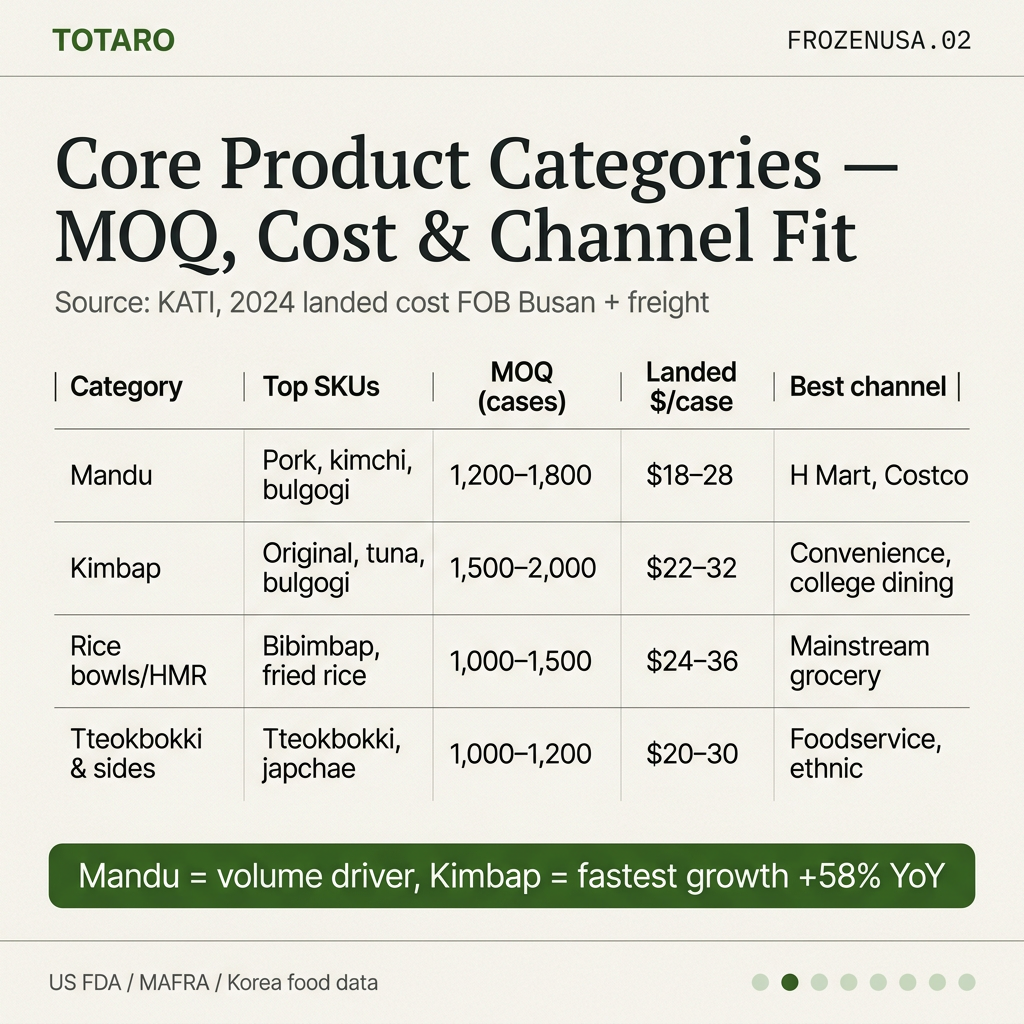
Korean frozen food breaks into four buckets. Each has different margin profile, MOQ, and target channel.
| Category | Top SKUs | Typical MOQ (cases) | Landed cost per case (FOB + freight) | Retail price point | Best channel |
|---|---|---|---|---|---|
| Mandu | Pork & vegetable, kimchi, beef bulgogi | 1,200–1,800 | $18–28 | $5.99–8.99 (16–24 oz bag) | H Mart, Costco, Asian grocers |
| Kimbap | Original, tuna, bulgogi | 1,500–2,000 | $22–32 | $3.99–6.99 (3–4 rolls) | Convenience, college dining, grab-and-go |
| Rice bowls / HMR | Bibimbap, fried rice, jjajangbap | 1,000–1,500 | $24–36 | $6.99–9.99 (10–12 oz bowl) | Mainstream grocery, club stores |
| Tteokbokki & sides | Tteokbokki (rice cakes in sauce), japchae | 1,000–1,200 | $20–30 | $4.99–7.99 | Foodservice, ethnic retailers |
Mandu is the volume driver. CJ's Bibigo brand sold over 15 million units in the US in 2023. Pork-and-vegetable is the baseline SKU; kimchi mandu and bulgogi variations add margin. Pan-fry or steam prep makes it easy for foodservice.
Kimbap is the fastest-growing segment — up 58% year-over-year in 2023. Pulmuone and smaller makers like Choripdong ship flash-frozen rolls that thaw in 2–3 hours at ambient or microwave in 90 seconds. Colleges, hospitals, and 7-Eleven-style chains are testing Korean kimbap as sushi alternatives at lower cost.
Rice bowls and HMR target time-pressed households. Bibimbap bowls with gochujang sauce sachet, fried rice with bulgogi, and jjajangbap (black-bean noodles) retail at $6.99–9.99. Margin is 35–42%, higher than ambient instant noodles. MOQs are lower because production runs are shorter.
Tteokbokki and sides serve two niches: foodservice operators who want authentic Korean snacks, and specialty retailers. Tteokbokki is sauce-heavy and reheats well in microwave or steamer. Japchae (glass noodles with vegetables) is popular for catering and meal-prep kits.
Supplier Tiers: Big 3, Mid-Tier OEMs & Regional Brands
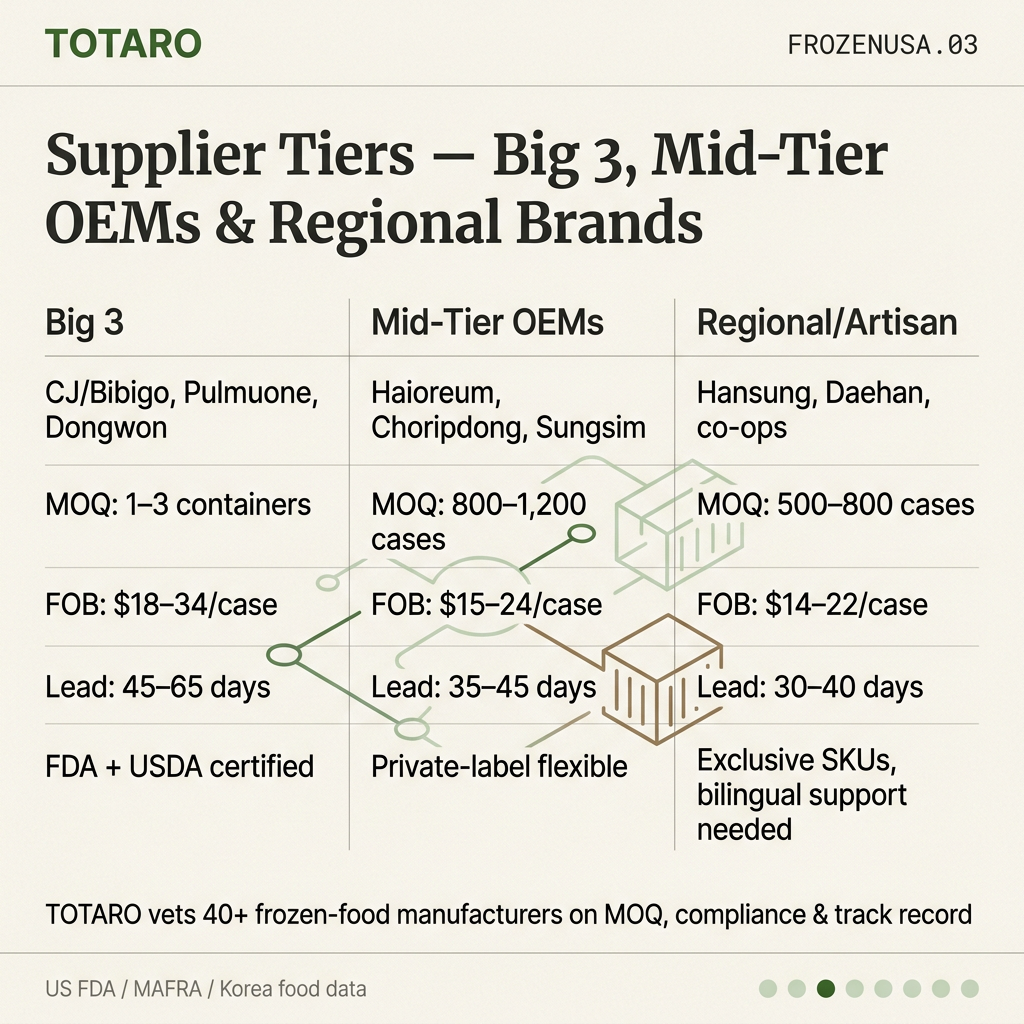
Korean frozen-food supply breaks into three tiers, each with trade-offs on MOQ, price, customization, and speed.
Big 3 — CJ CheilJedang (Bibigo), Pulmuone, Dongwon F&B
CJ CheilJedang is the 800-pound gorilla. Bibigo mandu is in 4,000+ US stores. CJ operates FDA-registered plants in Korea and the US (Foodservice plant in New Jersey). They offer 20+ frozen SKUs — mandu, rice bowls, Korean fried chicken, potstickers.
MOQ: 2–3 containers for new accounts, 1 container for repeat. Lead time 45–60 days. FOB Busan prices run $18–26 per case for mandu, $24–34 for rice bowls.
Pulmuone specializes in health-focused HMR. Their frozen kimbap and tofu-based bowls use non-GMO ingredients and organic certifications. MOQ is 1–2 containers. Lead time 50–65 days. FOB Busan $22–32 per case. Pulmuone has a US office in Fullerton, CA, which can facilitate FSVP and regulatory docs.
Dongwon F&B (Yangban, Dongwon brands) offers tuna kimbap, tteokbokki, and side dishes. MOQ 1,200–1,800 cases per SKU. Lead time 40–50 days. FOB Incheon $20–28 per case. Strong in foodservice because they ship bulk 5 lb and 10 lb formats.
Mid-Tier OEMs — Haioreum, Choripdong, Sungsim Foods
These factories produce for multiple brands, including private-label. Haioreum supplies H Mart house brand frozen mandu and kimbap. Choripdong makes kimbap for regional grocers. Sungsim specializes in vegetarian and vegan mandu (tofu, mushroom fillings).
MOQ: 800–1,200 cases. Lead time 35–45 days. FOB Busan $15–24 per case. They're flexible on packaging, labeling, and minor recipe tweaks (spice level, wrapper thickness). Many speak fluent English and have experience with FDA labeling requirements.
Regional & Artisan Brands — Hansung, Daehan Food, local co-ops
Smaller producers in Busan, Gwangju, and Jeolla provinces. They focus on traditional recipes — kimchi mandu with house-made kimchi, wild-vegetable kimbap, handmade tteok (rice cakes). Quality can be outstanding, but consistency and MOQ are challenges.
MOQ: 500–800 cases. Lead time 30–40 days. FOB Busan $14–22 per case. Best for specialty retailers or exclusive SKUs. You'll need a bilingual agent or TOTARO to handle contracting, QC, and export docs.
Cold-Chain Import: Reefer Containers, Temperature & Timing
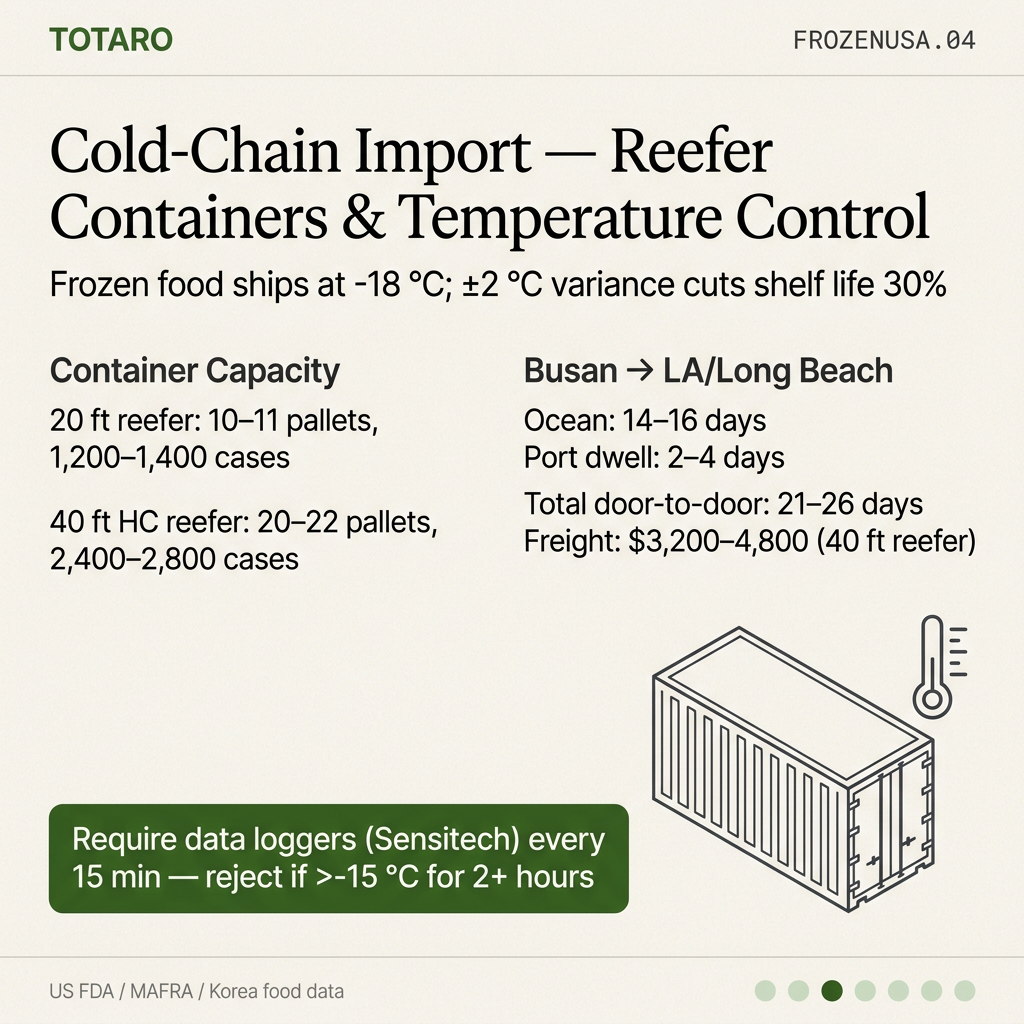
Frozen Korean food ships in 20 ft or 40 ft reefer containers set to -18 °C (-0.4 °F). Temperature precision is non-negotiable: +2 °C variance can shorten shelf life by 30%.
Container capacity
- 20 ft reefer: 10–11 pallets, roughly 1,200–1,400 cases (40–45 cases per pallet, depending on case dimensions).
- 40 ft high-cube reefer: 20–22 pallets, roughly 2,400–2,800 cases.
Most importers start with a 20 ft reefer split across 2–3 SKUs to test velocity.
Shipping routes & lead times
- Busan → Los Angeles / Long Beach: 14–16 days ocean transit. Port dwell 2–4 days. Total door-to-door (Korea factory to US cold-storage) 21–26 days.
- Busan → Oakland / Seattle / Tacoma: 16–18 days ocean. Shorter drayage if your warehouse is in NorCal or Pacific Northwest.
- Busan → Savannah / Newark / Houston: 28–34 days via Suez or Panama Canal. East Coast buyers often consolidate shipments or order larger volumes to justify the longer transit.
Freight cost (2024 rates, subject to seasonal swings):
- Busan → LA/Long Beach, 40 ft reefer: $3,200–4,800 depending on carrier (CMA CGM, Maersk, HMM).
- Busan → Oakland: $3,400–5,000.
- Busan → East Coast: $5,500–7,500.
Reefer surcharge runs $400–800 per container above dry rates. Peak season (October–January for holiday stocking) adds 15–25%.
Temperature monitoring
Require suppliers to install data loggers (Sensitech TempTale, Elpro Libero) inside containers. Log every 15 minutes. If temperature exceeds -15 °C for more than 2 hours, inspect and potentially reject the shipment. Your marine cargo insurance should cover temperature deviation claims — add "reefer breakdown" rider.
US cold-storage drayage
Most US ports have public cold-storage facilities (Americold, Lineage Logistics, Preferred Freezer). Drayage from port to cold-storage runs $250–450 per container (LA/Long Beach). Monthly storage is $0.40–0.60 per cubic foot. Plan 7–14 days of port-side storage while you arrange final-mile distribution.
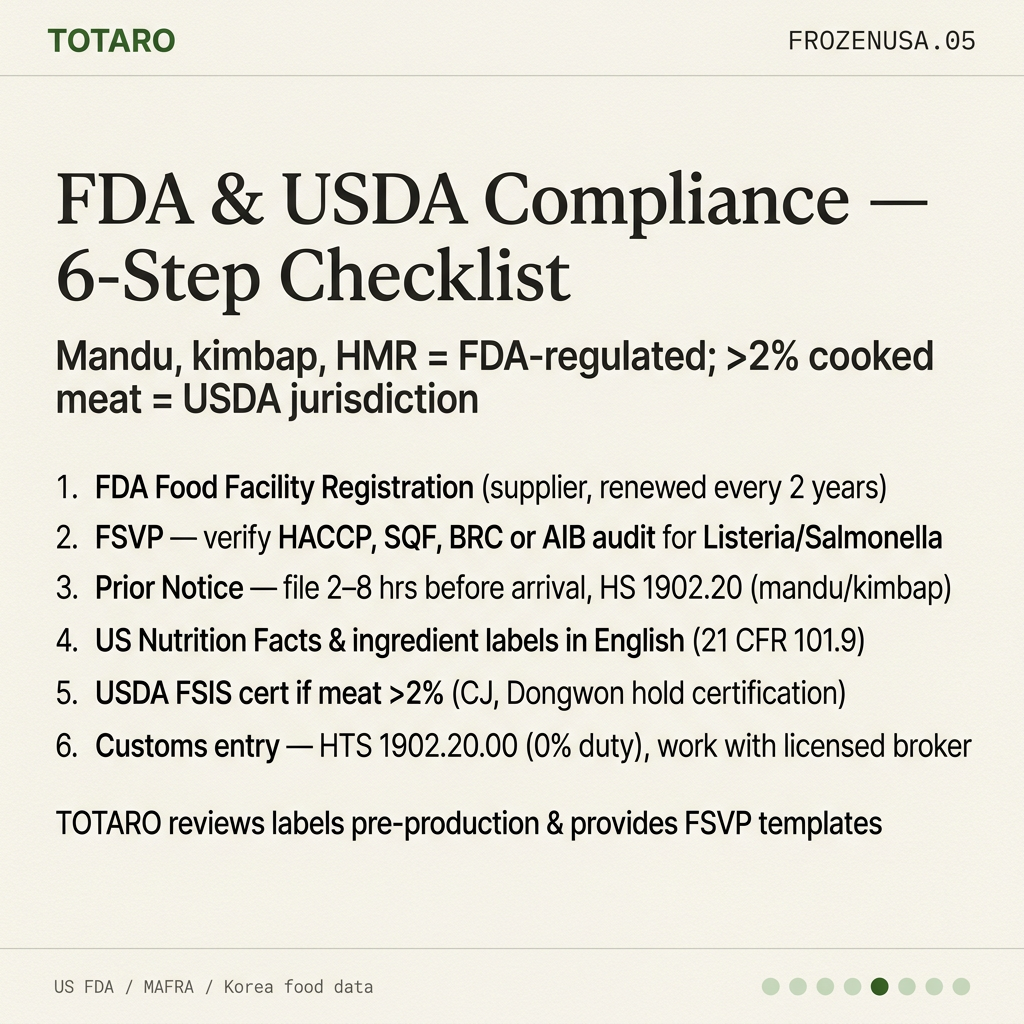
FDA & USDA Compliance for Frozen Korean Food
Frozen mandu, kimbap, and HMR are FDA-regulated foods. USDA jurisdiction applies only if the product contains more than 2% cooked meat or poultry (e.g., bulgogi mandu may need USDA if beef exceeds 2% by weight).
Key regulatory steps:
-
FDA Food Facility Registration. Your Korean supplier must have an active FDA Food Facility Registration (renewed every two years). Verify registration number at FDA.gov before contracting.
-
FSVP (Foreign Supplier Verification Program). You, as the US importer, must identify hazards, verify supplier controls, and maintain FSVP records. For frozen food, critical hazards are Listeria monocytogenes, Salmonella, and temperature abuse. Require HACCP certification or third-party audit (AIB, SQF, BRC) from your supplier.
-
Prior Notice. File FDA Prior Notice 2–8 hours before shipment arrival (frozen food = 8-hour window). Include HS codes (most frozen mandu = 1902.20, frozen kimbap = 1902.20 or 1604.20 depending on filling), manufacturer name, and intended use.
-
Nutrition labeling. Ensure Korean supplier prints US-compliant Nutrition Facts panels (21 CFR 101.9) and ingredient lists in English. Common errors: wrong serving size, missing allergen bold, incorrect rounding. TOTARO can review labels pre-production.
-
USDA (if applicable). If your mandu or kimbap contains >2% cooked meat/poultry, the Korean plant must be USDA FSIS-certified. As of 2024, six Korean frozen-food plants hold USDA certification (including CJ and Dongwon). USDA shipments require export certificates (Form 9060) and may have longer lead times.
-
Customs entry & tariffs. Frozen mandu and kimbap enter under HTS 1902.20.00 (stuffed pasta) at 0% duty under Most Favored Nation. Frozen rice bowls may be 1901.90.90 (food preparations) at 6.4%. Work with a licensed customs broker (e.g., Flexport, Shapiro, Livingston) to classify correctly and file entry summaries.
Wholesale Pricing, Margin & Payment Terms
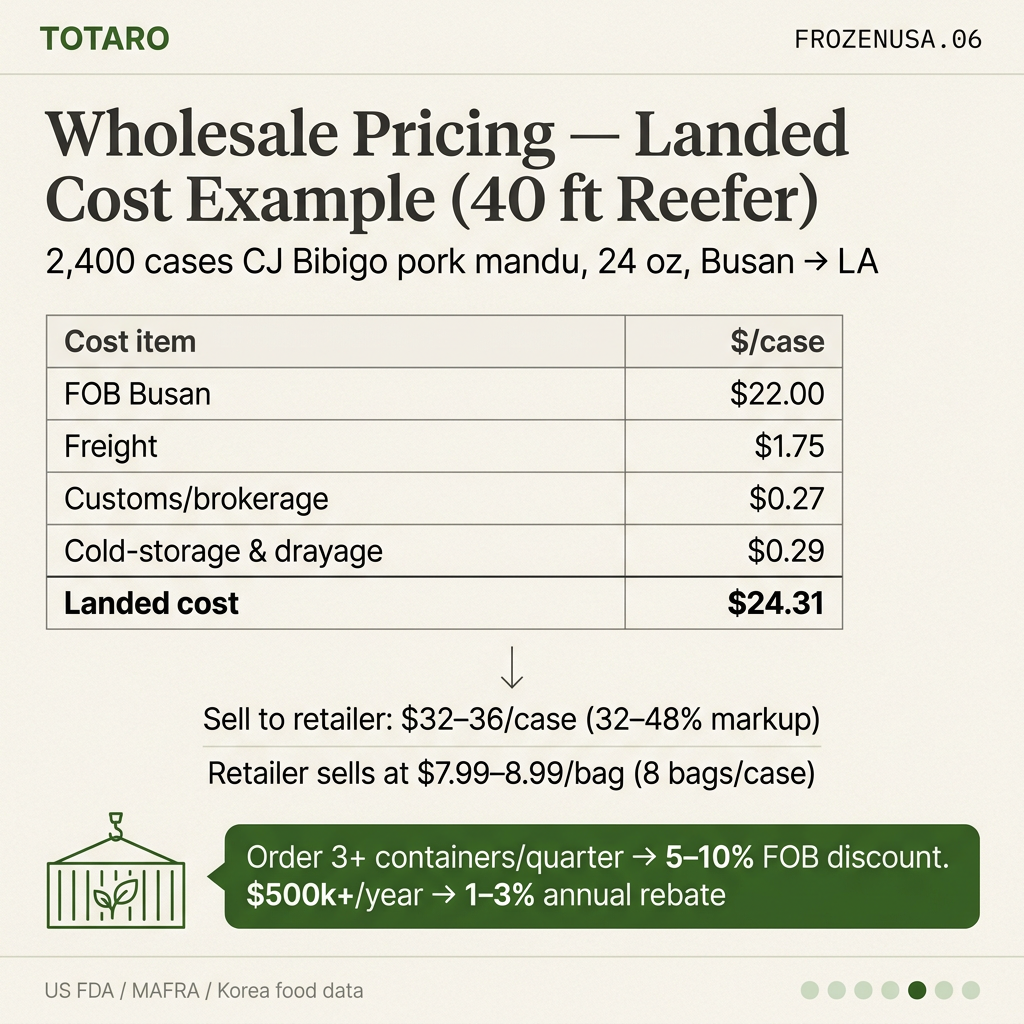
Landed cost = FOB + freight + customs/brokerage + cold-storage + inland freight.
Example: 40 ft reefer of frozen mandu (2,400 cases)
- FOB Busan (CJ Bibigo, pork mandu, 24 oz): $22.00/case
- Freight (Busan → LA): $4,200 ÷ 2,400 = $1.75/case
- Customs/brokerage: $650 ÷ 2,400 = $0.27/case
- Cold-storage drayage + 10 days: $450 + $240 = $690 ÷ 2,400 = $0.29/case
- Landed cost: $24.31/case
You sell to retailers at $32–36/case (32–48% markup). Retailer sells 24 oz bag at $7.99–8.99 (8 bags per case = $63.92–71.92 retail per case; retailer margin 40–50%).
Payment terms
- First order: 30% deposit, 70% against copy of Bill of Lading (via T/T wire).
- Established relationship: Net 30–60 after shipment. Some Korean suppliers accept Letter of Credit (LC) at sight or 60–90 days usance, but LC fees run 0.5–1.5% of invoice value.
- Private-label / exclusive SKU: Expect 50% deposit to cover tooling, packaging design, and initial production run.
Volume discounts
Order 3+ containers per quarter to unlock 5–10% FOB reduction. CJ and Pulmuone offer annual rebates (1–3%) if you hit $500k+ per year.
Choosing the Right Partner: What to Ask Suppliers
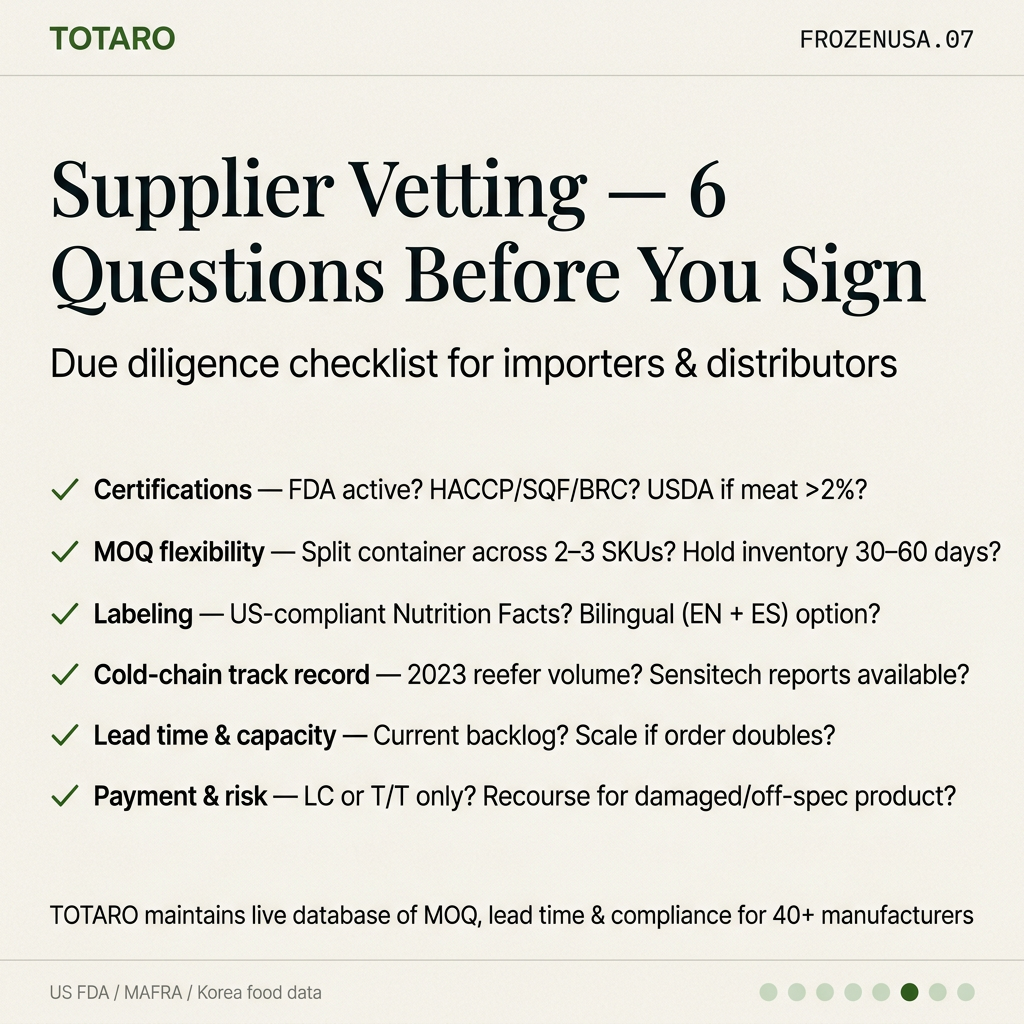
Before signing, vet suppliers on six dimensions:
- Certifications: FDA registration active? HACCP, SQF, BRC, or equivalent? USDA FSIS if meat >2%?
- MOQ flexibility: Can they split a container across 2–3 SKUs for testing? Will they hold inventory for 30–60 days before shipment?
- Labeling & compliance: Do they provide US-compliant Nutrition Facts and ingredient lists? Can they print bilingual (English + Spanish) for wider retail reach?
- Cold-chain track record: How many reefer containers did they ship to the US in 2023? Any temperature deviation claims? Ask for Sensitech reports from recent shipments.
- Lead time & capacity: What's current production backlog? Can they scale if your order doubles in six months?
- Payment terms & risk: Are they open to LC, or only T/T? What's recourse if product arrives damaged or off-spec?
TOTARO vets all Korean suppliers on these points and maintains a live database of MOQ, lead time, and compliance status for 40+ frozen-food manufacturers.
FAQ
What is the minimum order quantity for Korean frozen mandu or kimbap?
MOQ depends on supplier tier. Big 3 (CJ, Pulmuone, Dongwon) require 1–2 containers (1,200–2,400 cases) per SKU for new buyers. Mid-tier OEMs accept 800–1,200 cases. Regional brands may go as low as 500 cases, but consistency and compliance documentation can be weaker. Most US importers start with a 20 ft reefer (1,200–1,400 cases) split across 2–3 SKUs to test market fit before committing to 40 ft volumes.
Do I need USDA approval to import frozen Korean mandu with meat?
It depends on meat content. If cooked meat or poultry exceeds 2% of product weight, USDA FSIS jurisdiction applies. The Korean plant must be USDA-certified, and you must obtain a USDA export certificate (Form 9060) for each shipment. As of 2024, six Korean frozen-food plants hold USDA certification, including CJ CheilJedang and Dongwon F&B. If meat content is below 2%, FDA regulates the product and USDA approval is not required. Check with your customs broker or email USDA FSIS import division to confirm classification.
How do I maintain cold chain from Korea to my US warehouse?
Book a reefer container set to -18 °C. Require the supplier to install a data logger (Sensitech, Elpro) that records temperature every 15 minutes. Upon arrival at the US port, arrange drayage to a public cold-storage facility (Americold, Lineage) within 24–48 hours to minimize port dwell. Inspect the data logger report — if temperature exceeded -15 °C for more than 2 hours, conduct a sample inspection or file a claim with your marine cargo insurer. Most insurers offer "reefer breakdown" riders that cover spoilage due to mechanical failure or temperature deviation.
What are typical lead times from order to delivery for frozen Korean food?
Plan 60–75 days total: 7–10 days for production and QC, 5–7 days domestic trucking in Korea to port, 14–18 days ocean transit (Busan to LA/Long Beach), 2–4 days port clearance, and 3–5 days drayage to your cold-storage or distribution center. Add 10–15 days if shipping to the East Coast. Rush orders can shave 10 days by air freight (Incheon to LAX), but air costs $6–9 per kg vs. $0.15–0.25 per kg ocean, making it viable only for small test shipments or emergency restocks.
Related Guides
Ask AI to find your Korean food supplier
Describe what you need in plain language — get matched with verified suppliers in seconds.
Try AI Supplier Search