카드 1 / 8
Korean Flavored Tea & Aroma Teas — US Wholesale Sourcing
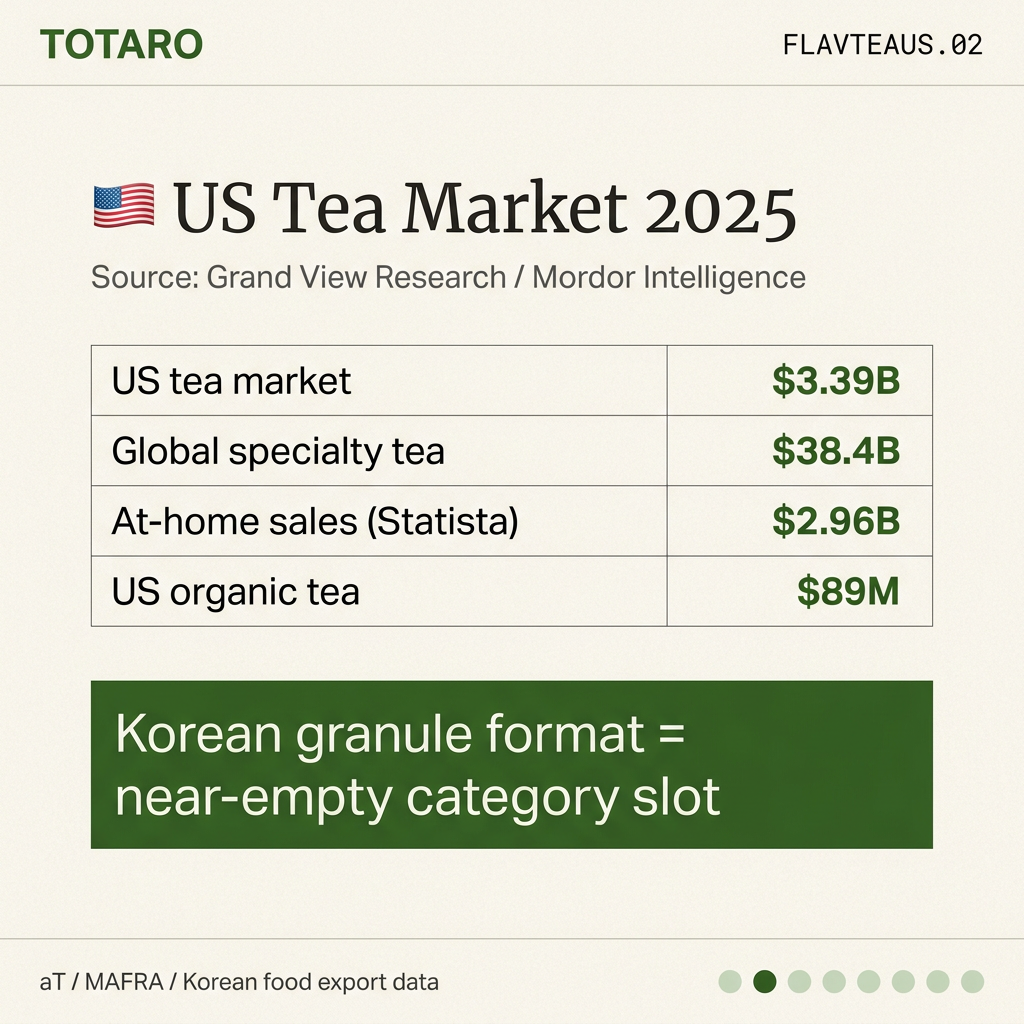
The US tea market reached $3.39 billion in 2025 and is projected to grow to $5.37 billion by 2033 (Grand View Research, 2025). The global specialty tea sub-segment is $38.42 billion in 2026, growing at 6.51% CAGR (Mordor Intelligence, 2026). Korean flavored teas — particularly the granule format unique to Korea (yuzu, jujube, ginger, omija) — sit in a near-empty differentiation slot within US specialty retail.
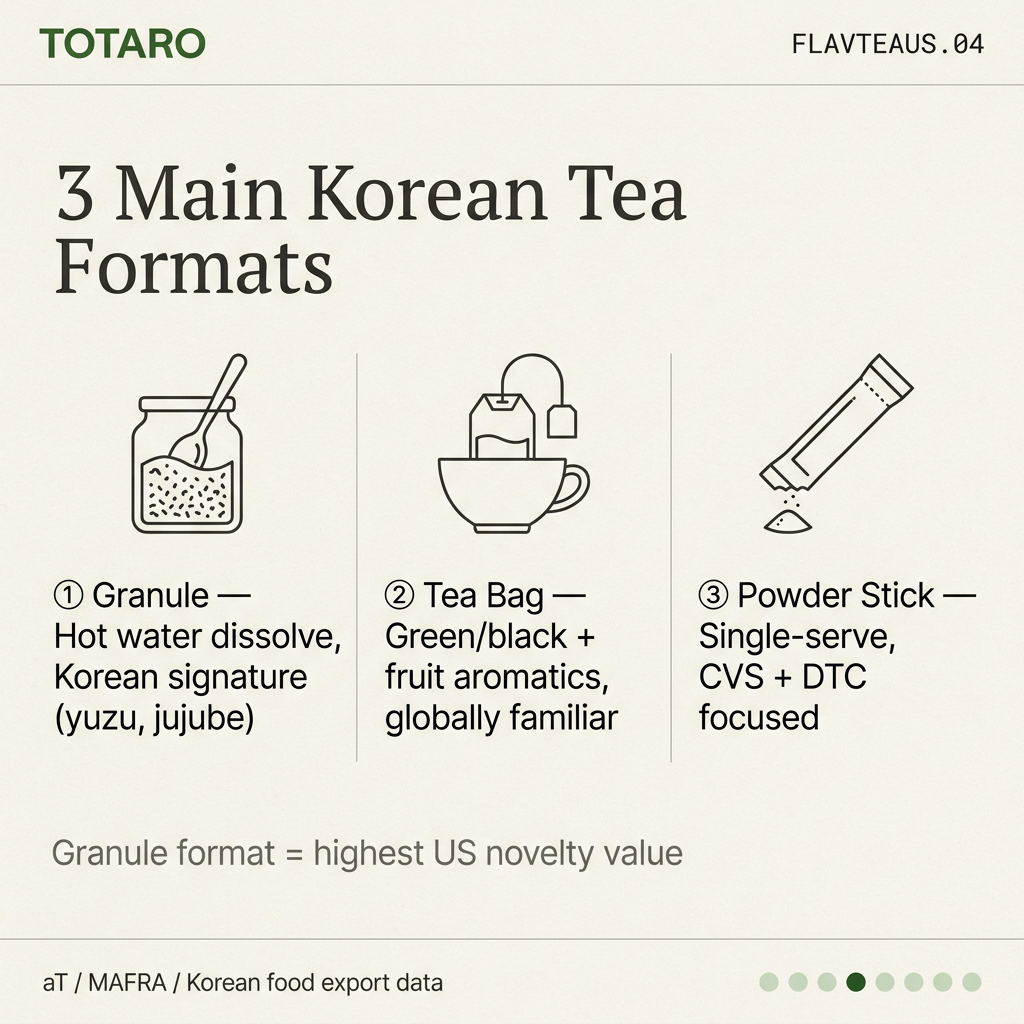
Three Formats of Korean Flavored Teas
Korean flavored teas come in three formats distinct from global black/green tea standards:
- Granule type — fruit extract + sugar + flavor compounds, dissolved in hot water. Korean signature format, dominant for yuzu and jujube teas. Aligns with Trader Joe's and World Market's experimental Asian-format SKUs.
- Tea bags — green or black tea base + fruit aromatics, globally familiar
- Powder sticks — single-serve, popular for convenience and direct-to-consumer
Granule teas are particularly novel in US specialty retail.
Major Korean Manufacturers
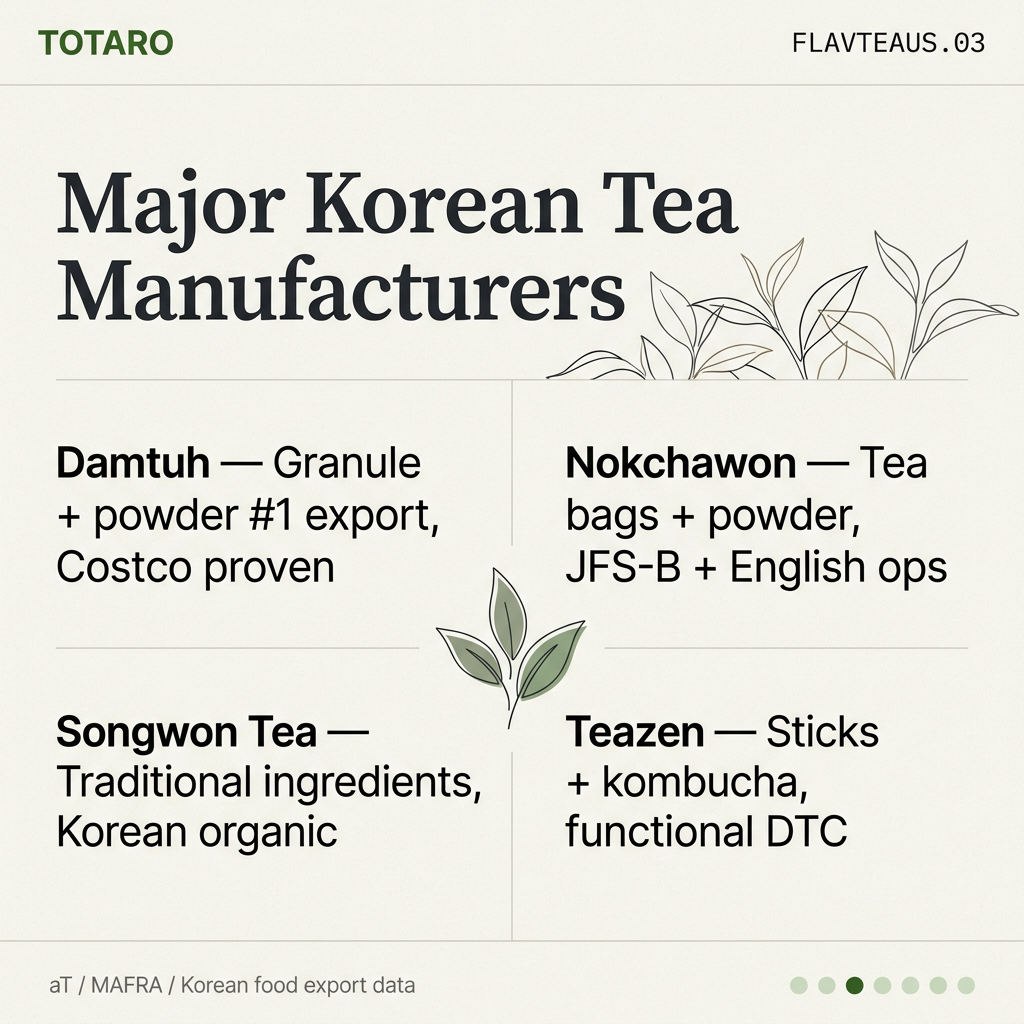
| Manufacturer | Specialty | Strength |
|---|---|---|
| Damtuh (담터) (damtuh.com) | Granule + powder sticks | Top export share, Costco channel proven |
| Nokchawon (녹차원) | Tea bags + powders | OEM-strong, JFS-B certified, English ops |
| Songwon Tea (송원) | Traditional ingredients | Korean organic source, premium positioning |
| Teazen (티젠) (teazen.com) | Sticks + kombucha | Functional positioning, DTC-strong |
| Sempio (샘표) (sempio.com) | Traditional extracts | Major Korean food brand, supply stability |
US Market Opportunity
US tea total at $3.4B (Grand View 2025), with broader at-home sales reported at $2.96B (Statista 2025). Specialty/functional tea sub-segment grows fastest. Mainstream herbal/flavored tea (Celestial, Bigelow, Yogi) dominates volume; the 'functional + Asian-style + clean ingredient' niche is fragmented and underserved.
Korean granule teas offer differentiated category position vs:
- Indian chai
- Chinese green tea
- Japanese matcha
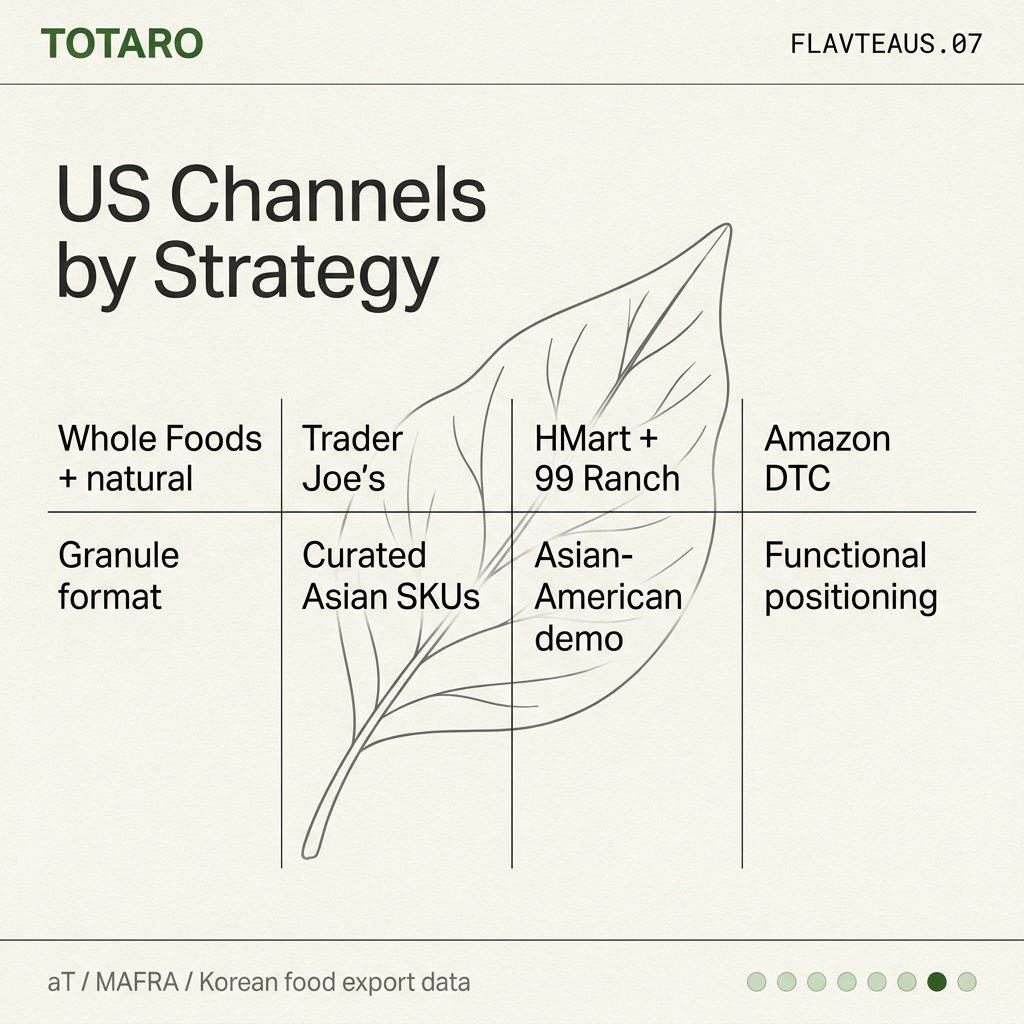
Key US channels:
- Whole Foods (natural channel) — granule + organic positioning
- Trader Joe's (curated Asian SKUs)
- HMart, 99 Ranch (Asian-American consumer)
- Amazon DTC — functional / wellness-positioned
- Emerging Asian-fusion cafes
US organic tea growing fast: $88.9M in 2024 → $228.2M by 2030 (Grand View). Songwon Tea and selected organic-certified lines fit this tier.
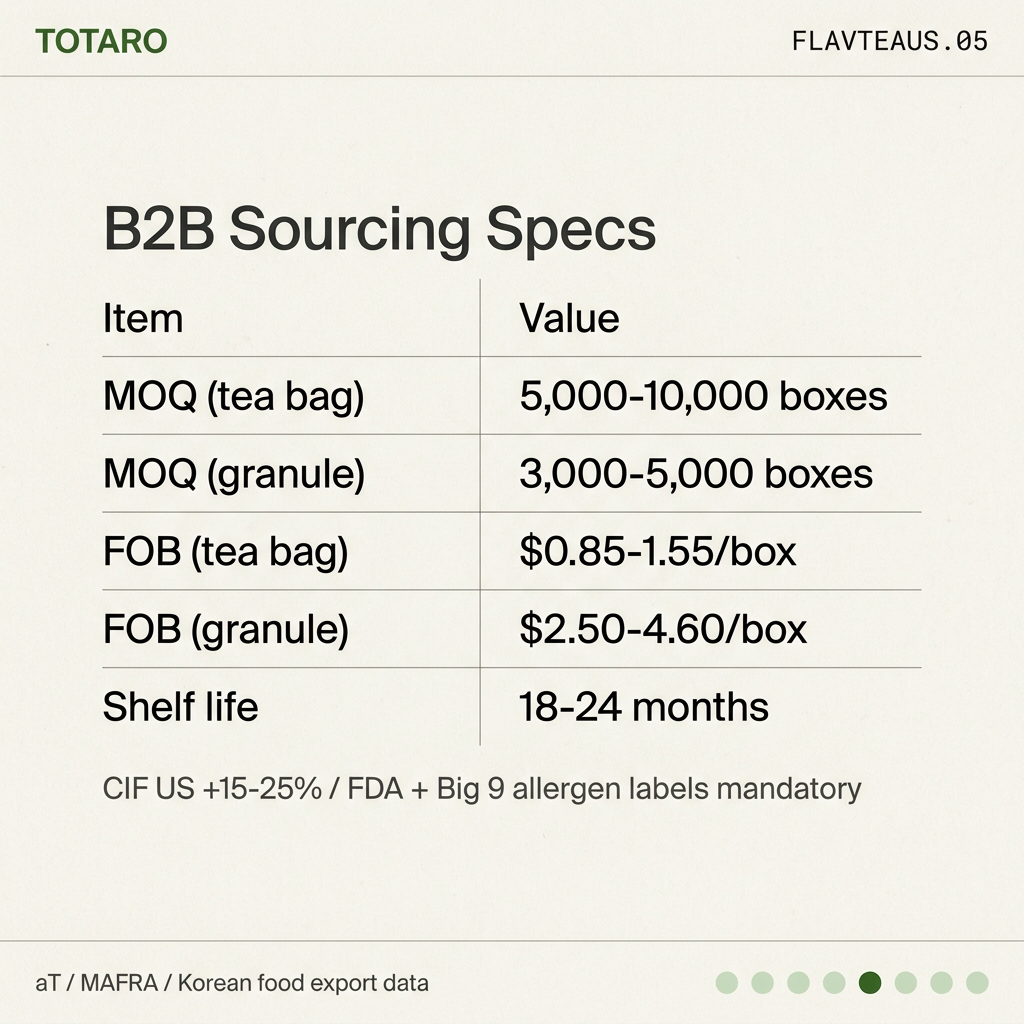
B2B Sourcing Specs (Industry Estimates)
| Spec | Range |
|---|---|
| MOQ (tea bag) | 5,000-10,000 boxes — industry estimate, requires RFQ |
| MOQ (granule) | 3,000-5,000 boxes — industry estimate |
| FOB Busan (tea bag) | $0.85-1.55/box (industry estimate) |
| FOB Busan (granule) | $2.50-4.60/box (industry estimate) |
| Shelf life | 18-24 months from production |
| Lead time | Busan → Long Beach 14 days; → NY 28 days |
| Shipping | Ambient (no cold chain) |
US-required labeling (nutrition facts, allergens, FDA compliance) available at MOQ 5,000+ for most manufacturers per industry-typical service.
FDA Regulatory Path
FDA Food Facility Registration (FDA Food Facility Registration) — Korean manufacturing facility + US importer
FSVP Compliance (FDA FSVP page)
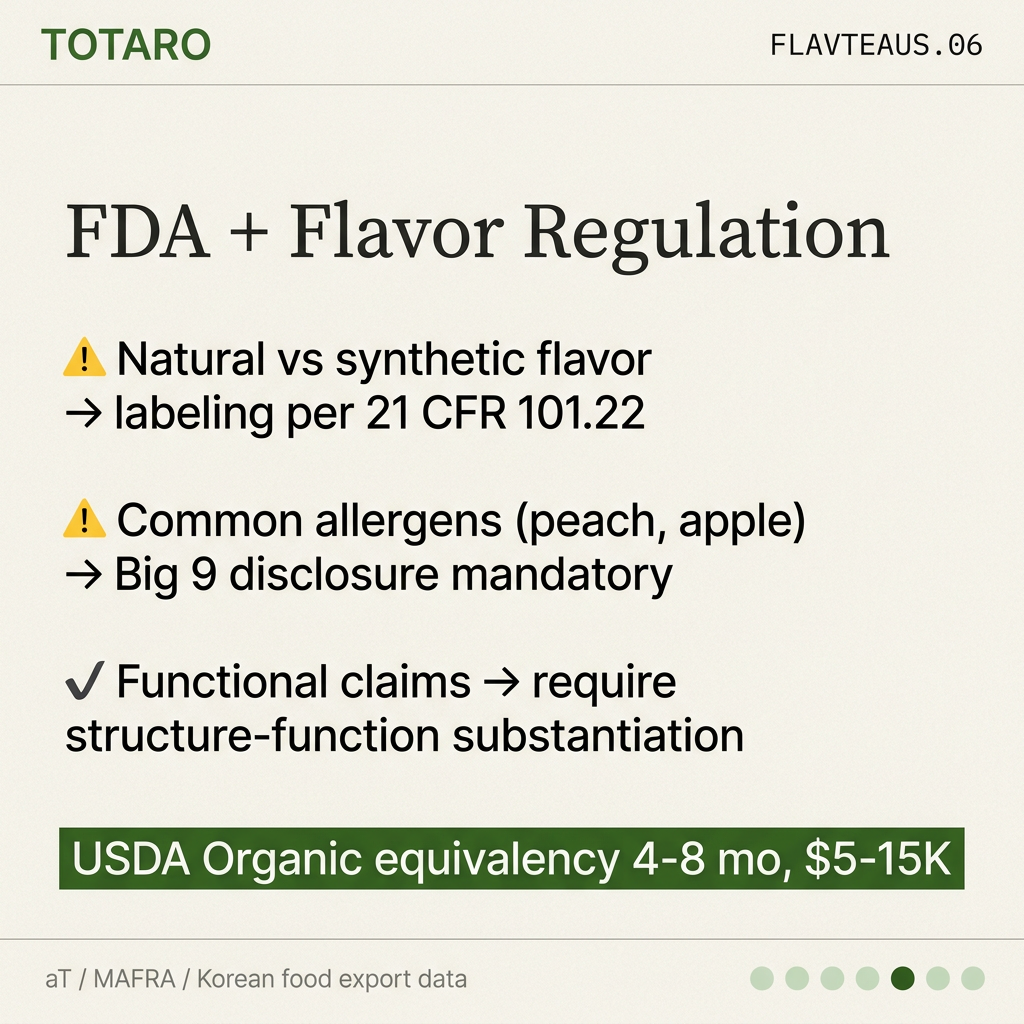
Flavor Compounds and Labeling:
- Per 21 CFR 101.22, natural vs synthetic flavor distinction must be clearly labeled
- Korean flavor compounds generally meet FDA GRAS standards but require import documentation review
Big 9 Allergen Disclosure per 21 CFR 101.91:
- Common allergens in fruit-based Korean teas: peach, apple — require disclosure
USDA Organic for premium tier — Korean organic certification → US equivalency typically 4-8 months + $5,000-15,000 (industry estimate). Songwon Tea and selected specialty manufacturers offer organic-certified lines.
FAQ
Q1. Can we get organic-certified Korean flavored teas? A. Yes — Songwon Tea and selected Damtuh/Nokchawon lines offer Korean organic certification. USDA Organic equivalency for US retail requires either USDA Organic certification or recognized equivalency — typical setup 4-8 months and $5K-15K industry estimate.
Q2. What's typical PB (private label) commitment? A. Industry pattern: Damtuh and Nokchawon accept private label at 5,000-10,000 boxes minimum. Custom recipe, packaging design, English-language labeling included. Development cycle 3-4 months; mold fees $5K-15K industry-typical. Verify with direct RFQ.
Q3. Which products perform best in US natural retail? A. Yuzu honey tea (granule), jujube tea, and ginger granule teas show industry-typical strong category fit. Five-flavor (omija) tea has differentiation but slower consumer education curve.
Q4. Shipping and storage considerations? A. Ambient shipping (no cold chain needed), 18-24 month shelf life. Granule sticks are particularly humidity-sensitive — recommend ocean container with desiccant, avoid summer Gulf Coast East Coast routing per logistics best practice.
This article verified with Grand View Research, Mordor Intelligence, FDA, and CFR primary sources. MOQ, FOB, and adoption pattern ranges marked as industry estimates pending direct supplier RFQ.
Sources
Related Guides
Ask AI to find your Korean food supplier
Describe what you need in plain language — get matched with verified suppliers in seconds.
Try AI Supplier Search