카드 1 / 8
Korean Canned Energy Drinks — US Wholesale B2B Guide
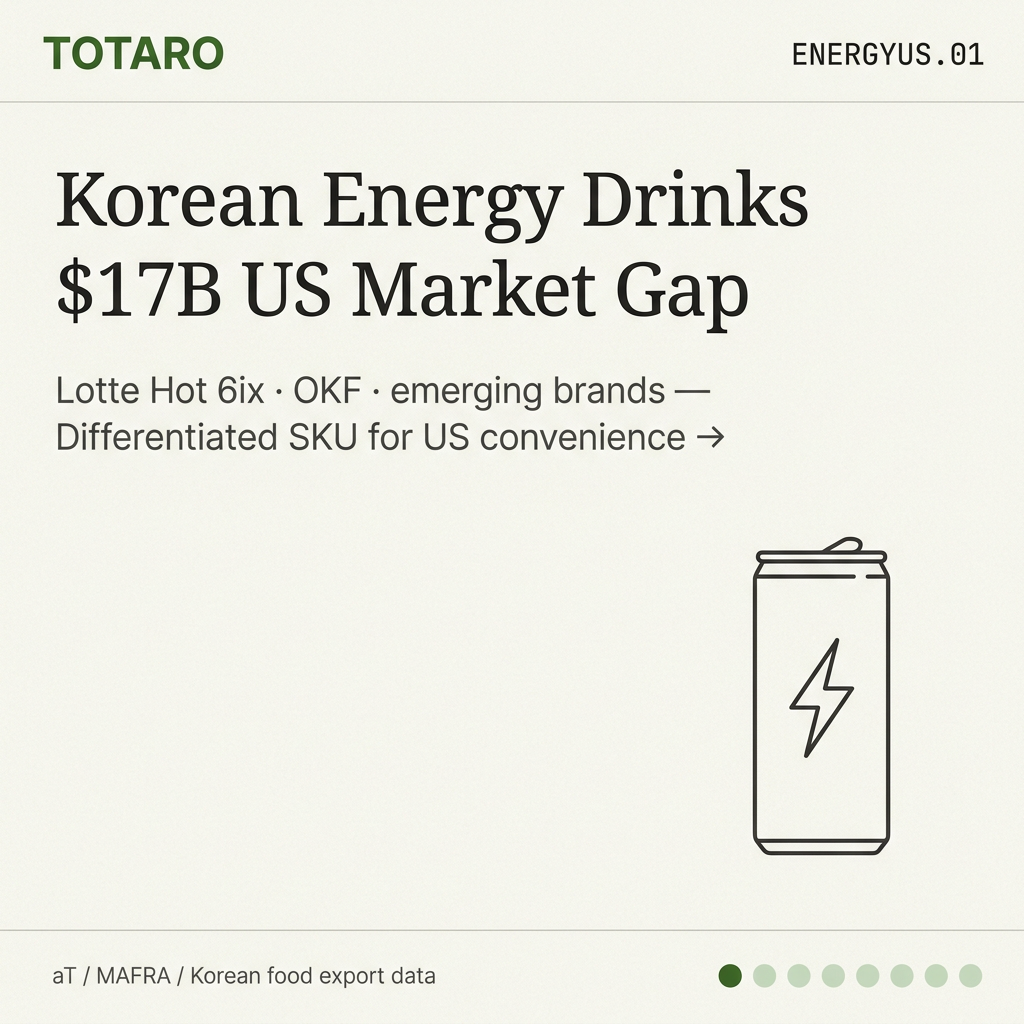
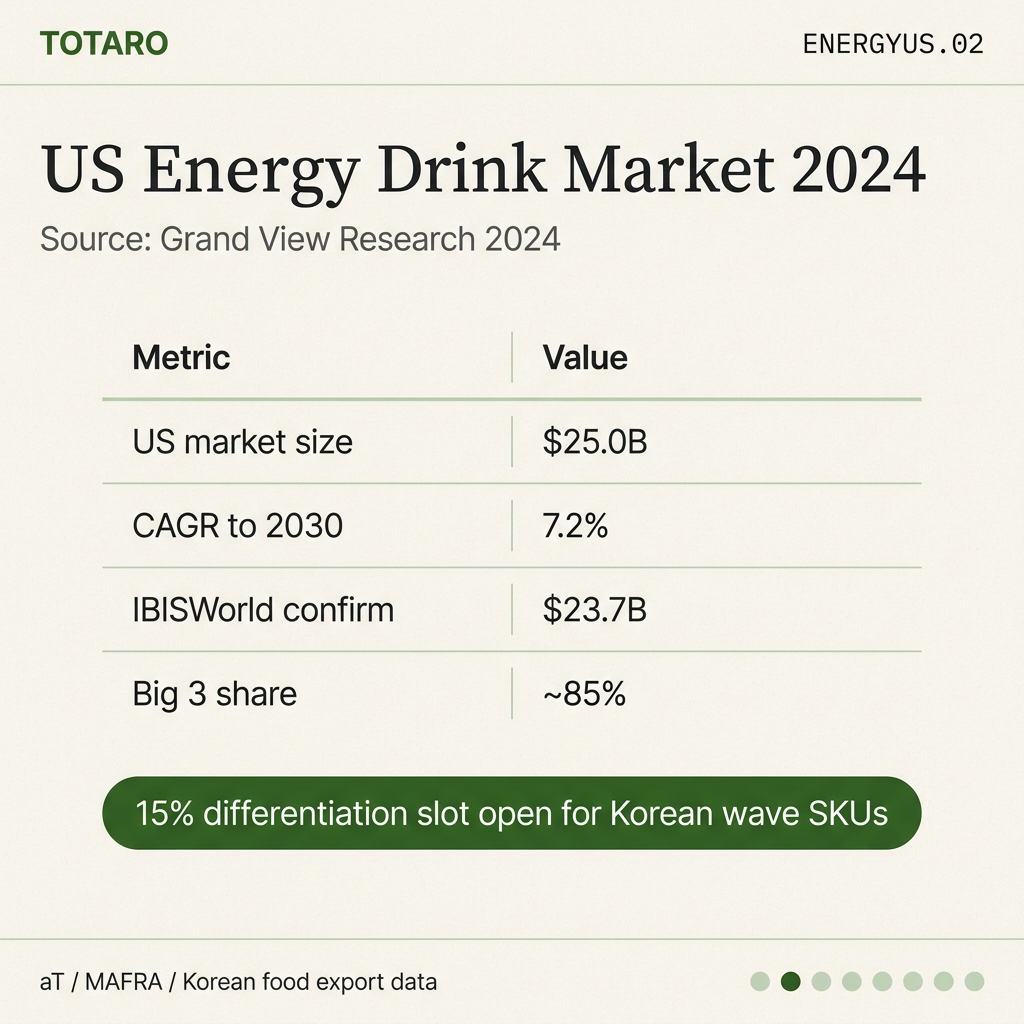
The US energy drink market reached $25.01 billion in 2024 and is projected to grow at 7.2% CAGR to $37.83B by 2030 (Grand View Research, 2024). Confirmed by IBISWorld at $23.7B for the same period (IBISWorld Energy Drink Production in the US, 2024). For US importers, Korean canned energy drinks offer a differentiation slot: Red Bull and Monster dominate ~85% of category share, leaving 15% as a Korean wave + clean-label opportunity in convenience, specialty, and DTC channels.
Major Korean Brands and Product Lines
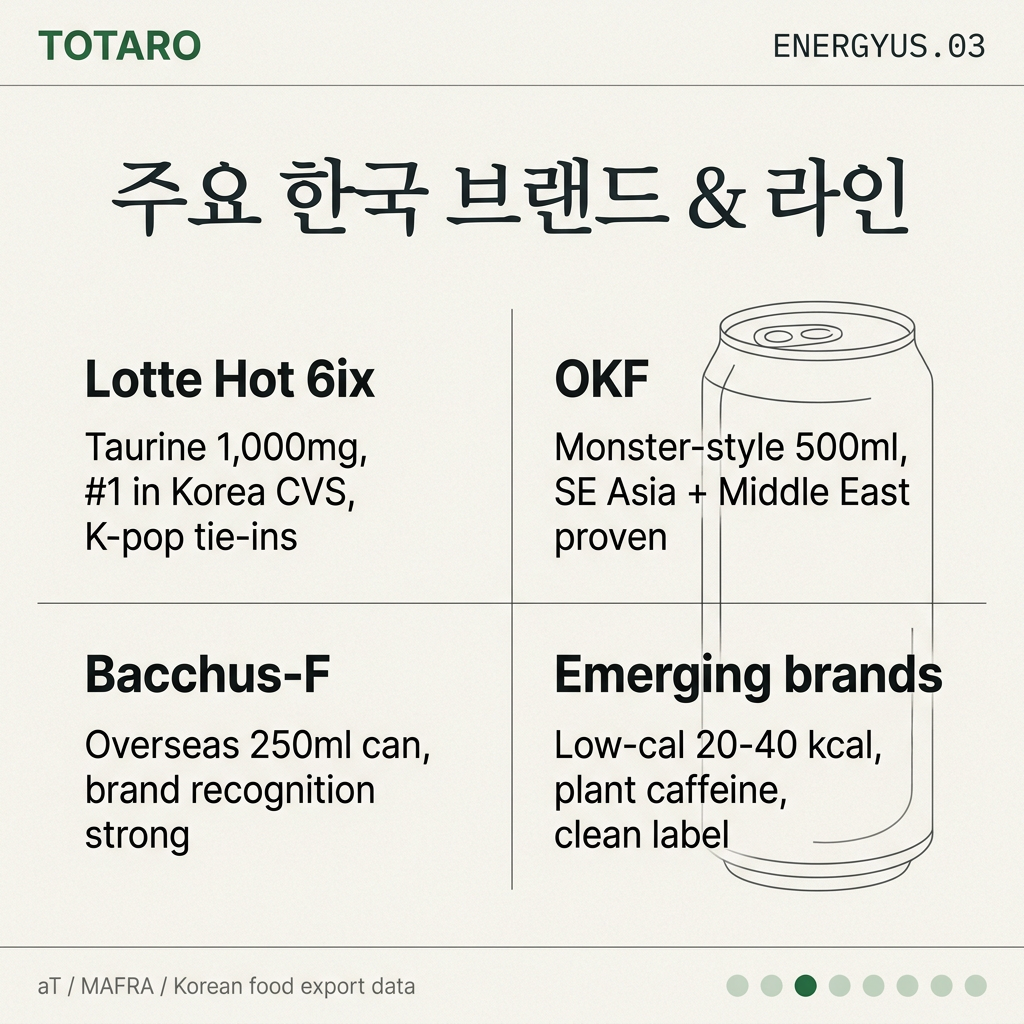
Korean canned energy is dominated by three established names with newer entrants gaining shelf in K-pop adjacent markets:
- Lotte Hot 6ix (lottechilsung.co.kr) — Korea's #1 canned energy drink, marketed heavily through K-pop tie-ins. Standard formulation contains taurine (typically 1,000mg per 250ml serving per Lotte product spec).
- OKF Corporation (okf.com) — Monster-style 500ml format with strong Southeast Asia and Middle East distribution. US export-experienced.
- Bacchus-F (Dong-A) (dapharm.com) — Originally a Pharmacy energy tonic; 250ml can variant for overseas markets.
- Emerging brands — Low-calorie (20-40 kcal), B-vitamin functional positioning, plant caffeine from green tea or guarana — aligned with US clean-label and Celsius-style growth trends.
US Market Opportunity
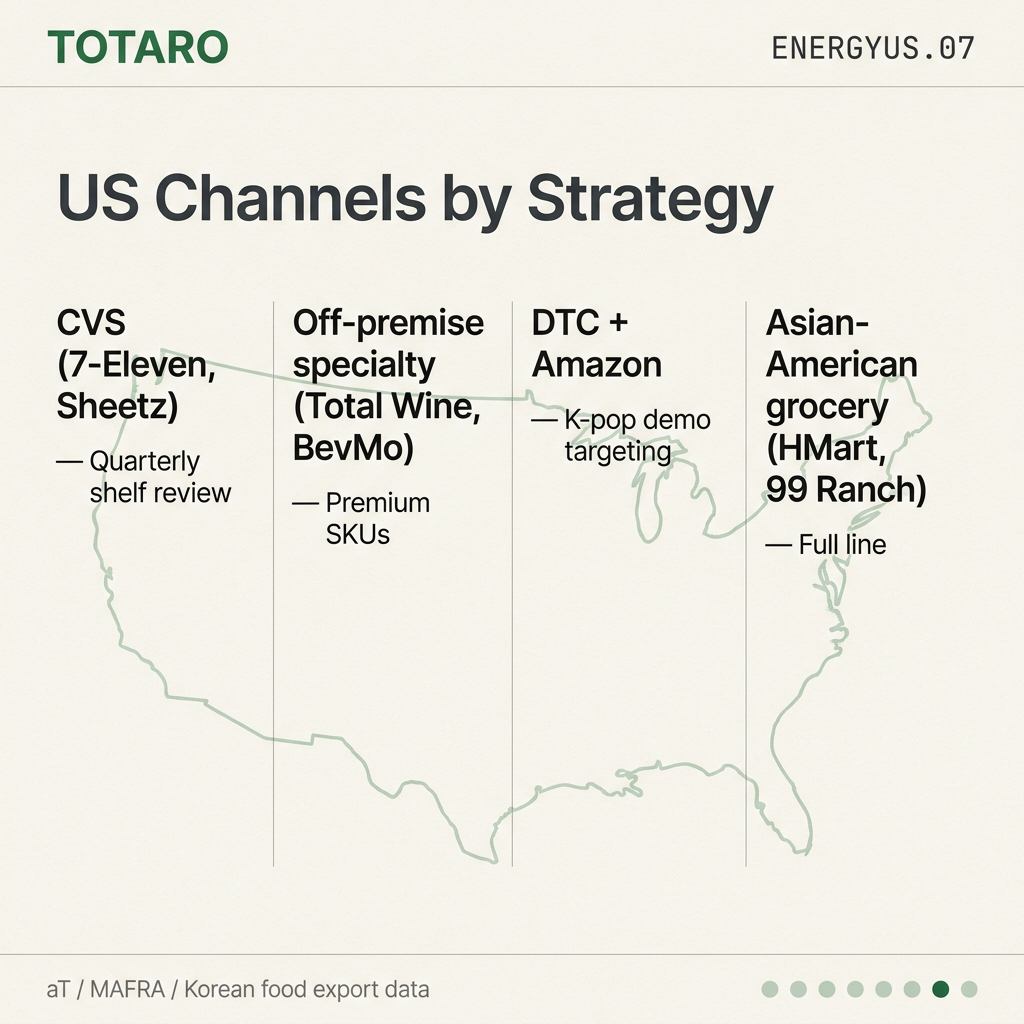
The US energy drink market ($25B in 2024) is dominated by Red Bull, Monster, and Bang/Celsius. The remaining 15% category share is the entry zone for differentiated SKUs in:
- Convenience chains: 7-Eleven, Sheetz, Wawa, Circle K (quarterly shelf refresh cycles)
- Specialty + DTC: Asian-American grocery (HMart, 99 Ranch), Amazon DTC, K-pop demo-targeted channels
- Costco + warehouse: Multi-pack format ($1.50-2.00/can)
Korean brands offer three distinct angles: K-pop demographic targeting for ages 16-30, lower-calorie formulations (matching Celsius trend), and cleaner ingredient stories.
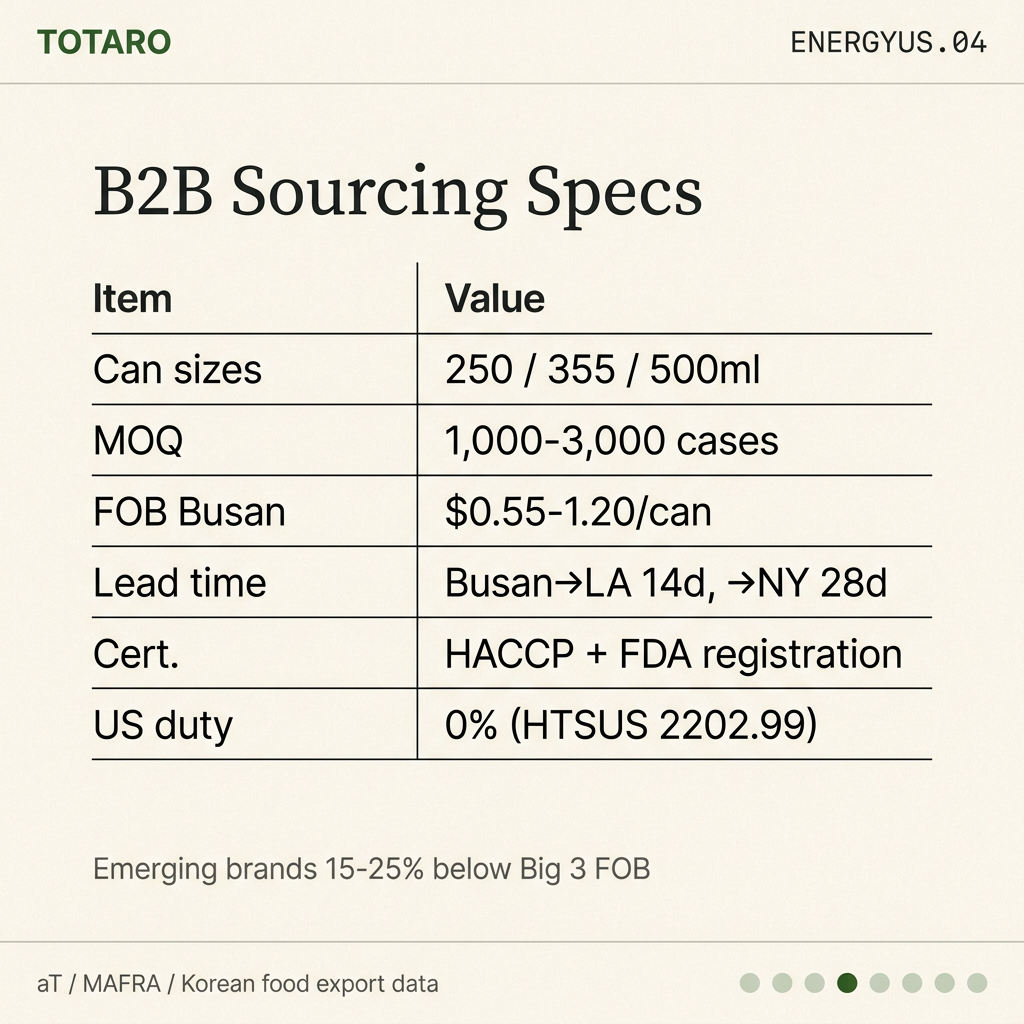
B2B Sourcing Specs (Industry Estimates)
| Spec | Value |
|---|---|
| Can sizes | 250 / 355 / 500ml |
| MOQ | 1,000-3,000 cases (24/case) — industry pattern, requires direct quote |
| FOB Busan | $0.55-1.20/can — industry estimate |
| Lead time | Busan → Long Beach 14 days; → NY 28 days |
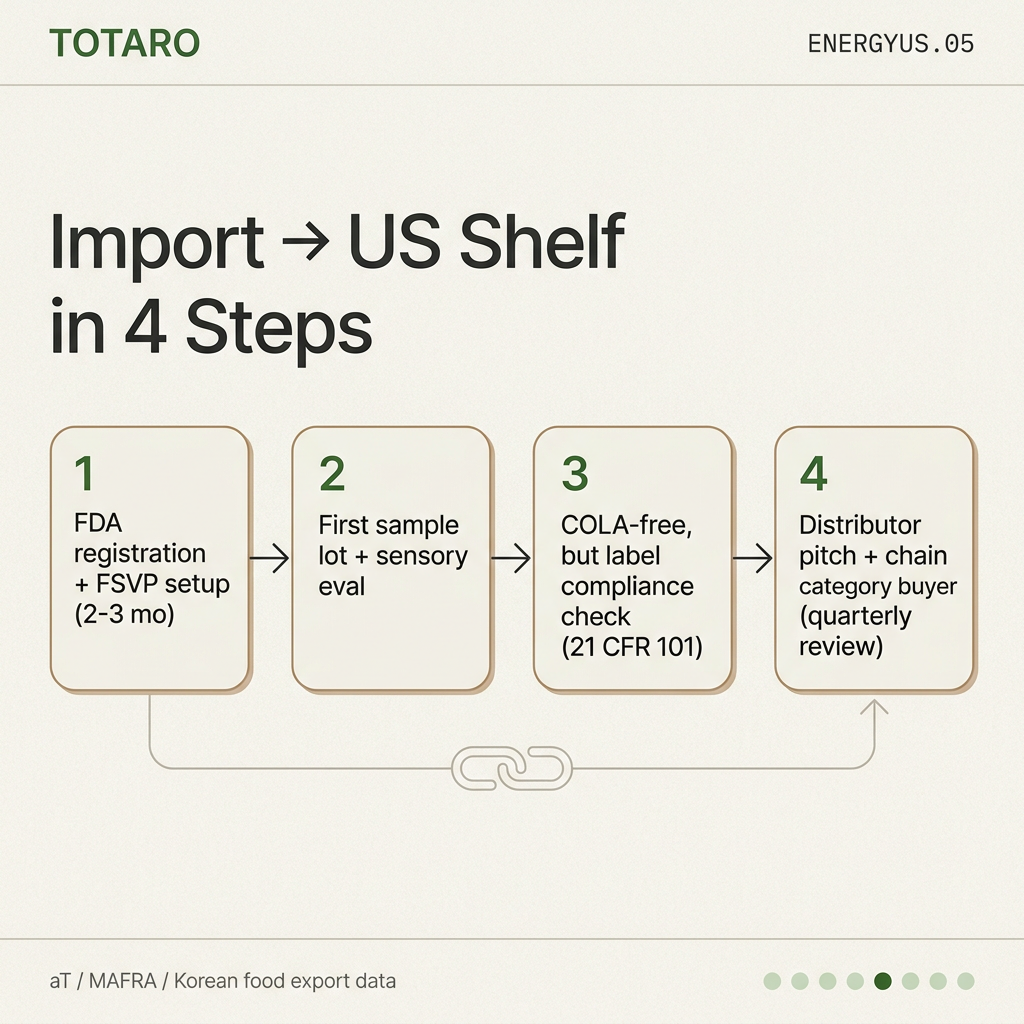
| Certifications | HACCP (required for Korean export), FDA food facility registration |
| US import duty | 0% MFN on most beverages under HTSUS 2202.99 |
(MOQ and FOB ranges marked as industry estimates pending direct supplier RFQ.)
FDA Regulatory Path
For US import of Korean canned energy drinks:
FDA Food Facility Registration (FDA Food Facility Registration):
- Korean manufacturing facility must be registered with FDA (free, biennial renewal)
- US importer registers as US agent
Prior Notice (FDA Prior Notice System Interface (PNSI)):
- Each shipment requires Prior Notice filed before US arrival
FSVP Compliance (FDA FSVP Program):
- Foreign Supplier Verification Program mandatory since 2017
- US importer or designated FSVP agent verifies Korean supplier's safety controls
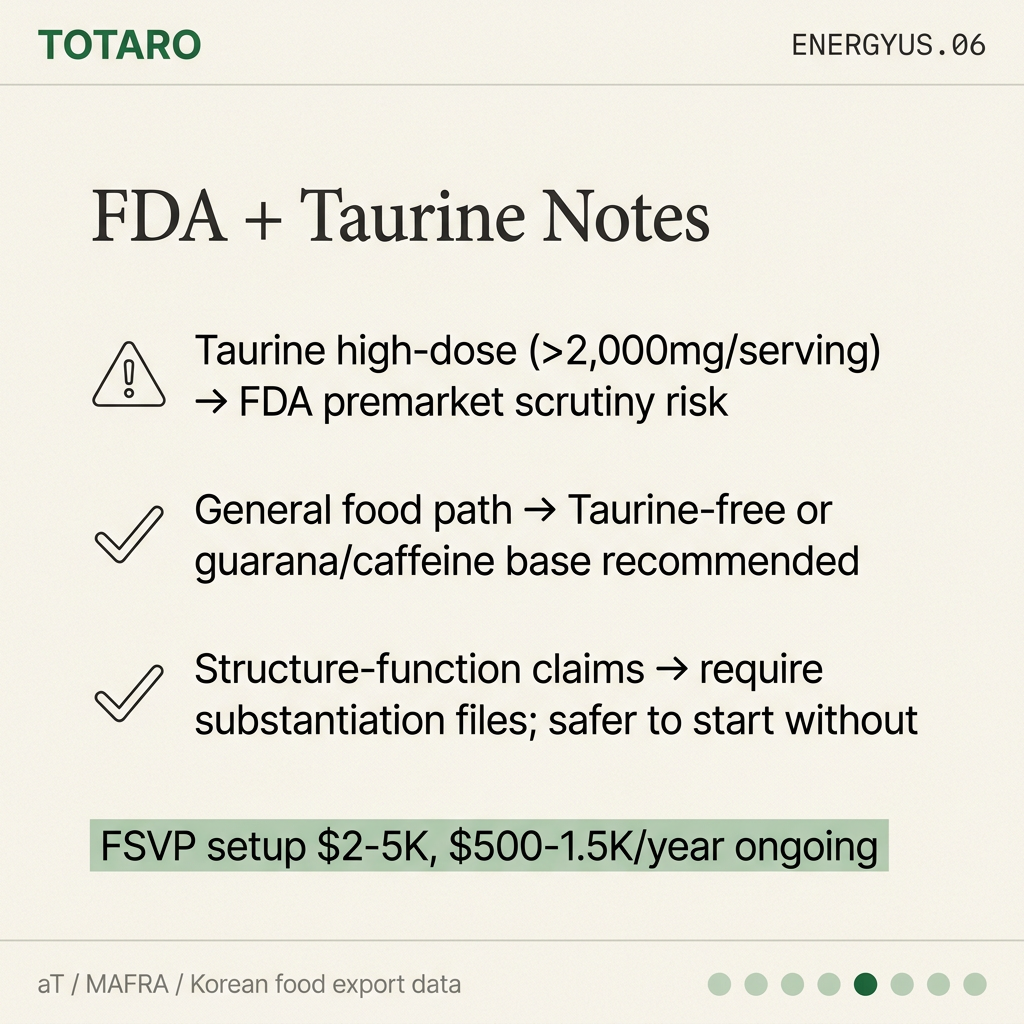
- Industry-typical FSVP agent setup: $2,000-5,000 initial + $500-1,500/year ongoing (verify with FDA-registered FSVP service providers)
Taurine and Ingredient Considerations
Taurine is approved for use as a food additive in non-alcoholic beverages per 21 CFR 172 (Food Additives Permitted for Direct Addition to Food for Human Consumption). High-dose formulations may trigger FDA scrutiny under structure-function claim rules. Functional health claims (energy, focus, performance) require substantiation files per FDA Structure/Function Claims guidance.
Practical guidance: General food market entry path — keep taurine at standard 1,000mg/serving level; avoid therapeutic claims; rely on flavor + Korean brand story for differentiation.
Pricing Structure and Distribution
Industry pattern for FOB Busan to US shelf:
| Step | Range |
|---|---|
| FOB Busan | $0.55-1.20/can |
| CIF West Coast | $0.80-1.50/can (freight + insurance + customs) |
| Wholesale to US distributor | $1.20-2.20/can |
| Retail (convenience + DTC) | $2.50-3.99/can |
Distributor margin 25-30%, retailer margin 35-45%. New Korean brands typically price 15-25% below domestic Big 3 at wholesale to win shelf entry.
FAQ
Q1. Do I need FDA pre-market notification before importing? A. No — food beverages don't require pre-market clearance. Required: FDA facility registration (both Korean and US side), Prior Notice per shipment, labeling compliance with 21 CFR Part 101 Food Labeling, and FSVP. Engage FSVP agent if you don't establish in-house compliance.
Q2. Realistic timeline sourcing to first US shelf? A. 4-6 months industry typical: 4-6 weeks sample evaluation and supplier vetting, 8-10 weeks FSVP/labeling/test ordering, 6-8 weeks production and shipment.
Q3. Private label for US convenience chain client? A. Korean OEMs like Lotte Chilsung and OKF accept private label — verify MOQ via direct RFQ. Industry pattern: 2,000-5,000 cases minimum, custom formulation and packaging, 8-12 week development cycle. Mold fees $5,000-15,000 industry-typical.
Q4. Hot 6ix vs emerging brand — strategic difference? A. Lotte Hot 6ix offers authentication + supply stability + slower innovation. Emerging brands offer 15-25% better wholesale margins + differentiated brand story + faster category buyer interest, at cost of higher MOQ risk + less proven shelf rotation. Match to channel: convenience chains favor scale, DTC + specialty favor differentiation.
This article verified with Grand View Research, IBISWorld, FDA, and CFR primary sources. MOQ, FOB, and pricing ranges marked as industry estimates pending direct supplier RFQ.
Sources
Related Guides
Ask AI to find your Korean food brand
Describe what you need in plain language — get matched with verified brands in seconds.
Try AI Brand Search